メインコンテンツにスキップ
OpenAI

ChatGPT メモリ機能のより強固な基盤

鮮度、継続性、関連性の最適化に向けた ChatGPT のメモリ統合の改善。

読み込んでいます...

このたび、より高性能で拡張性の高いメモリ合成システムの展開を開始します。このシステムは、ChatGPT のメモリを数億人規模のユーザーに、複数年にわたって適用していく中で生じる課題に対処するために開発されました。具体的には、情報が古くなること、正確性の維持、拡張性といった課題に対応します。

メモリは、ChatGPT がユーザーの好み、環境、条件を学習するのに役立ち、将来の会話をゼロから始めるのではなく、共有された文脈情報から開始できるようにします。

過去2年間で、メモリ機能は ChatGPT の体験において非常に重要な要素となり、ChatGPT がユーザーの状況をより深く理解し、長期的に有意義な目標達成を支援できるようになりました。ChatGPT をより便利にするには、ChatGPT がユーザーのことを理解し、必要な支援を行い、ユーザーのためにより多くのことができるようになることが不可欠です。

このアップデートは、まず米国の Plus および Pro ユーザーに提供され、今後数週間かけて他の国のユーザー、および Free と Go のユーザーにも順次展開される予定です。

メモリ機能はどのように進化してきたのか

メモリ機能は2024年4月に初めてリリースされました(保存済みメモリとも呼ばれます)。この機能を使うと、ChatGPTに情報を記憶させて、今後のチャットに引き継ぐように指示できます。
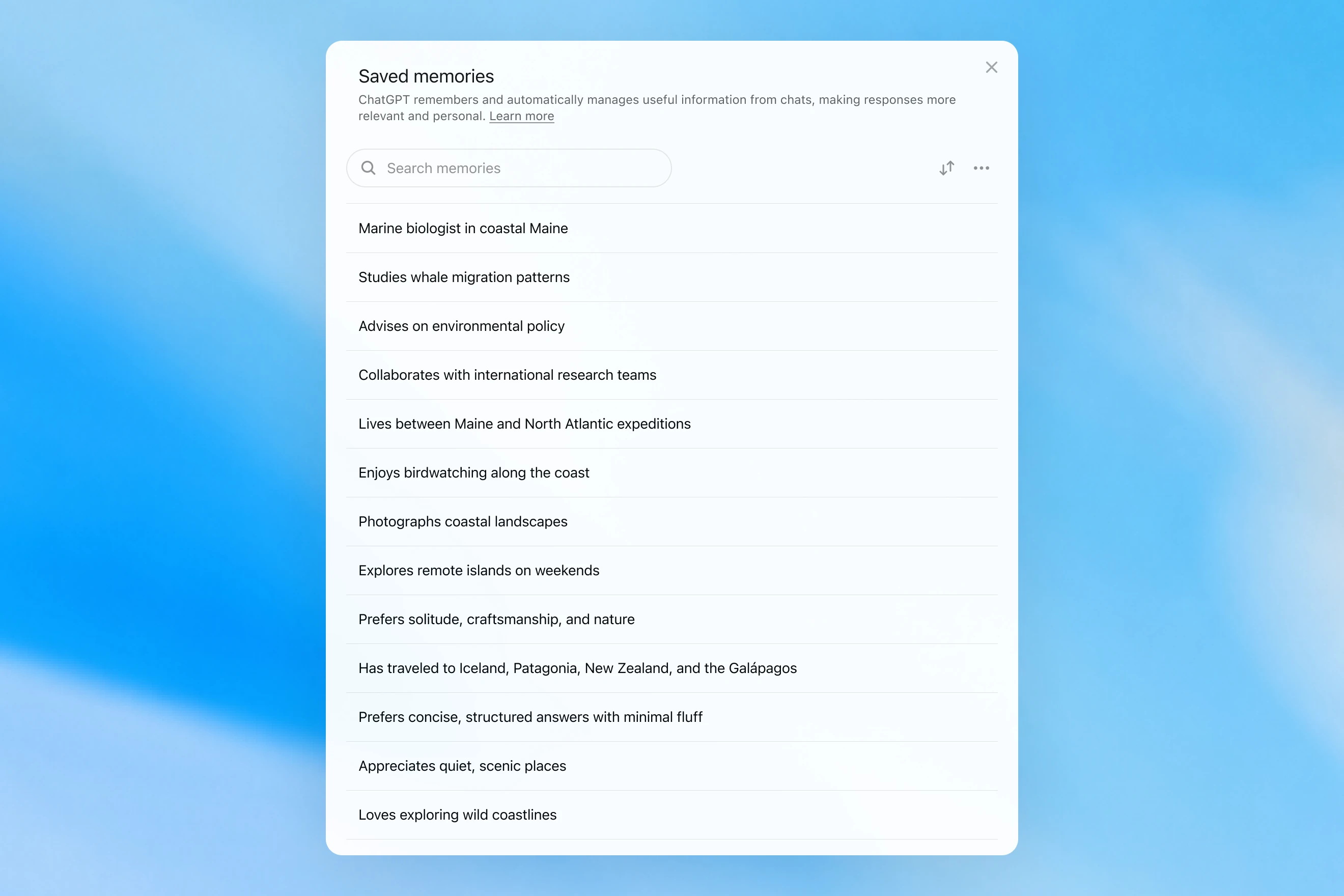
Saved memories modal showing a searchable list of personal details, including work, interests, travel, and response preferences.

保存済みメモリは、ChatGPT とのチャット中にのみ書き込まれていました。そのため、メモリをいつ呼び出すかは、「7月にシンガポールに行くことを覚えておいて」といった明確な指示など、強い手がかりに依存していました。実際には、従来のメモリ機能は、いくつかメモを取ってくれるものの、書き留めていないことは忘れてしまう相手と話しているように感じられることがありました。保存済みメモリも、時間の経過とともに古くなり、最終的には不正確になったり、関連性が低くなったりする傾向がありました。

2025年4月、OpenAI は ChatGPT のメモリ機能をアップデートし、保存済みメモリのリスト以外のチャットの文脈もモデルが参照できるようにしました。ChatGPT がチャット履歴を参照しながら、バックグラウンドでメモリを 自動的に に整理する手法である「 dreaming 」の最初のバージョンを導入することで実現しました。
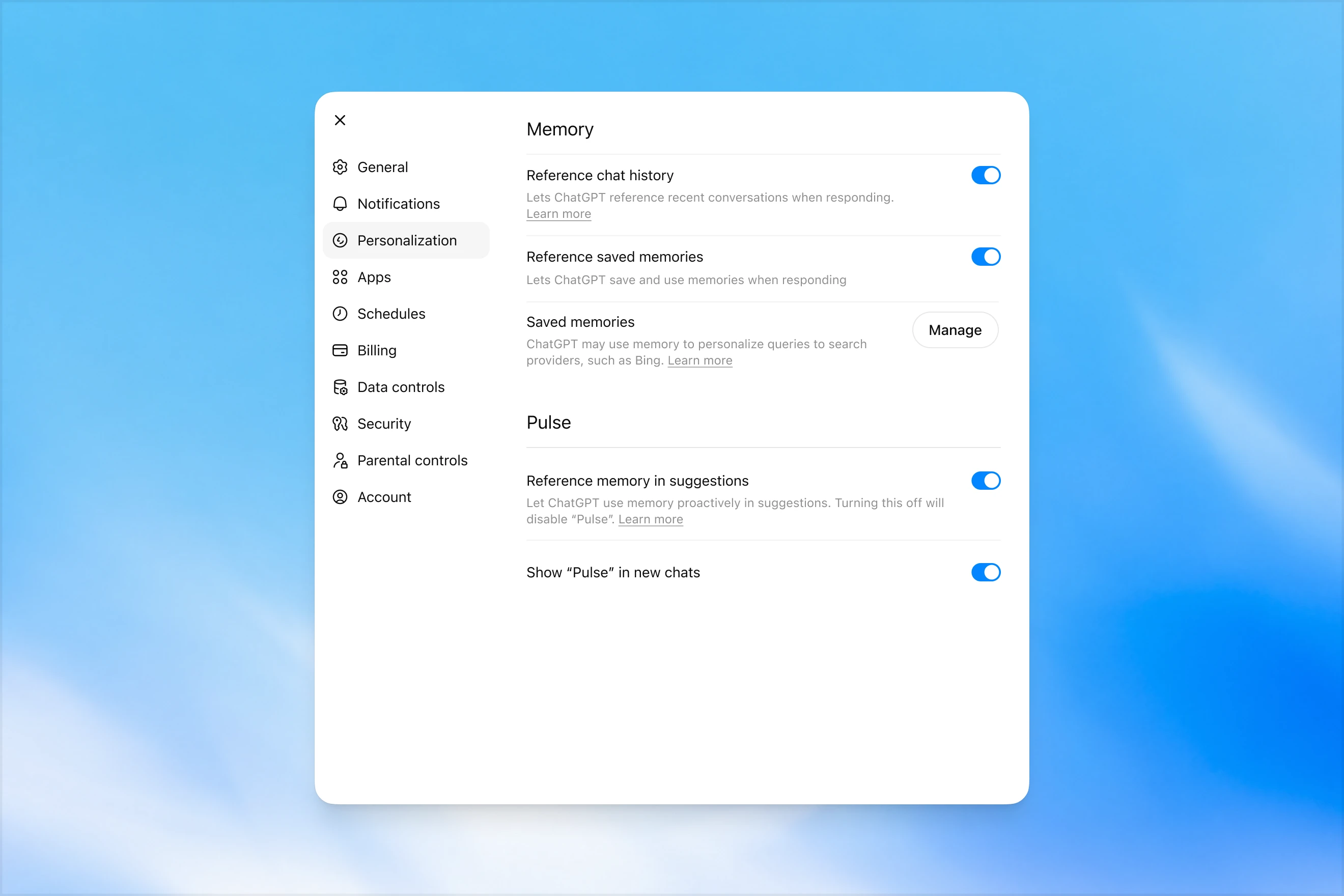
Memory settings page in ChatGPT showing options to reference chat history, use saved memories, manage saved memories, and enable Pulse memory suggestions.

保存済みメモリとは異なり、dreaming はバックグラウンドプロセスを活用します。これにより、ChatGPT は多くの会話から学習し、ChatGPT のメモリ状態を統合することで、常に最新で、最も関連性の高い文脈情報を会話に提供できます。dreaming により、何かを覚えておくよう明示的に依頼しなくても、会話の中で自然に生じる文脈情報をメモリに取り込みやすくなります。

この1年間、dreaming は保存済みメモリをを補完し、ChatGPT が応答をパーソナライズする能力を飛躍的に向上させるとともに、保存済みメモリが古くなることによる影響を抑える役割を果たしてきました。しかし、これまでは単独のメモリシステムとして十分な性能を発揮するには至っていませんでした。

今回、OpenAI は dreaming を基盤とする、より高性能で計算効率に優れたメモリアーキテクチャを発表します。

dreaming によって統合されたメモリは、メモリサマリーページに表示される要約を通じて確認できます。メモリサマリーでは、ChatGPT がユーザーについて把握している内容の要点をすばやく確認したり、ユーザー自身に関する情報を追加・更新したり、ChatGPT がどのトピックをいつ取り上げるべきかを指示したりできます。特定の分野についてさらに詳しく知りたい場合は、ChatGPT とチャットしてください。
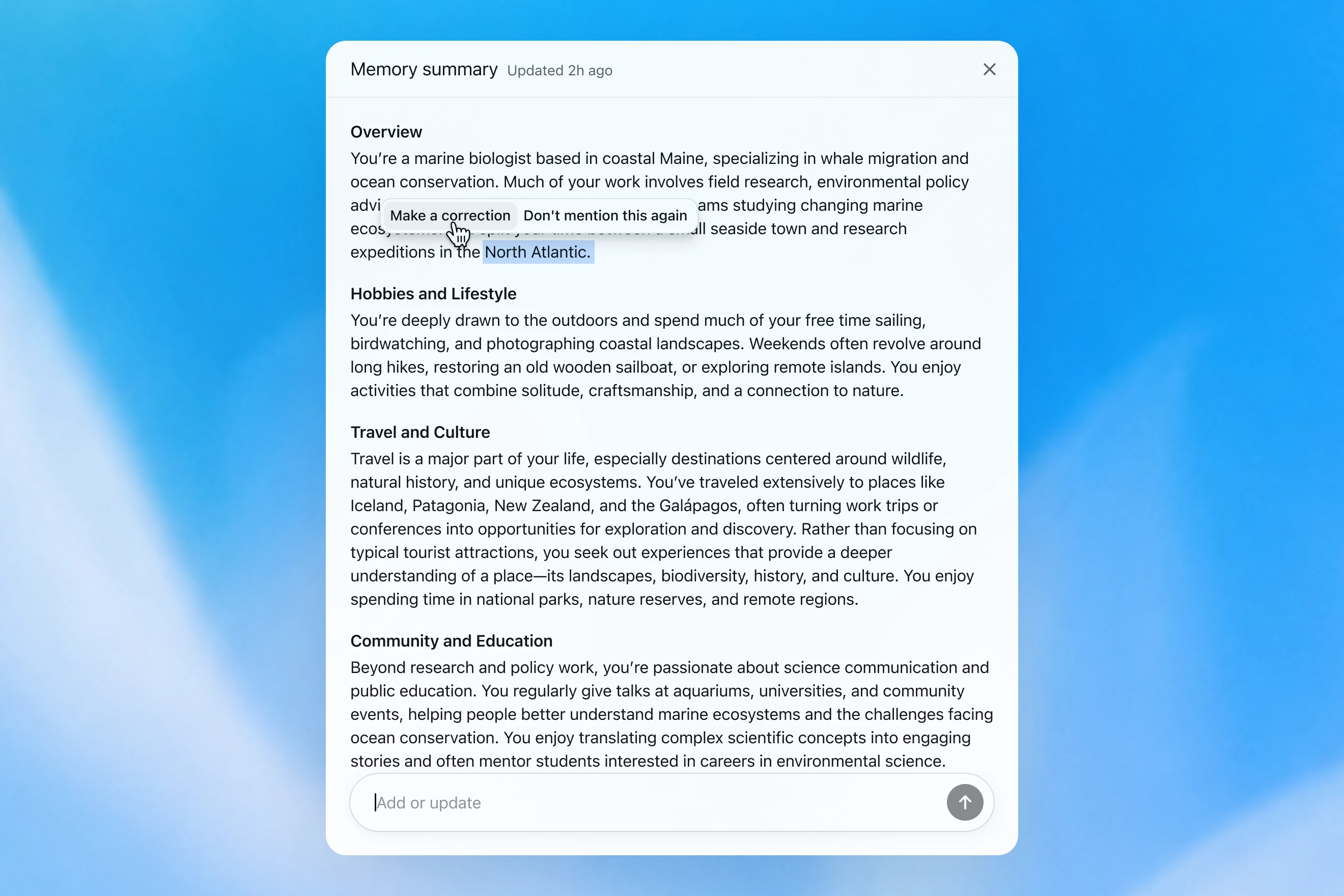
Memory summary modal showing a personalized overview of a user’s work, hobbies, travel interests, and community involvement, with options to correct or dismiss specific details.

メモリをどのように評価するか

ChatGPT における「優れたメモリ」とはどのようなものかについては、いくつかの点が挙げられます。

  1. 有用な文脈情報を引き継ぐ: ChatGPT に一度伝えた情報が、その後のチャットにも引き継がれます。
  2. 好みや条件に従う:ユーザーが好み(例えば、ベジタリアンであるなど)を表明した場合、ChatGPTは今後、その好みに沿った行動をとります。
  3. 時間が経っても最新の状態を保つ:メモリは、時間の経過を考慮に入れます。「ユーザーは来週の土曜日に誕生日パーティーを計画している」とします。その後、日曜日を迎えたとします。

上記3つのメモリ目標それぞれに関して、ChatGPT Plus と Pro のメモリが時間の経過とともにどのように改善されたかを評価できます。以下の各バージョンについて評価します。

  1. 2024年:保存済みメモリ
  2. 2025 : 保存済みメモリ + dreaming V0
  3. 2026年:dreaming V3

文脈情報を引き継ぐ

ChatGPT で新しいチャットを始める際、自己紹介を最初からする必要はありません。ChatGPT は、特に複雑で長期にわたるプロジェクトにおいて、時間を節約し、既存の文脈情報を活用できます。

例えば、ChatGPT を使って、現在お使いのカメラと互換性のある新しいカメラ機材を探していると想像してみてください。過去に ChatGPT とカメラの構成について話したことがあれば、後から「私の撮影環境に合う製品」を尋ねるだけで、自分のニーズに合わせたおすすめを受け取ることができます。

GPT-5.2 Instant

What would I need to buy to use TTL for my underwater photography setup?

To use TTL flash underwater, you need a compatible chain from camera → housing/trigger → cable → strobe. What you buy depends mostly on whether your setup uses fiber-optic TTL or electrical TTL.

Basic shopping checklist

  • TTL-capable underwater strobe
    Look for strobes that support your TTL type, such as Inon S-TTL, Sea & Sea DS-TTL, Ikelite DS TTL, or compatible Backscatter/Nauticam systems. TTL has to be supported by the strobe, not just the camera.
  • TTL trigger or TTL converter
    This is the key piece. It translates your camera’s flash metering into something the underwater strobe can understand. Examples include Nauticam optical TTL converters, Sea & Sea TTL converters, Backscatter Smart Control optical TTL triggers, or Ikelite DS Link TTL converters, depending on housing and camera brand. Backscatter notes that Nauticam optical TTL converters can work with fiber-optic-connected Inon and Sea & Sea TTL strobes, while Ikelite’s DS Link converters are made around Ikelite DS strobes and electrical sync setups. (Backscatter.com(新しいウィンドウで開く))
  • Connection cable
    For fiber optic TTL, buy one fiber optic cable per strobe. Ikelite’s fiber-optic guide says each strobe needs its own light path, converter/adapter, and cord. (Ikelite(新しいウィンドウで開く))
    For
    electrical TTL, buy the correct sync cord, such as Ikelite-style, Nikonos 5-pin, or housing-specific bulkhead cable.
  • Housing compatibility parts
    You may need a hot-shoe adapter, bulkhead, fiber optic window/adapter, or housing-specific TTL board. Many TTL triggers mount inside the housing on the camera hot shoe.
  • Strobe arms, clamps, tray, and mounting hardware
    TTL controls exposure, but you still need to physically mount and aim the strobes.
  • Batteries and spares
    Bring strobe batteries, trigger batteries if required, spare fiber optic cables or sync cord O-rings, and silicone grease for serviceable O-rings.

Which route should you choose?

Fiber optic TTL is usually easiest if your housing has optical ports or can use the camera’s pop-up flash/LED trigger. It is common with compact, mirrorless, Nauticam, Sea & Sea, AOI, and Olympus/OM TG-style setups.

Electrical TTL is often best if you use Ikelite DS strobes or an Ikelite-style housing/bulkhead. Ikelite says its DS Link TTL converters are faster and more reliable than fiber-optic TTL triggers, and they do not require batteries. (Backscatter.com(新しいウィンドウで開く))

The compatibility rule

You need all three to match:

camera brand/protocol + housing/trigger type + strobe TTL system

For example:

  • Sony camera + Nauticam housing + optical TTL trigger + Inon/Sea & Sea-compatible fiber optic strobe
  • Nikon/Canon/Sony camera + Ikelite housing/bulkhead + Ikelite DS Link TTL converter + Ikelite DS strobe
  • Compact camera with built-in flash + fiber optic cable + S-TTL/DS-TTL-capable strobe

So the practical answer is: buy a TTL-compatible strobe, the correct TTL trigger/converter for your camera and housing, and the right fiber optic or electrical sync cable. The exact part numbers depend on your camera, housing, and strobe model.

モデルの回答は汎用的な内容にとどまり、ユーザー自身で複雑な互換性確認を行う必要があります。

GPT-5.3 Instant

What would I need to buy to use TTL for my underwater photography setup?

I’ll verify this against your actual setup: Sony A1 II in Nauticam NA-A1II, with Backscatter Mini Flash 3 and Inon Z-330 strobes. The key question is whether you want TTL with the Mini Flash 3, the Z-330s, or both.

For your setupSony A1 II + Nauticam NA-A1II + Backscatter Mini Flash 3 + Inon Z-330 — there are two different TTL paths:

Best buy for Mini Flash 3 TTL

Buy:

Backscatter Smart Control TTL LED Nauticam Flash Trigger for Sony
SKU: BS-TR-SN2

Backscatter lists it as custom-designed for Nauticam full-frame Sony housings, TTL-compatible with Mini Flash 3, and the NA-A1II housing page offers it as the “Backscatter Smart Control TTL Flash Trigger” option. (Backscatter.com(新しいウィンドウで開く))

You’d use normal optical fiber cables from the housing to the Mini Flash 3. On the MF-3, you’d use SC or SC Macro mode; Backscatter says SC / SC Macro are the TTL modes for Mini Flash 3, with SC Macro specifically tuned for close macro work. (Backscatter.com(新しいウィンドウで開く))

For Inon Z-330 TTL

For the Inon Z-330, the relevant unit is:

UW Technics 11075-HSS TTL Converter for Sony / Nauticam

UW Technics explicitly lists Inon Z-330 as a compatible TTL strobe and supports optical TTL output. (UWTechnics(新しいウィンドウで開く))

But I would not buy this for Mini Flash 3 TTL. Backscatter’s own UW Technics listing says Backscatter strobes are manual / HSS only on that converter, while the Backscatter Smart Control trigger is the one listed for Sony TTL with the Mini Flash 3. (Backscatter.com(新しいウィンドウで開く))

Practical recommendation

Since you shoot macro and have the Mini Flash 3, I’d buy the Backscatter Smart Control TTL LED Nauticam Flash Trigger for Sony — BS-TR-SN2.

The catch: there probably is no single trigger that gives true TTL for both the Mini Flash 3 and Inon Z-330 at the same time. The Backscatter trigger is the right TTL solution for the MF-3; the UW Technics converter is the right TTL solution for the Z-330. So choose based on which strobe you actually want TTL for.

For your use case, I’d prioritize Mini Flash 3 TTL / SC Macro and treat the Z-330s as manual when needed.

モデルはユーザーのカメラ環境を覚えており、互換性のある製品をおすすめします。

GPT‑5.2 Instant は最終的に質問には回答しますが、安全上の制限を説明しようとするあまり、対応できない内容について長い前置きを置いています。一方、GPT‑5.3 Instant はすぐに本題に入ります。

こうした例をもとに、同様の評価を構築できます。この評価では、モデルがユーザーに関する事実情報を思い出したうえで、プロンプトに応答できるかを確認します。モデルは、関連する文脈情報を正しく利用して回答した場合に高く評価されます。この評価では、新しい dreaming ベースのシステムにより、関連する事実を思い出すモデルの能力が向上したことが示されました。

好みや条件に従う

メモリは、ChatGPT がユーザーの好みや条件により適した方法で応答するのにも役立ちます。

シンガポールへの旅行を計画していると想像してみてください。旅行の2ヶ月前に、あなたは ChatGPT に旅程作成のサポートを依頼します。ChatGPT は、過去の旅行計画から、あなたが野生動物の写真撮影を楽しみ、エアコンの効いたホテルを好み、混雑したバーよりも静かなディナーを好むことを既に把握しています。

GPT-5.2 Instant
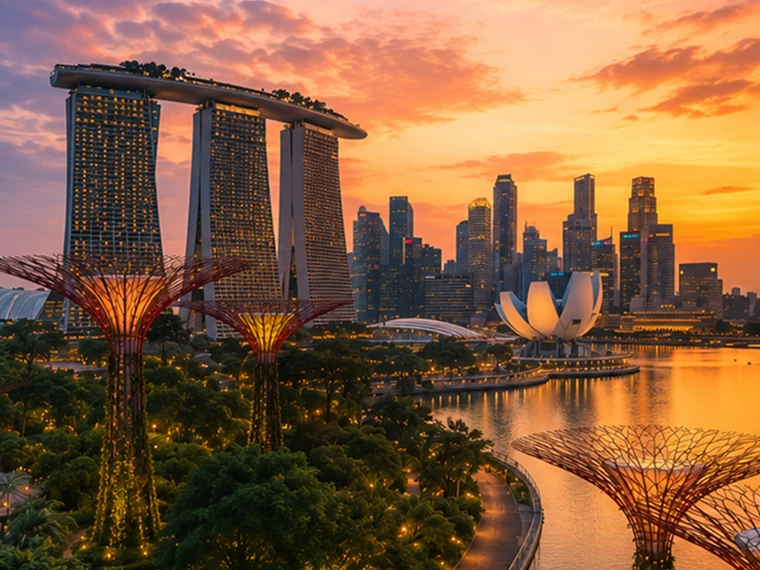
Help me plan a trip to Singapore. I'm going to be there for a work trip in July and will have a few days free at the end.

Great add-on city for a work trip: Singapore is compact, safe, excellent for solo exploring, and easy to do in 2–4 free days. July is hot and humid; expect daytime highs around 31–33°C / 88–91°F, warm nights, and sudden rain, so plan outdoor time early morning or after 5 p.m. and keep midday for museums, malls, cafés, or hotel downtime. Singapore’s official weather service notes typical daily highs of 31–33°C and lows of 23–25°C. (Singapore Weather Service(新しいウィンドウで開く))

memory-preferences-without

A strong 3-day plan

Day 1: Marina Bay, Gardens, and skyline

Start late afternoon at Marina Bay and walk the waterfront: Merlion Park, Helix Bridge, ArtScience Museum exterior, then into Gardens by the Bay. Book Cloud Forest, Flower Dome, and either the OCBC Skyway or Supertree Observatory if views matter to you. Gardens by the Bay lists Cloud Forest and Flower Dome as open daily 9 a.m.–9 p.m.; Supertree Observatory is also listed as 9 a.m.–9 p.m. with last admission at 8:30 p.m., but check maintenance closures before booking. (Gardens by the Bay(新しいウィンドウで開く))

Evening: stay for the Supertree light show area, then dinner at Lau Pa Sat for an easy first-night hawker experience near the CBD. It has 80+ stalls and local staples like satay, laksa, nasi lemak, bak kut teh, kaya toast, and char kway teow. (Laupasat(新しいウィンドウで開く))

Day 2: Culture neighborhoods and food

Morning: Chinatown. Visit Buddha Tooth Relic Temple, walk the shophouse streets, and eat at Maxwell Food Centre or Chinatown Complex Food Centre. Visit Singapore lists Maxwell, Chinatown Complex, Old Airport Road, Tiong Bahru Market, Newton, and others among popular hawker centres. (Visit Singapore(新しいウィンドウで開く))

Afternoon: Kampong Glam and Haji Lane for Sultan Mosque, murals, boutiques, and cafés. Then head to Little India around golden hour for temples, flower garlands, Tekka Centre, and dinner.

Evening: either cocktails around Ann Siang / Club Street, or keep it low-key with a night walk along the Singapore River: Boat Quay to Clarke Quay to Robertson Quay.

Day 3: Nature or beach day

Pick one based on your energy.

For nature: do Singapore Botanic Gardens early, then the National Orchid Garden, followed by lunch in Dempsey Hill or Tiong Bahru. This is the best “green Singapore” day without leaving the city.

For beach/resort mode: go to Sentosa. Choose the southern beaches, Fort Siloso Skywalk, or a beach club. I would skip trying to do every Sentosa attraction unless you love theme parks.

For local food focus: do Tiong Bahru Market for breakfast, National Gallery Singapore midday, then Old Airport Road Food Centre for dinner. The official events page also shows exhibitions and cultural events, so it is worth checking once your exact July dates are fixed. (Visit Singapore(新しいウィンドウで開く))

Best places to stay after the work part

Marina Bay / CBD is easiest if you want polished, walkable, skyline-heavy Singapore and minimal transit.

Chinatown / Telok Ayer / Tanjong Pagar is my top pick for a few free days: great food, MRT access, heritage streets, cocktail bars, and close to work districts.

Bugis / Kampong Glam is better if you want boutique hotels, cafés, street art, and a slightly more relaxed neighborhood feel.

Orchard is convenient for shopping and rainy-day malls, but less atmospheric.

What to book ahead

Book Gardens by the Bay conservatories/Skyway, any special restaurants, and possibly a cocktail bar. For hawker centres, do not over-plan; just go hungry, carry tissues or wet wipes, and be ready to share tables.

July packing notes

Bring breathable work clothes, comfortable walking shoes, a small umbrella, and a light layer for aggressive air-conditioning. I would also plan one “rain-flexible” indoor block each day, because showers can arrive suddenly even when the forecast looks fine.

My suggested balance: Day 1 Marina Bay/Gardens, Day 2 Chinatown–Kampong Glam–Little India, Day 3 Botanic Gardens or Sentosa. That gives you the Singapore highlights without turning your post-work break into another work project.

モデルは旅行者向けの一般的な回答を生成し、ホテル予約の助けにならず、ユーザーの関心もほとんど反映していません。

GPT-5.3 Instant
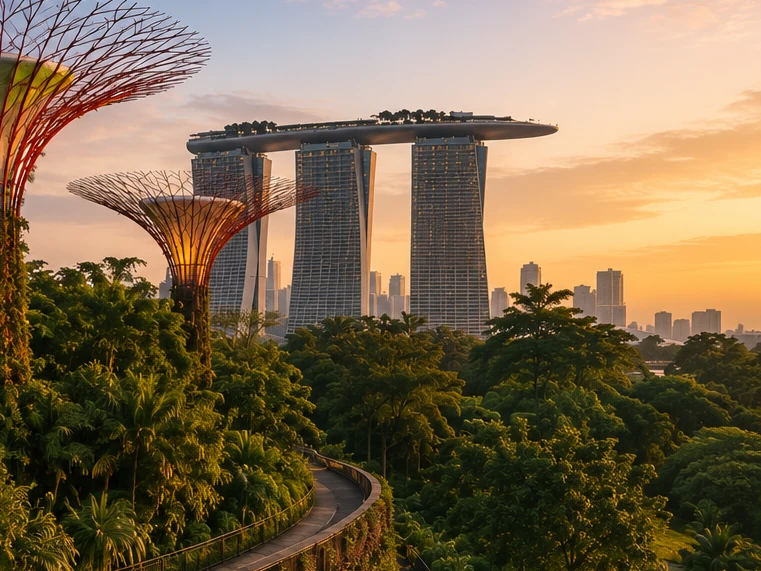
Help me plan a trip to Singapore. I'm going to be there for a work trip in July and will have a few days free at the end.

I’ll build this around your known constraints: a few free days after work, hot/humid July weather, wildlife/photography/nature bias, strong AC needs for sleep, and good but not overly social dining. I’ll verify current July logistics and then give a practical short itinerary rather than a generic Singapore list.

memory-preferences-with

Here’s how I’d structure it: 2–3 free days, mostly nature / wildlife / photography, with heat-managed mornings and AC breaks. July is hot and humid: Singapore’s July long-term stats are about 31.4°C / 88.5°F average daily max, 25.4°C / 77.7°F min, 146.6 mm rain, and 14 rain days, so outdoor plans should be early morning or evening, not midday. (National Environment Agency(新しいウィンドウで開く))

Best plan for 3 free days

Day 1 — Gardens by the Bay + Marina Bay, low-friction

Morning: Cloud Forest + Flower Dome. This is the obvious “touristy” pick, but it fits you well because it’s visually interesting, good for photography, and climate-controlled. Gardens by the Bay lists Cloud Forest and Flower Dome-type attractions running 9:00am–9:00pm, and Cloud Forest currently has the Jurassic World experience listed as ongoing. (Gardens by the Bay(新しいウィンドウで開く))

Late afternoon / evening: Supertree Grove + Borealis / light show. Gardens currently lists Borealis every Sat, Sun & Mon, 8:00–8:30pm at Supertree Grove, so try to align this with one of those nights. (Gardens by the Bay(新しいウィンドウで開く))

Dinner: do something easy nearby: Marina Bay / Tanjong Pagar / Telok Ayer. For you, I’d prioritize reservation-based restaurants with real tables over hawker centers on the first night, because you dislike cramped solo seating.

Day 2 — Mandai wildlife day

Morning to afternoon: Bird Paradise + River Wonders. Bird Paradise is probably the best fit photographically; River Wonders is less “wildlife photography” and more controlled exhibits, but it pairs well logistically. River Wonders is listed as daily 9:00am–6:00pm, last entry 5:00pm. (Mandai Wildlife Reserve(新しいウィンドウで開く))

Evening: Night Safari. This is the rare Singapore attraction that is genuinely better at night and avoids the worst heat. Night Safari is listed as daily 6:00pm–12:00am, last entry 11:15pm, with tram plus walking trails and over 900 nocturnal animals. (Mandai Wildlife Reserve(新しいウィンドウで開く))

This is a full day. I would not add Singapore Zoo unless you have 4 free days; Mandai can become exhausting fast.

Day 3 — Nature reserve / macro-ish walking + food

Early morning: Singapore Botanic Gardens or MacRitchie / Windsor Nature Park. For a few free days, Botanic Gardens is the safer pick: easier transport, less sweaty, better bailout options, and more consistent casual photography. MacRitchie / Windsor is better if you want more actual forest, but it is hotter, sweatier, and less predictable.

Midday: AC break.

Late afternoon: Joo Chiat / Katong or Chinatown / Telok Ayer for walking, architecture, coffee, and dinner. This gives you a different texture from Marina Bay without turning the day into a logistics project.

My ranking for you

  1. Cloud Forest / Gardens by the Bay — best combination of photogenic, iconic, heat-managed.
  2. Bird Paradise + Night Safari — best wildlife-focused day.
  3. Botanic Gardens early morning — best low-stress outdoor nature.
  4. Joo Chiat / Katong — best neighborhood walk.
  5. Hawker centers — worth doing, but not ideal for your seating preferences unless timed off-peak.

What I’d avoid or deprioritize

I would skip Sentosa unless you specifically want beach/resort stuff. I would also skip a packed “greatest hits” day of Merlion / Orchard / Little India / Chinatown / Clarke Quay; it’s inefficient and hot. For you, the trip will be better if each day has one strong anchor plus one easy evening plan.

Hotel / sleep note

Since this is a work trip, your hotel may be fixed. If you can choose or extend at the same hotel, the hard gate is still AC. Singapore hotels are generally AC-heavy, but your requirement is unusually strict.

One thing I need to make this concrete

Send the exact free dates and whether your work hotel is fixed. Then I’d turn this into a day-by-day plan with restaurant targets and a hotel/AC callout.

モデルは、野生動物の写真撮影、静かな夕食、ホテル予約時の優先事項といったユーザーの興味に合わせてパーソナライズされた回答を生成します。

GPT‑5.2 Instant は最終的に質問には回答しますが、安全上の制限を説明しようとするあまり、対応できない内容について長い前置きを置いています。一方、GPT‑5.3 Instant はすぐに本題に入ります。

好みはさまざまな形で現れる可能性があります。

  1. ChatGPT の応答方法に関する指示(「Stan の話題はもう出さないで」)。
  2. 個人的な好みや条件(「私はベジタリアンです」など)
  3. 関連性を左右する暗黙の好みや条件(「私はサンフランシスコ近郊に住んでいます」→ 地域に応じた選択肢を提案する必要があります)

新しいメモリシステムの開発にあたり、OpenAI は、過去の会話から関連する好みを適用する ChatGPT の能力を向上させました。上記の「私はベジタリアンです」の例に沿って、ベジタリアンのユーザーが食事準備の提案を求めたときに、モデルがメモリを正しく活用して、ベジタリアン向けの食事オプションを提示できるかを評価できます。

時間の経過とともに最新の状態を維持する

チャットが終わっても、時間は経過し続けます。

従来のメモリシステムでは、情報が古くなることがあります。例えば、ChatGPT に「シンガポールにいるので、今夜の夕食のおすすめを教えてほしい」と伝えます。その後、時間が経って旅行が終わったにもかかわらず、ChatGPT がまだあなたはシンガポールにいると認識していたら、不思議に思うかもしれません。

dreaming により、時間の経過とともにメモリが自動的に更新されるため、旅行が終わると、ChatGPT は「あなたは7月にシンガポールに行く予定です」というメモリを「あなたは2026年7月にシンガポールに行きました」というメモリに修正できます。そして、自宅に戻ったときには、ChatGPT はあなたの自宅の場所とタイムゾーンに合わせてカスタマイズされたおすすめ情報を再び提供できます。

GPT-5.2 Instant

Help me find something for take-out tonight that's still open.

It’s about 5:19 AM Sunday in Singapore, so your safest take-out/delivery bets are 24-hour places.

Best bets right now:

  1. McDelivery / McDonald’s Singapore — easiest islandwide option; McDonald’s says McDelivery is available 24 hours, 7 days a week. Breakfast menu should be on now. (McDonald's Singapore(新しいウィンドウで開く))
  2. Srisun Express — good for prata, Indian Muslim food, local comfort food; their site says they’re halal-certified and open 24/7. (Sri Sun Express(新しいウィンドウで開く))
  3. 89.7 Supper Club — good if you’re near Changi Village or Geylang East; their outlets page says both locations are open 24 hours, 7 days a week. (89.7 Supper Club(新しいウィンドウで開く))
  4. 126 Dim Sum Wen Dao Shi — worth checking on GrabFood/foodpanda if you’re in the East; a 2025 guide says it runs till 5:30 AM on weekdays and round-the-clock on weekends. Since it’s Sunday morning, it may still be available. (Eatbook(新しいウィンドウで開く))
  5. Prata around Geylang / Serangoon / Bedok / Jalan Kayu — look in GrabFood or Google Maps for “prata open now”; guides list multiple 24-hour prata/supper spots, including Mufiz Prata Corner and RK Eating House. (Eatbook(新しいウィンドウで開く))

For the fastest path: open GrabFood / foodpanda / Deliveroo, set filter to Open now, then search “prata,” “McDonald’s,” “Srisun,” “89.7,” “dim sum,” or “nasi lemak.” If you tell me your neighborhood or nearest MRT, I’ll narrow it to specific nearby places.

モデルはユーザーがまだシンガポールにいると考えています。

GPT-5.3 Instant

Help me find something for take-out tonight that's still open.

I’ll use Portola Valley / Ladera as the starting point and prioritize places that are plausibly open for takeout tonight, then narrow to low-friction options rather than a huge list.

For tonight, Saturday May 30, near Ladera / Portola Valley, I’d start here:

  1. Alpine Inn — safest casual pickup option. Open Saturday until 9:30 pm and has Order Takeout on its site. Good for burgers / tavern food. (Rossotti's Alpine Inn(新しいウィンドウで開く))
  2. Taverna Portola Valley — nearby at Ladera Country Shopper; open daily, Saturday dinner until 9:00 pm. Better if you want Greek / Mediterranean. (TAVERNA Portola Valley(新しいウィンドウで開く))
  3. Portola Bistro — also nearby; Saturday dinner until 9:30 pm. Good option for Italian / Mediterranean / pizza-ish dinner. (Portola Bistro -(新しいウィンドウで開く))
  4. Amigos Grill — Mexican, very close in Ladera Country Shopper. Official site says call to order at 650-851-3997; DoorDash / order.online lists pickup/delivery ordering until 8:40 pm. (Amigos Grill(新しいウィンドウで開く))
  5. State of Mind Slice House, Palo Alto — best fallback if you want pizza and can drive farther; Friday–Saturday hours are 11 am–10 pm. (State of Mind Slice House(新しいウィンドウで開く))

My pick: Alpine Inn for easiest local takeout, Taverna if you want something less heavy, State of Mind if it’s later and you want the most reliable post-9 pm option.

モデルは、ユーザーの自宅の場所に関連した回答を提供します。

GPT‑5.2 Instant は最終的に質問には回答しますが、安全上の制限を説明しようとするあまり、対応できない内容について長い前置きを置いています。一方、GPT‑5.3 Instant はすぐに本題に入ります。

メモリ評価では、時間の経過が正しい回答やおすすめに大きく影響するプロンプトに対して、ChatGPT が正しく応答できるかを測定します。dreaming により、この分野で大きな改善が見られました。

将来に向けた、より拡張性の高い基盤

OpenAI の使命は、汎用人工知能が全人類に利益をもたらすようにすることです。

dreaming ベースのメモリ機能は、Plus および Pro ユーザーには以前から提供されていましたが、これまでは Free ユーザーに提供するには品質基準を満たし、大規模な運用に適したバージョンではありませんでした。最近の改善により、dreaming を Free ユーザーに提供するために必要な計算量が約5分の1に削減されました。これにより、今後数週間で Free ユーザーへの dreaming の展開を開始し、Plus および Pro ユーザー向けのメモリ容量を増やすことが可能になります。

将来を見据えると、dreaming はすべてのユーザーに共通するメモリ基盤を提供するものになります。今回のアップデートは、これまでで最も高性能なメモリシステムであり、OpenAI は今後も改善を続けていきます。

このリリースとメモリのユーザーコントロールに関する詳細については、メモリに関するよくある質問(FAQ)(新しいウィンドウで開く)をご覧ください。

著者

OpenAI