跳至主要內容
OpenAI

2026年7月29日

公司研究發布

Accelerating scientific discovery with ChatGPT for Academic Researchers

We’re putting our frontier models and tools in the hands of 100,000 scientists, mathematicians, and engineers—at no cost.

載入中…

We believe the benefits of frontier AI should not be concentrated in a few companies and well-resourced labs. Scientific progress depends on researchers asking the right questions, testing new ideas, and building on what others have discovered. Our role is to put powerful tools in their hands—and work alongside them to design models that accelerate their research while keeping them in control.

We’re introducing ChatGPT for Academic Researchers, a program that will give 100,000 researchers at selected academic institutions free access to our frontier models. The program will help researchers across the sciences, mathematics, and engineering take on advanced problems, accelerate discovery, and improve productivity, from preparing grant applications to testing hypotheses.

We’re starting with 10,000 researchers this summer, with access already available at institutions such as the Institute for Advanced Study (IAS) and École normale supérieure (ENS). We plan to expand to 100,000 researchers through 2027. Participants will have access to our frontier models, including GPT‑5.6 Sol Pro at launch, and can invite up to four collaborators from their institution. Workspaces include business-grade privacy and security protections, and data is not used to train our models by default. Researchers can use tools and skills to support work ranging from genomic analysis and protein modeling to literature reviews, grant writing, and publishing.

The program also includes training, hands-on support, and opportunities to learn from other researchers and share feedback with us.

For institutions with ChatGPT Edu, free access granted through this program will be coordinated through the institution's workspace. Learn more about ChatGPT Edu and how OpenAI supports higher education.

ChatGPT for Academic Researchers is part of a commitment of more than $250 million through 2027 to support external scientific research and discovery. That includes NextGenAI, our $50 million initiative supporting research institutions, and our work with the Department of Energy’s Genesis Mission to bring frontier AI to researchers at national laboratories and universities. Together, these efforts reflect our belief that scientific progress accelerates when more researchers have the tools to pursue their own ideas.

AI is accelerating research

AI is becoming a more capable research tool faster than many expected. Each week, roughly 1.3 million people use ChatGPT for advanced science and mathematics, generating about 8.4 million messages.

The shift is especially visible in mathematics. In the past six months, AI has moved from occasional use on isolated problems to a more regular part of mathematical research. A growing number of papers now acknowledge ChatGPT’s contribution, reflecting how quickly researchers are adopting these tools in their work.

* 月份資料不完整;全文索引目前涵蓋至 7 月 21 日。

Researchers use ChatGPT and Codex across nearly every stage of scientific work. ChatGPT helps researchers interrogate ideas, acquire knowledge, generate hypotheses, and communicate their findings. Codex supports research execution and formal analysis, including writing code and analyzing results.

依科學工作流程類別與產品劃分的科學研究請求占比(2026 年 6 月 21 日至 7 月 20 日)

These patterns are showing up in research. Physicist Rogerio Jorge and his team are using AI to develop open-source fusion research software used by industry and national laboratories to design fusion energy devices. In theoretical computer science, researchers Barna Saha, Yinzhan Xu, and Christopher Ye used GPT‑5.5 Pro to develop a proof establishing new limits on how efficiently computers can solve high-dimensional geometry problems, then validated and refined the results themselves.

Researchers using these tools most intensively are also taking on more ambitious work. Those in the top 20% of AI usage within their field are almost twice as likely as their peers to ask AI to take on tasks estimated to require four hours or more: nearly 7% of their requests, compared with 3.5% among other researchers in the same field.

依預估人工實際工時與科學家 AI 使用強度劃分的科學研究請求占比(2026 年 6 月 21 日至 7 月 20 日)

Our strategy is not to decide which scientific problems deserve attention or try to solve them all ourselves. It is to put capable tools in the hands of the research community and let researchers pursue the questions they know best.

參與者可獲得的資源

參與者將可免費使用我們在 ChatGPT、ChatGPT Work 和 Codex 提供的前沿模型,包括推出時的 GPT‑5.6 系列模型。他們也能使用更多深度研究功能、更高的使用額度,以及更大的上下文視窗。這些能力結合起來,可支援跨領域的科學推理、智慧體式執行與研究工作流程。

GPT‑5.6 Terra 在能力與效率之間取得平衡,適合日常研究;GPT‑5.6 Luna 可更快回應較輕量的任務;GPT‑5.6 Sol 則能處理最困難的科學與數學問題。FrontierMath(第 4 級)用於衡量研究層級的數學推理能力;GPT‑5.6 Sol 得分為 83%,高於 GPT‑5.5 的 72.5%。GeneBench Pro 用於評估複雜的生物資料分析與科學推理能力;GPT‑5.6 Sol Pro 可解決 31.5% 的任務。

研究人員可使用超過 75 項生命科學技能(在新視窗中開啟),涵蓋遺傳學、基因體學、定序、單細胞分析、蛋白質建模與藥物探索。連接器可支援跨領域研究,提供科學文獻、公開基因體與臨床資料庫、衛星影像、運算筆記本、資料平台和文獻管理工具等資源。
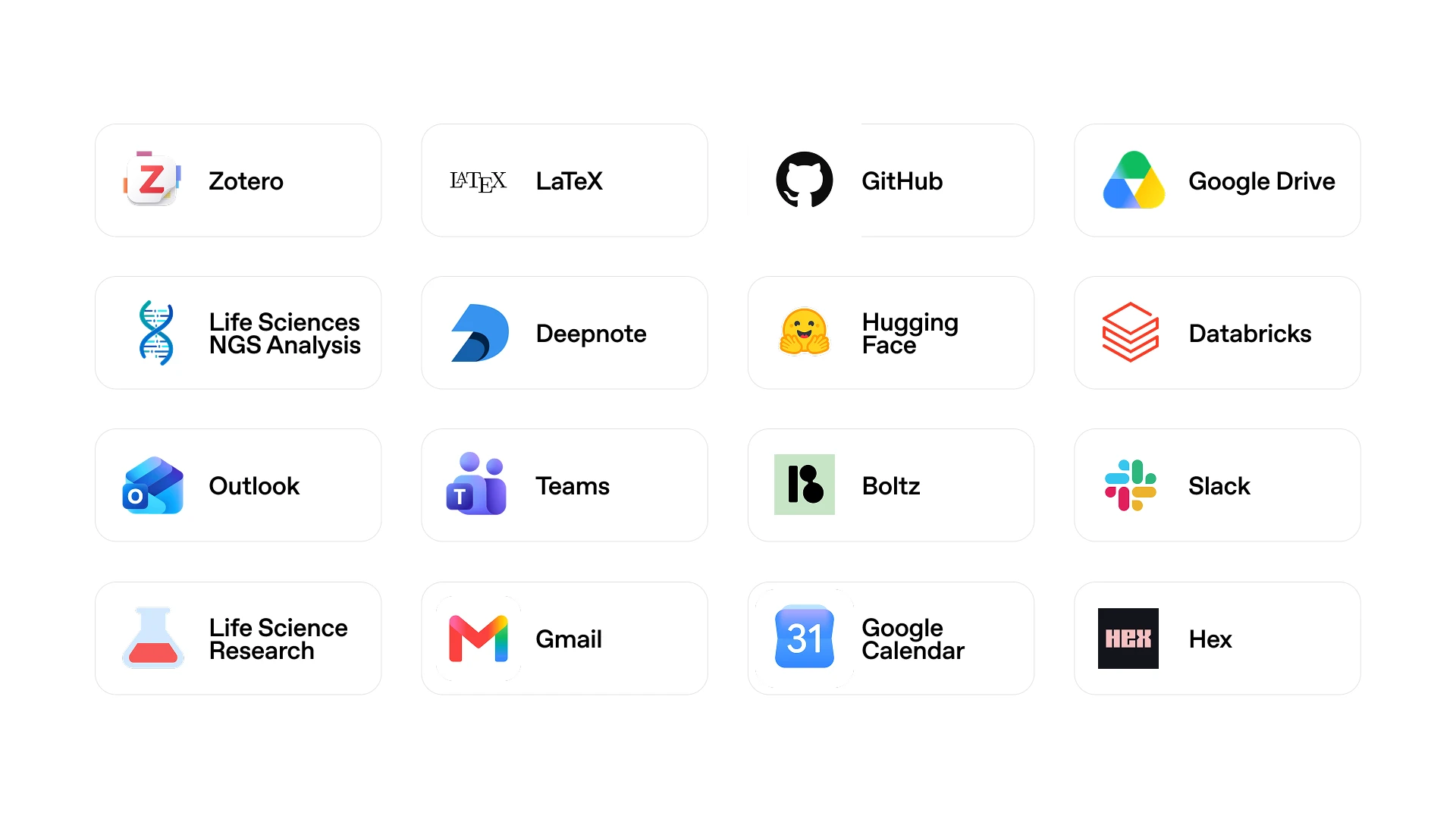
研究技能與連接器的標誌排列,包括 Life Science Research、NGS Analysis、Hex、Boltz、Google Drive、Gmail、Google 日曆、Zotero、Outlook、Teams、GitHub、Slack、LaTeX、Deepnote、Hugging Face 和 Databricks。

ChatGPT 與 Codex 提供的技能、連接器和工具代表性範例。

Codex 可協助撰寫與偵錯程式碼、分析資料集,以及建立可重現的工作流程。ChatGPT Work 可支援較長期的專案,例如尋找經費機會、準備研究經費申請、回顧文獻、撰寫論文初稿,以及製作用於分享研究成果的資料。

培訓與研究支援

研究人員運用 AI 的起點各不相同。有些人可能是第一次使用這些工具,另一些人則可能已在其領域開發進階應用。

本計畫將依參與者不同的經驗程度提供相應培訓,從入門與改善工作流程,到進階研究應用皆涵蓋在內。參與者可向熟悉研究工作流程的專家尋求協助,包括如何將這些工具整合至工作中。

隨著研究人員持續取得新成果,我們計畫創造更多機會,讓他們分享實務做法、相互學習,並展現跨領域的應用成果。他們的意見將協助我們瞭解模型在哪些方面實用、有哪些不足,以及如何提升模型對研究社群的價值。

申請方式

初期計畫開放特定學術機構中符合資格的研究人員參加。符合資格的機構(在新視窗中開啟)必須是獲認可、可授予學位,且研究活動活躍的學院或大學。

申請人必須驗證所屬機構,提供目前進行中的研究,以及預計如何將本計畫用於科學研究等資訊。獲核准的研究人員可邀請同機構最多四名協作者。每位協作者也必須驗證所屬機構,並計入本計畫的名額總數。

即日起開放申請。你可以在這裡(在新視窗中開啟)查看申請資格並提出申請。
作者

OpenAI