Mapping Europe’s AI Workforce Opportunity
How the EU’s mix of occupations and institutions can shape where AI supports growth, redesigns work, and encourages adaptation
AI capabilities can cross borders quickly. Jobs do not change in such a frictionless way. Work is shaped by licensing systems, local institutions, and the practical realities of delivering care, education, justice, public services, and other forms of human support. These systems matter because they help determine if and how AI changes the labor market. What will AI’s labor market impact be? Where will the impacts be felt most and when? And how can we ensure that the AI transition works for everyone?
These are the questions at the center of OpenAI Economic Research's new report, The AI Jobs Transition Framework for the EU. The report extends the AI Jobs Transition Framework(opens in a new window), first developed for the United States in April 2026, to the European labor market. It uses the official European Skills, Competences, Qualifications and Occupations (“ESCO”) taxonomy, along with Eurostat employment data, to examine how AI capabilities may translate into different kinds of near-term occupational change across EU member states. Compared with the U.S., the EU has a smaller share of employment in occupations with higher near-term automation potential.
The framework identifies four transition archetypes: occupations that may grow with AI, occupations at higher automation potential, occupations likely to reorganize, and occupations with less immediate change. These categories are not employment forecasts. They are a planning map for where different kinds of adjustment pressure and opportunity may emerge.
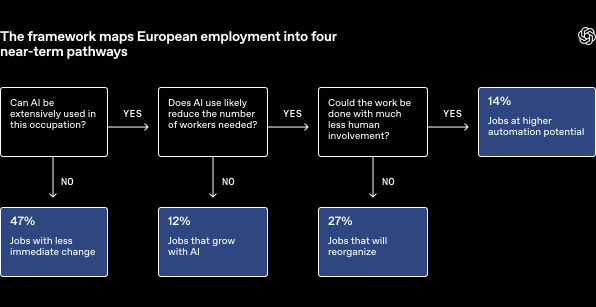
Applied to the EU, the framework suggests that AI may increase demand in some occupations, reduce labor needs in others, and reorganize many more:
- About 12% of employment is in occupations that may grow with AI as lower costs expand access or make more projects viable.
- About 14% is in occupations with relatively higher near-term automation potential.
- Another 27% is in occupations likely to reorganize, where AI may change workflows and skill needs even when people remain central to delivery.
- The remaining 47% is in occupations with less immediate change.
The report shows that country-level patterns vary across the EU. Luxembourg, Sweden, and the Netherlands have larger shares in occupations that may grow with AI. Germany, Greece, and Italy have larger employment shares in occupations classified as higher automation potential. These differences reflect differences in the occupational structure across countries.
For policymakers, employers, educators, and researchers, the practical implication is to anticipate change and plan for it at a more detailed level. Aggregate employment statistics will reveal major changes only after firms, workers, and institutions have already begun to adapt. Europe has strong occupation, training, vacancy, wage, and official statistical systems. Connecting those systems to measures of AI capability and workplace adoption could help identify where transition pressure and opportunity are emerging before the effects show up in headline labor-market data.
The European extension of the AI Jobs Transition Framework is best understood as a map for preparation – a way to ask more useful questions about how AI capability becomes economic change in specific occupations and specific institutional settings. Better evidence gives workers, firms, and policymakers more time to prepare.
The report also offers preliminary ideas for public and private institutions working on AI and jobs, including strengthening monitoring capabilities to track labor market change, or establishing national readiness plans to tailor interventions.
Over the coming months, we will expand and build out these ideas through engagement with stakeholders at both national and EU levels, with the goal of identifying practical ways to ensure that AI supports prosperity and progress across Europe.