跳至主要内容
OpenAI

2026年5月15日

产品

ChatGPT 中的全新个人理财体验

正在加载…

今天,我们向美国的 Pro 用户发布 ChatGPT 全新个人理财体验的预览版。现在,你可以安全地连接自己的金融账户,查看资金流向仪表板,并基于你的财务背景向 ChatGPT 提问——同时始终掌控自己的数据。我们先向较小范围用户提供预览,以便从真实使用中学习、改进体验,并审慎扩展。

金钱几乎影响生活的方方面面:我们住在哪里、做出什么决定、如何照顾所爱之人、想象怎样的未来。但如今管理财务往往意味着要把账户、应用、银行卡、贷款和电子表格拼凑起来,才能知道自己的整体状况。即便如此,也仍然很难看清全貌,或知道下一步该做什么。

人们已经在向 ChatGPT 寻求帮助每月有超过 2 亿人来到 ChatGPT(在新窗口中打开),处理预算、投资相关问题、比较不同路径、规划未来目标等。GPT‑5.5 的最新进展让 ChatGPT 在处理个人理财中常见的复杂且依赖具体背景的问题时,具备更强的推理能力。

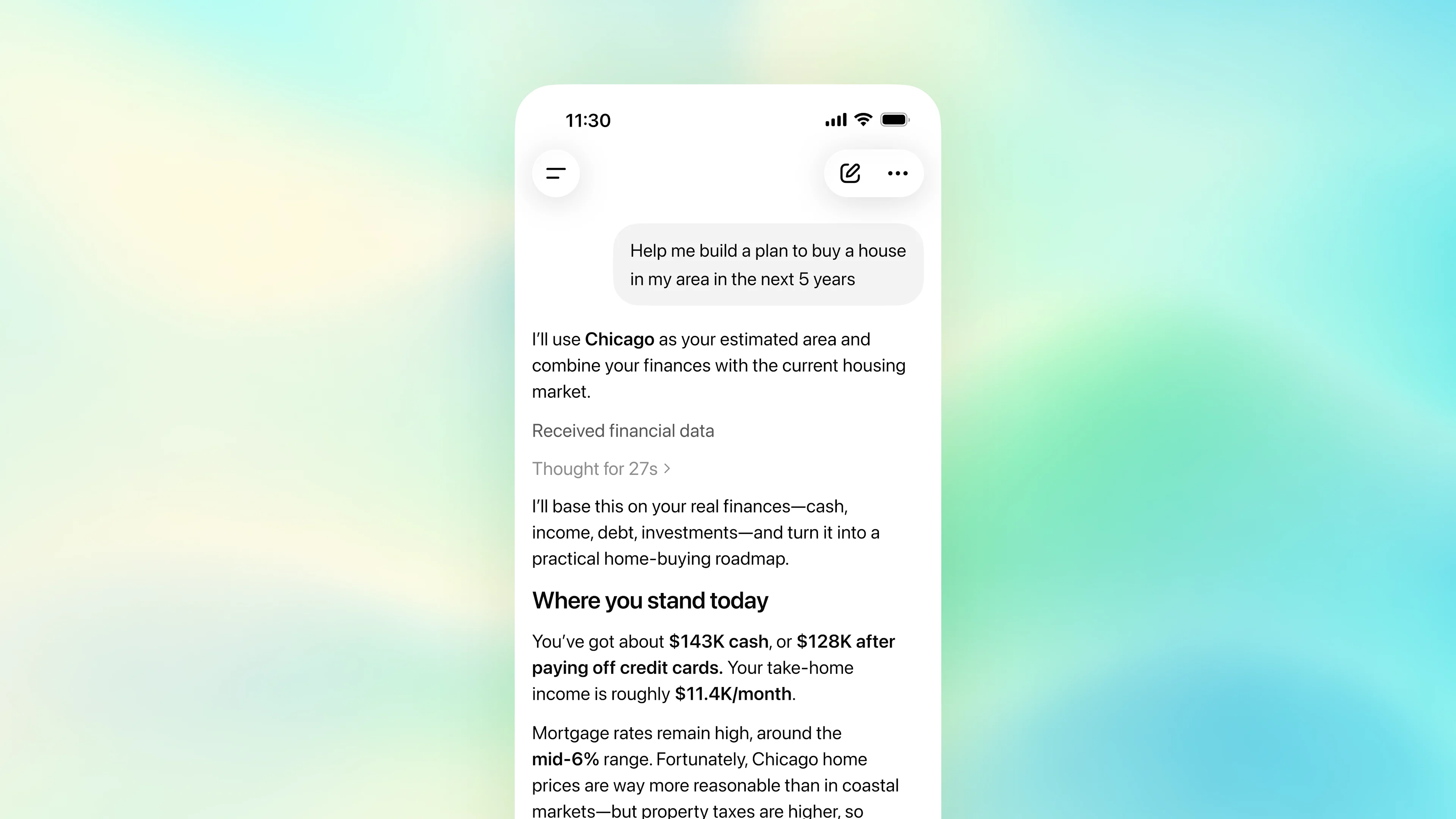
连接你的金融账户后,ChatGPT 可以将这种推理能力与你真实的财务背景,以及你分享的目标、生活方式和优先事项结合起来,帮助你发现模式、理解权衡,并以更个性化、更完整的方式为重大决策做规划。现在你可以提出这样的问题:

手机应用显示个人理财助手根据用户财务状况和芝加哥住房市场数据制定五年购房计划。

ChatGPT 可以帮助你及时了解情况,并更有信心地管理财务,但它不能替代专业财务建议。

从今天开始,我们将向美国的 Pro 用户逐步推出在网页版和 iOS 版 ChatGPT 中连接金融账户的功能,支持超过 12,000 家金融机构。在向 Plus 用户推出之前,我们会先从早期使用中学习并持续改进,目标是最终让所有人都能使用。

如何开始使用

连接你的财务信息

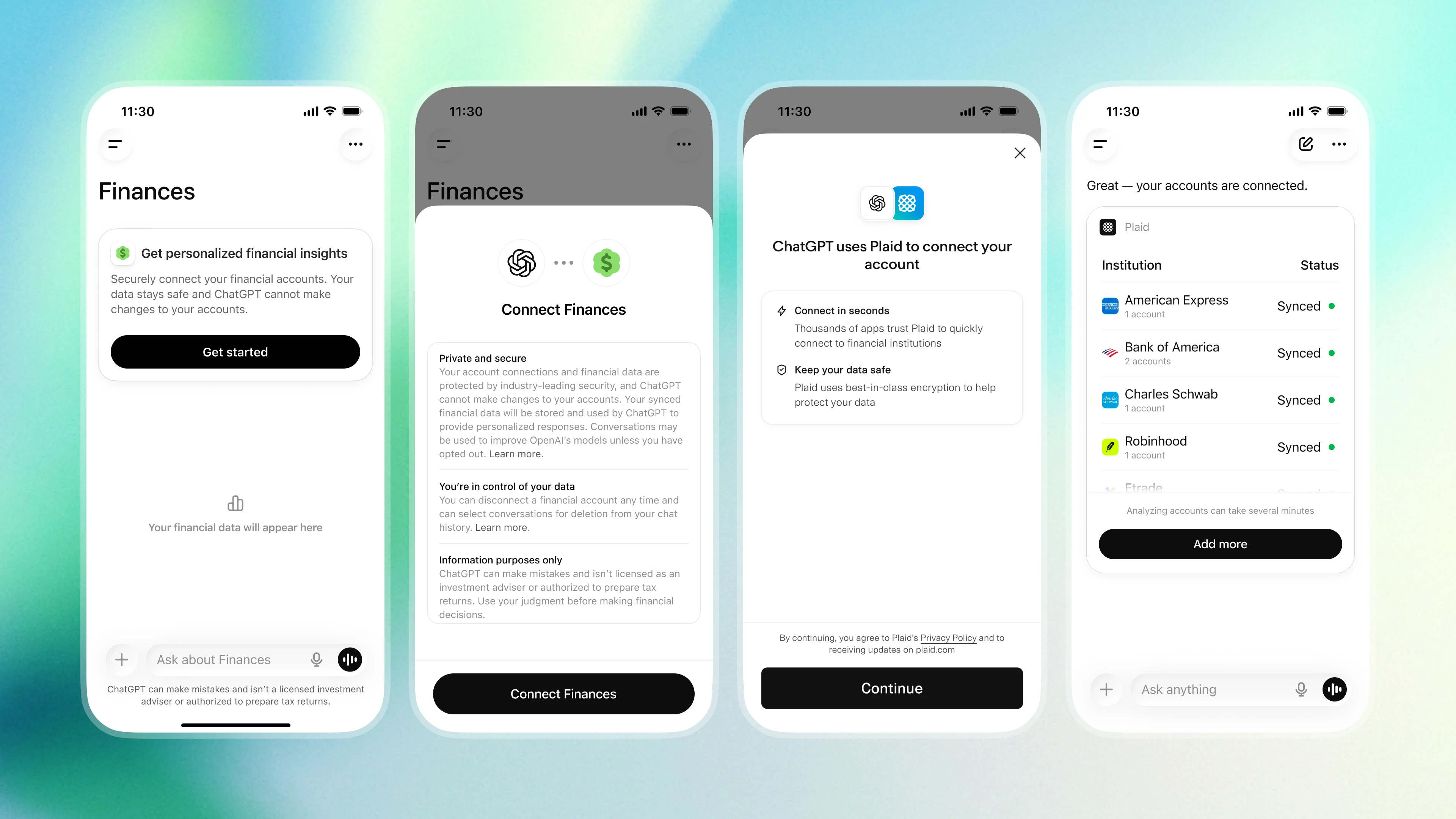
要开始使用,请从 ChatGPT 侧边栏打开 Finances 并选择“开始使用”,或者在 ChatGPT 的任意位置发起对话,说“@Finances,连接我的账户”。 

随后,ChatGPT 会引导你通过 Plaid 安全地关联账户,Intuit 支持即将推出。完成身份验证后,ChatGPT 将开始同步并分类你的数据,这可能需要几分钟时间。

四个手机应用界面展示将金融账户连接到 ChatGPT 的过程

账户同步完成后,你可以查看一个仪表板,实时了解你的投资组合表现、支出、订阅、即将到来的付款等整体情况。

除了已连接的账户外,你还可以分享自己财务生活中的重要背景信息,例如房贷、储蓄目标,或你正在规划的一项重大购买。例如,你可以告诉 ChatGPT:“我正在为明年年初买车攒钱”,或者“我还欠父母他们借给我的贷款 [X amount]。”ChatGPT 可以将这些背景保存到你的财务记忆中,为未来的对话提供参考。

这种更广泛的背景正是这一体验有用的原因之一——ChatGPT 不会把每个问题孤立看待,而是可以帮助串联你的账户、目标以及你已经分享的信息,从而让建议更个性化、更完整。

未连接 Finances

Help me come up with a plan to save a little bit more in the next few months.

Here’s a practical way to save a bit more over the next 2–3 months without making your life miserable.

1. Pick a specific target

Make the goal concrete and time-bound.

Examples:

  • “Save an extra $1,500 by August.”
  • “Build a one-month emergency cushion.”
  • “Save enough for travel / taxes / moving / investing.”

A vague goal like “spend less” usually fades quickly.

2. Focus on the 3 highest-impact categories

Most people don’t need to optimize everything. Usually 70–80% of extra savings comes from a few categories:

Food & delivery

Good targets:

  • Reduce takeout from 5x/week → 2x/week
  • Bring coffee/lunch a few days per week
  • Set a fixed “fun food” budget

Even a small reduction here can free up a few hundred dollars monthly.

Subscriptions & recurring charges

Look for:

  • Duplicate streaming/services
  • Annual plans you forgot about
  • Apps you rarely use
  • Higher-tier plans you don’t need

A 20-minute cleanup can permanently lower monthly burn.

Impulse spending

Instead of “don’t buy stuff,” use friction:

  • 48-hour rule for purchases over a set amount
  • Remove saved cards from shopping apps
  • Keep a running wishlist instead of instant purchases

This cuts emotional purchases without feeling restrictive.

3. Automate the saving immediately

The biggest difference-maker is usually automation.

Try:

  • Automatic transfer every payday
  • Separate high-yield savings account
  • Move the money before you see it

Even:

  • $75/week = ~$900 in 3 months
  • $150/week = ~$1,800 in 3 months

Small consistent transfers beat occasional big efforts.

4. Create one “low-spend default”

Don’t try to optimize every decision.

Examples:

  • Weeknights = home-cooked meals
  • One no-spend day per week
  • Fixed entertainment budget
  • Only one convenience purchase category at a time

Simple rules reduce decision fatigue.

5. Increase income slightly instead of only cutting

For a short-term savings push, earning a little extra is often easier psychologically than aggressive budgeting.

Ideas:

  • Sell unused gear/clothes/electronics
  • Freelance or consulting work
  • Small weekend project
  • Negotiate a recurring expense (insurance, internet, phone)

Even an extra few hundred dollars changes momentum fast.

6. Track only one number weekly

Avoid overcomplicated budgeting systems.

Every week, check:

“How much did my savings increase this week?”

That keeps attention on progress rather than guilt.

A realistic “light effort” version

If you want something sustainable and low-stress:

Monthly

  • Cut 2–3 subscriptions
  • Reduce dining out modestly
  • Auto-transfer savings on payday

Weekly

  • One no-spend day
  • One meal-prep session
  • Quick 5-minute money check-in

That alone can often create an extra few hundred dollars/month without dramatic lifestyle changes.

If you want, I can also help you build:

  • a lean 3-month savings plan,
  • a category-by-category budget,
  • or a “minimal pain” version based on your current spending habits.

已连接 Finances

@Finances Help me come up with a plan to save a little bit more in the next few months.

I’ll look at recent spending, recurring charges, and cash-flow patterns, then turn that into a practical “save a little more” plan rather than a harsh budget.

按类别划分支出的储蓄计划

Here’s the plan I’d use for the next few months. May is still early, so I’m anchoring this mostly on February–April plus the May-to-date spending.

At a $110K salary, the goal is not to make life feel overly restricted. It’s to create more consistency across normal spending categories so saving happens before the month gets away from you.

Your biggest flexible spending levers recently are:

类别

2 月 1 日–5 月 9 日支出

说明了什么

杂货与家庭用品

约 2,150 美元

属正常范围,但值得通过每周目标进一步收紧

购物

约 1,250 美元

很有优化空间,尤其是 Target/Amazon/服装购物

交通

约 1,450 美元

油费、停车、网约车和用车成本会不断累积

餐饮与酒水

约 1,620 美元

非常适合采取行动,而且不必完全砍掉

订阅与账单

约 420 美元

金额虽小,但很容易清理

Target: save an extra $500–$750/month

I would not start by trying to eliminate every small pleasure. Your biggest wins are dining, shopping, transportation, and grocery pacing.

1. Dining: cap at $450/month

Dining has been one of the easiest places for spending to drift. I’d set a realistic cap of $450/month, which still leaves room for takeout, coffee, and a few meals out.

Expected savings: $150–$250/month.

Use a simple rule: pick 2–3 meals out per week, then default to groceries for the rest.

2. Shopping: cap at $300/month

Shopping is not extreme, but it’s the kind of category that can quietly turn into $500–$700 months through Amazon, Target, clothes, and household extras. I’d set a $300/month cap through August.

Expected savings: $150–$250/month.

Use a simple rule: anything over $75 waits 24 hours before buying.

3. Transportation: set a monthly ceiling

Between gas, parking, car maintenance, and occasional rideshare, transportation can become a bigger budget item than it feels in the moment. I’d set a $400/month transportation target, excluding true emergencies or required repairs.

Expected savings: $100–$200/month.

The rule I’d use: rideshare is for late nights, bad weather, carrying things, or when it saves 25+ minutes. Otherwise default to driving, walking, transit, or planning ahead.

4. Groceries: use a weekly target, not a strict diet

Groceries and household basics are necessary, so I wouldn’t treat this as “bad spending.” But I would set a weekly grocery target of about $125–$150 and try to avoid extra midweek convenience runs.

Expected savings: $100–$150/month.

5. Subscriptions: small cleanup only

The recurring charges are not where the big money is, but they’re still worth checking: streaming, apps, news, fitness, cloud storage, and memberships. Canceling one or two might save $20–$50/month. Useful, but not the main plan.

The monthly savings formula
For June–August:

每月目标

餐饮上限

+200 美元

购物上限

+200 美元

交通上限

+150 美元

杂货节奏控制

+125 美元

订阅清理

+30 美元

总潜力

约 705 美元/月

To make it stick, I’d automate $500/month to savings first. Then treat the extra $200–$250 as the stretch goal when dining, shopping, or transportation comes in lighter.

Best version of the plan: auto-save $500/month, cap dining at $450, cap shopping at $300, set a transportation ceiling, and use weekly grocery targets so the plan feels realistic instead of restrictive.

从回答到行动,与 Intuit 等生态合作伙伴携手实现

ChatGPT 的愿景是不止于回答问题,还要帮助用户采取行动、改善自己的财务生活;为此,我们正与 Intuit 等值得信赖的生态合作伙伴合作。例如,用户可以从获得信用卡推荐,进一步了解自己的获批几率并提交申请;或者从询问出售股票的税务影响,进一步获得由 Intuit 提供的可信税额估算,并预约与本地真人税务专家的咨询——这一切都可在 ChatGPT 内完成。

保护你的信息隐私与安全 

你的财务数据非常敏感,我们构建这一体验时充分考虑了你的隐私,并确保你始终掌控自己的信息。

当你连接账户后,ChatGPT 可以访问你的余额、交易、投资和负债,以帮助可视化你的财务状况或回答你的问题。它无法查看完整账号,也不能对你的账户进行任何更改。 

与你已连接金融账户相关的对话,将遵循你在 ChatGPT 中选择的相同模型训练设置。你可以随时在 设置 > 数据控制(在新窗口中打开) 中更改此设置。

你始终掌控自己的信息:

  • 断开账户连接:你可以随时在“设置 > 应用 > Finances”中,或从 Finances 页面断开你的金融账户连接。断开连接后,你同步的账户数据将在 30 天内从 OpenAI 的系统中删除。断开账户连接不会影响你在 ChatGPT 对话历史中的财务信息,但你可以随时删除单个对话。 
  • 删除财务记忆:ChatGPT 可以记住你分享的关键细节,例如目标、义务或与你资金相关的背景信息,从而让 ChatGPT 中未来的财务对话更相关、更个性化。这些内容会被保存为财务记忆,这是一种专门用于支持财务对话的记忆类型。你可以随时在 Finances 页面查看或删除它们。 
  • 临时聊天:当你使用临时聊天时,ChatGPT 不会访问你已连接的金融账户。临时聊天不会出现在你的历史记录中。

为进一步保护你的 ChatGPT 账户,你可以启用多因素身份验证 (MFA)(在新窗口中打开),增加一层额外保护,帮助防止未经授权的访问。

为准确性和质量而设计与评估

与已连接金融账户相关的对话默认使用 GPT‑5.5 Thinking,这是 ChatGPT 中我们最新的推理模型。

财务问题具有个人性、复杂性,并且高度依赖具体背景。有帮助的回答需要考虑一个人的收入、支出、余额、债务、目标和时间安排,同时清楚说明不确定性、假设,以及何时需要更多信息。 

为了更好地了解 ChatGPT 在这些场景中服务用户的效果,我们构建了一个内部基准测试,帮助我们依据与专家共同制定的标准,全面评估回答质量。我们与来自领先机构的 50 多位金融专业人士合作,对这一体验进行评估,并为 ChatGPT 在高难度个人理财任务中的表现打分。

GPT‑5.5 Thinking 在复杂个人理财任务上的表现优于更早期的模型。面向 ChatGPT Pro 用户提供的 GPT‑5.5 Pro 实现了整体最佳表现。

* 个人理财基准测试在高难度理财任务中的评分。这是由专家评分的回答质量和回答准确性加权汇总而成;分数越高越好。Finances 中的默认模型 GPT‑5.5 Thinking 在该基准测试中获得了 100 分中的 79 分。GPT‑5.5 Pro 获得了 100 分中的 82.5 分。

这一基准测试让我们能更清晰地衡量进展,我们也将继续随着时间推移改进 ChatGPT 处理复杂个人理财任务的能力。

我们的 ChatGPT Pro 社区测试者怎么说

“在 ChatGPT 中连接我的财务信息,帮助我弄清楚如何用一个我真正能执行的现实月度计划还清房贷。”
—Richard K.Sohn,PsyD,心理学家

作者

OpenAI