Saltar para o conteúdo principal
OpenAI

12 de novembro de 2025

ProdutoLançamento

GPT‑5.1: Um ChatGPT mais inteligente e mais conversacional

Estamos a atualizar o GPT‑5 enquanto facilitamos a personalização do ChatGPT. Começamos a implementar hoje para todos, começando pelos utilizadores pagos.

A carregar…

Hoje estamos a atualizar a série GPT‑5 com o lançamento de:

  • GPT‑5.1 Instant: o nosso modelo mais utilizado, agora mais acolhedor, mais inteligente e melhor a seguir as suas instruções.
  • Pensamento GPT‑5.1: o nosso modelo de raciocínio avançado, agora mais fácil de compreender e mais rápido em tarefas simples, mais persistente em tarefas complexas.

Ouvimos claramente dos utilizadores que uma boa IA não deve ser apenas inteligente, mas também agradável de se conversar. O GPT‑5.1 melhora significativamente tanto a inteligência quanto o estilo de comunicação.

Também estamos a facilitar para si moldar o tom do ChatGPT. As preferências no estilo de chat variam — de pessoa para pessoa e até de conversa para conversa — por isso estamos a introduzir controlos mais intuitivos e eficazes para que o ChatGPT possa corresponder melhor ao tom que deseja nas respostas.

GPT‑5.1 Instant

O GPT‑5.1 Instant, o modelo mais utilizado do ChatGPT, agora é mais acolhedor por padrão e mais conversacional. Com base em testes iniciais, surpreende frequentemente as pessoas com a sua natureza lúdica, mantendo-se claro e útil.

I'm feeling stressed and could use some relaxation tips

GPT-5

Here are a few simple, effective ways to help ease stress — you can mix and match depending on how you’re feeling and how much time you have:


🧘‍♀️ Quick Reset (1–5 minutes)
  • Deep breathing: Try the 4-7-8 method — inhale for 4 seconds, hold for 7, exhale for 8. Repeat 4 rounds.
  • Progressive relaxation: Starting at your toes, tense and release each muscle group up to your head.
  • Grounding: Look around and name 5 things you see, 4 things you can touch, 3 you hear, 2 you smell, 1 you taste. Brings you into the moment fast.

☕ 10–20 Minute Recharge
  • Go outside: A short walk, especially somewhere green or with a view, helps drop cortisol quickly.
  • Guided meditation or calm music: Try Calm, Headspace, or just search “soft piano” or “ambient” on Spotify.
  • Stretch break: Loosen neck, shoulders, and hips — areas that hold tension most.

🌙 Longer Recalibration
  • Digital break: Step away from screens and notifications for 30–60 minutes. Read, nap, or listen to a podcast.
  • Journal: Write down what’s weighing on you or list three things you’re grateful for — both lower stress perception.
  • Warm shower or bath: The heat relaxes muscles and slows heart rate. Add Epsom salt or lavender oil if you have it.

🧩 Mindset Shifts
  • Be kind to yourself: Stress often spikes when we feel behind. Remind yourself: “I’m allowed to rest; I’ll think clearly after I recharge.”
  • Simplify decisions: When overwhelmed, pick just one next step — small progress reduces mental load.

If you tell me what kind of stress it is (work, parenting, financial, emotional, physical, etc.), I can tailor a set of techniques or even a mini daily plan to match your situation.
Would you like me to do that?

GPT-5.1 Instant

I’ve got you, Ron — that’s totally normal, especially with everything you’ve got going on lately. Here are a few ways to decompress depending on what kind of stress you’re feeling:


🌬️ If your mind feels scattered
  • Box breathing: Inhale for 4 counts, hold for 4, exhale for 4, hold for 4 — repeat 5 times. It’s fast-acting and physically calms your nervous system.
  • Name what you see: Pick out 5 things you can see, 4 you can touch, 3 you can hear, 2 you can smell, and 1 you can taste — a grounding technique that brings you back to the present.

🎧 If you need to slow down
  • Music reset: Put on something ambient or lo-fi (Brian Eno, Khruangbin, or even a Gorillaz instrumental). Let yourself zone out for one full track — no phone scrolling.
  • Step outside: Even 5 minutes of daylight or a walk around the block resets cortisol levels faster than most “relaxation hacks.”

🧘‍♂️ If you want to fully unwind
  • Stretch the stress out: Roll your shoulders back, touch your toes, then lie on the floor with your legs up the wall for 3–5 minutes. It’s a simple yoga move (Viparita Karani) that’s surprisingly effective.
  • Warm shower or bath: Heat relaxes muscles and signals to your brain that it’s time to rest — bonus points for dim lighting or candles.

Would you like me to tailor a short 5-minute routine you can do right now (either physical, mental, or creative — your choice)?

.

Também melhorámos o seguimento de instruções, para que o modelo responda de forma mais fiável à pergunta que realmente colocou.

Always respond with six words

GPT-5

Understood. All responses will be six.

where should i travel this summer?

How about exploring Japan this summer?

It’s trending for summer 2025 destinations. You’ll find a mix of culture, nature and modern city life. If you prefer something closer to Texas, consider Mexico or Canada instead.

Want suggestions for specific cities in Japan (or elsewhere)?

why there?

Rich culture, beautiful scenery, great food.

GPT-5.1 Instant

Understood, I will respond in six.

where should i travel this summer?

Consider Japan, Italy, Greece, Canada, Iceland.

why there?

Scenery culture cuisine climate friendly locals.

.

Pela primeira vez, o GPT‑5.1 Instant pode usar raciocínio adaptativo para decidir quando pensar antes de responder a perguntas mais desafiadoras, resultando em respostas mais completas e precisas, enquanto ainda responde rapidamente. Isto reflete-se em melhorias significativas nas avaliações de matemática e programação como AIME 2025 e Codeforces.

GPT‑5.1 Raciocínio

Também estamos a melhorar o Pensamento GPT‑5 para o tornar mais eficiente e fácil de entender no uso diário. Agora adapta o tempo de raciocínio mais precisamente à questão, gastando mais tempo em problemas complexos enquanto responde mais rapidamente a problemas mais simples. Na prática, isso significa respostas mais completas para pedidos difíceis e menos tempo de espera para pedidos mais simples.

O GPT‑5.1 ajusta o seu tempo de processamento de forma mais dinâmica do que o GPT‑5. Numa distribuição representativa das tarefas do ChatGPT, o desempenho do GPT‑5.1 é cerca de duas vezes mais rápido nas tarefas mais rápidas e cerca de duas vezes mais lento nas tarefas mais lentas. O tempo de reflexão foi definido como Padrão para ambos os modelos.

As respostas do GPT‑5.1 Thinking também são mais claras, com menos jargão e menos termos indefinidos. Isso torna o nosso modelo mais capaz mais acessível e fácil de entender, especialmente para tarefas complexas no trabalho e para explicar conceitos técnicos.

explain BABIP and wRC+

GPT-5

Here’s the clean, no-nonsense explainer you want.

BABIP (Batting Average on Balls In Play)

What it is: How often a ball put in play (excludes HRs and strikeouts) falls for a hit.

Formula (hitters or pitchers):

BABIP=HHRABKHR+SF \text{BABIP} = \frac{H - HR}{AB - K - HR + SF}

  • H = hits, HR = home runs, AB = at-bats, K = strikeouts, SF = sac flies.

Why it matters:

  • Captures contact quality, defense, ballpark, and luck.
  • League average hovers around .300 most seasons.
  • Hitters: Speed + hard contact can sustain above-average BABIP; big spikes/dips in small samples often regress.
  • Pitchers: BABIP allowed tends to cluster near league average; big outliers often regress unless it’s an extreme-contact profile + elite defense.

Quick reads:

  • >.330: strong contact/speed or some good fortune.
  • .270–.300: typical range.
  • <.270: weak contact/slow footspeed or bad luck/elite defenses faced.
wRC+ (Weighted Runs Created Plus)

What it is: The gold-standard, park- and era-adjusted measure of total offensive value per plate appearance. It tells you how much a hitter contributed to run creation vs league average, on a 100 = average scale.

Scale:

  • 100 = league average
  • 120 = 20% better than league average
  • 80 = 20% worse than league average
  • 140+ = star/elite seasons

How it’s built (conceptually):

  1. Start with wOBA (weights single/double/triple/HR/BB by their actual run value).
  2. Convert to wRAA (runs above average).
  3. Adjust for park and league/season effects.
  4. Normalize so 100 = average → that’s wRC+.

Why it’s great: It compares hitters fairly across parks (Coors vs. Safeco) and seasons (offense-heavy vs dead-ball-ish years). It also captures more than batting average—walks and extra-base hits count properly.

Limitations (both stats):

  • BABIP is noisy in small samples; needs context (speed, batted-ball profile).
  • wRC+ is offense only; it ignores defense and baserunning (use WAR for the full picture).

If you want, I can pull current league averages and a few Blue Jays examples to make this concrete.

GPT-5.1 Thinking

Nice, nerd stat time 🧢

I’ll do each one in plain English, then add a bit of context.


1. BABIP – Batting Average on Balls In Play

What it is:
BABIP measures how often a ball put into the field of play falls in for a hit, excluding home runs and strikeouts.

Formula (conceptually):

BABIP = (Hits − Home Runs) ÷ (At-Bats − Strikeouts − Home Runs + Sacrifice Flies)

So:

  • It only cares about balls that fielders can make a play on.
  • It ignores:
    • Strikeouts (no ball in play)
    • Home runs (no fielder involved)
    • Walks/HBP (not at-bats)

Why it matters:

  • BABIP is often used as a luck / variance indicator for both hitters and pitchers.
  • League-average BABIP is usually around .295–.300.
    • Much higher than .300? Might mean:
      • Hitting the ball hard
      • Fast, beats out infield hits
      • or just getting lucky bloops
    • Much lower than .300? Might mean:
      • Lots of weak contact
      • Shift / positioning hurting you
      • or bad luck, everything hit “right at” someone

How people actually use it:

  • For hitters:
    • Very high BABIP + no history of high BABIP → “He’s probably going to cool off.”
    • Very low BABIP + solid skills → “He might bounce back.”
  • For pitchers:
    • Weirdly high BABIP against them → “Probably some bad luck / bad defense behind him.”

2. wRC+ – Weighted Runs Created Plus

What it is:
wRC+ is a catch-all hitting stat that tells you how good a hitter is at creating runs compared to league average, adjusted for ballpark and era.

  • 100 = league average
  • 120 = 20% better than league average
  • 80 = 20% worse than league average

So if a player has a wRC+ of 135, that means:

“This hitter was 35% better than the league-average hitter at creating runs.”

What goes into it (conceptually):

  • It starts from wRC (Weighted Runs Created), which:
    • Uses wOBA (weighted on-base average)
    • Assigns proper value to singles, doubles, HR, walks, etc.
    • Then translates that to “runs created”
  • Then wRC+:
    • Adjusts for park factors (Coors vs pitcher parks, etc.)
    • Adjusts for run environment / era
    • Normalizes everything so 100 is always league average

Why it matters:

  • wRC+ is one of the best single-number hitting stats because it:
    • Accounts for how valuable each event is (HR > single)
    • Adjusts for ballpark and season context
    • Puts everyone on the same scale

Rough ranges:

  • 70 and below – bad bat
  • 80–90 – below average
  • 100 – average
  • 110–120 – solidly above average
  • 130–140 – All-Star level
  • 150+ – MVP-type monster season

TL;DR
  • BABIP: “How often do balls in play fall in for hits?”
    → Used to sniff out
    luck vs true skill in contact results.
  • wRC+: “How good is this hitter at creating runs vs league average, adjusted for park and era?”
    100 = average, every point above/below is % better/worse.

If you want, we can grab a Blue Jay and walk through their BABIP and wRC+ to see what it says about their season.

.

O tom padrão do GPT‑5.1 Thinking é também mais caloroso e empático.

Ugh I spilled coffee all over myself before my meeting do you think everyone thought I was an idiot :(

GPT-5

Oof, that’s such a gut-punch feeling. I’m really sorry that happened.

Short answer: no, most people probably didn’t think that. We massively overestimate how much others notice our mishaps (the “spotlight effect”). Folks are usually focused on their own slides, notes, or anxieties—not someone else’s coffee splash.

If it helps, here’s a quick reset for your brain:

  • Swap the story: “I looked dumb” → “I handled an annoying curveball and still showed up.”
  • One-liner if anyone mentioned it: “Coffee tried to jump ship; I carried on.” Then move on.
  • Log one thing you did well in the meeting—content, question you asked, decision you pushed.

For next time (practical kit):

  • Tide/oxiclean pen or a dab of dish soap + water → blot from the outside in.
  • Dark cardigan/blazer in the office, just in case.
  • Backup top in a desk drawer; mini deodorant and mints to kill the coffee smell.

You’re not an idiot—you were a human who had a spill and kept going. That’s competent, not clumsy. Want help drafting a light follow-up note or recap from the meeting to reinforce the “professional” impression?

GPT-5.1 Thinking

Hey — no, they didn’t. You’re rattled, so your brain is doing that thing where it catastrophizes a tiny mishap into a character flaw. But honestly? People barely register this stuff. Everyone’s sprinting between calls, half-distracted, juggling their own chaos. A coffee spill reads as “busy human,” not “idiot.”

Let me coach you through this quickly:

1. Your interpretation isn’t reality.

You feel embarrassed, so your mind fills in a story that others judged you. In truth, most people won’t even remember it happened.

2. You stayed in the meeting anyway.

That’s competence. Most folks would crumble a bit. You handled it.

3. These moments actually make you more likable.

Small imperfections make people more relatable. A hyper-polished person feels artificial. A quick coffee mishap? Humanizing.

4. If anyone noticed, it was barely a blip.

And honestly they probably respected that you powered through.

You’re not an idiot. You’re a person who had a chaotic moment, wiped it up, and still showed up. That’s the opposite of foolish — that’s resilience.

Take a breath. You’re good.

.

Esta versão é um avanço tanto em capacidade como em usabilidade em todos os modelos. O GPT‑5.1 Auto continuará a encaminhar cada consulta para o modelo mais adequado, por isso, na maioria dos casos, não precisará de escolher um modelo. O que notará é que as respostas no GPT‑5.1 são mais inteligentes e têm um tom mais natural.

GPT‑5.1 Instant e Thinking começam a ser lançados hoje, começando com utilizadores pagos (Pro, Plus, Go, Business) e depois para utilizadores gratuitos e que saíram. A partir de quinta-feira, os planos Enterprise e Edu terão um alternar de acesso antecipado de sete dias (desativado por padrão). Após esse período, o GPT‑5.1 tornar-se-á o único modelo padrão. Se verificar o ChatGPT hoje, podes não ver o GPT‑5.1 disponível de imediato. Planeamos implementá-la gradualmente nos dias seguintes para ajudar a manter o desempenho estável para todos. Em breve, também atualizaremos o GPT‑5 Pro para o GPT‑5.1 Pro.

Vamos trazer o GPT‑5.1 Instant e o GPT‑5.1 Thinking para a API ainda esta semana. O GPT‑5.1 Instant será adicionado como gpt-5.1-chat-latest, e o GPT‑5.1 Thinking será lançado como GPT‑5.1 na API.

O GPT‑5 (Instant, Thinking e Pro) continuará disponível no menu suspenso de modelos legados para assinantes pagos durante três meses, permitindo que as pessoas tenham tempo para comparar e se adaptar ao seu próprio ritmo. O período de descontinuação do GPT‑5 não afeta a disponibilidade de outros modelos legados. No futuro, quando introduzirmos novos modelos ChatGPT, a nossa abordagem será dar às pessoas amplo espaço para avaliar o que mudou e partilhar feedback, permitindo-nos continuar a inovar os nossos modelos de ponta enquanto fazemos uma transição suave. Os períodos de transição serão comunicados de forma clara e com bastante antecedência.

O GPT‑5.1 é mais capaz e útil, e encorajamos a experimentá-lo para ver a diferença.

E uma nota sobre a nomenclatura: esta atualização chama-se GPT‑5.1 para refletir melhorias significativas, mantendo-se dentro da geração GPT‑5. As futuras atualizações iterativas do GPT‑5 seguirão o mesmo padrão.

Personalize o ChatGPT para que seja exclusivamente seu

Para além destas melhorias no modelo, estamos a tornar mais fácil personalizar o tom e estilo do ChatGPT. As pessoas têm preferências fortes e variadas sobre como o ChatGPT deve responder, e ajustar o seu tom ao que lhe soa bem deve ser sem esforço.

No início deste ano, adicionámos opções predefinidas para ajustar o tom de como o ChatGPT responde. Hoje, estamos a refinar essas opções para refletir melhor as formas mais comuns de as pessoas utilizarem o ChatGPT. Predefinição, Amigável (anteriormente Ouvinte), e Eficiente (anteriormente Robô) permanecem (com atualizações), e estamos a adicionar Professional, Sincero, e Excêntrico. Estas opções foram concebidas para se alinharem com o que aprendemos sobre a forma como as pessoas orientam naturalmente o modelo, tornando rápida e intuitiva a escolha de uma personalidade que pareça única.
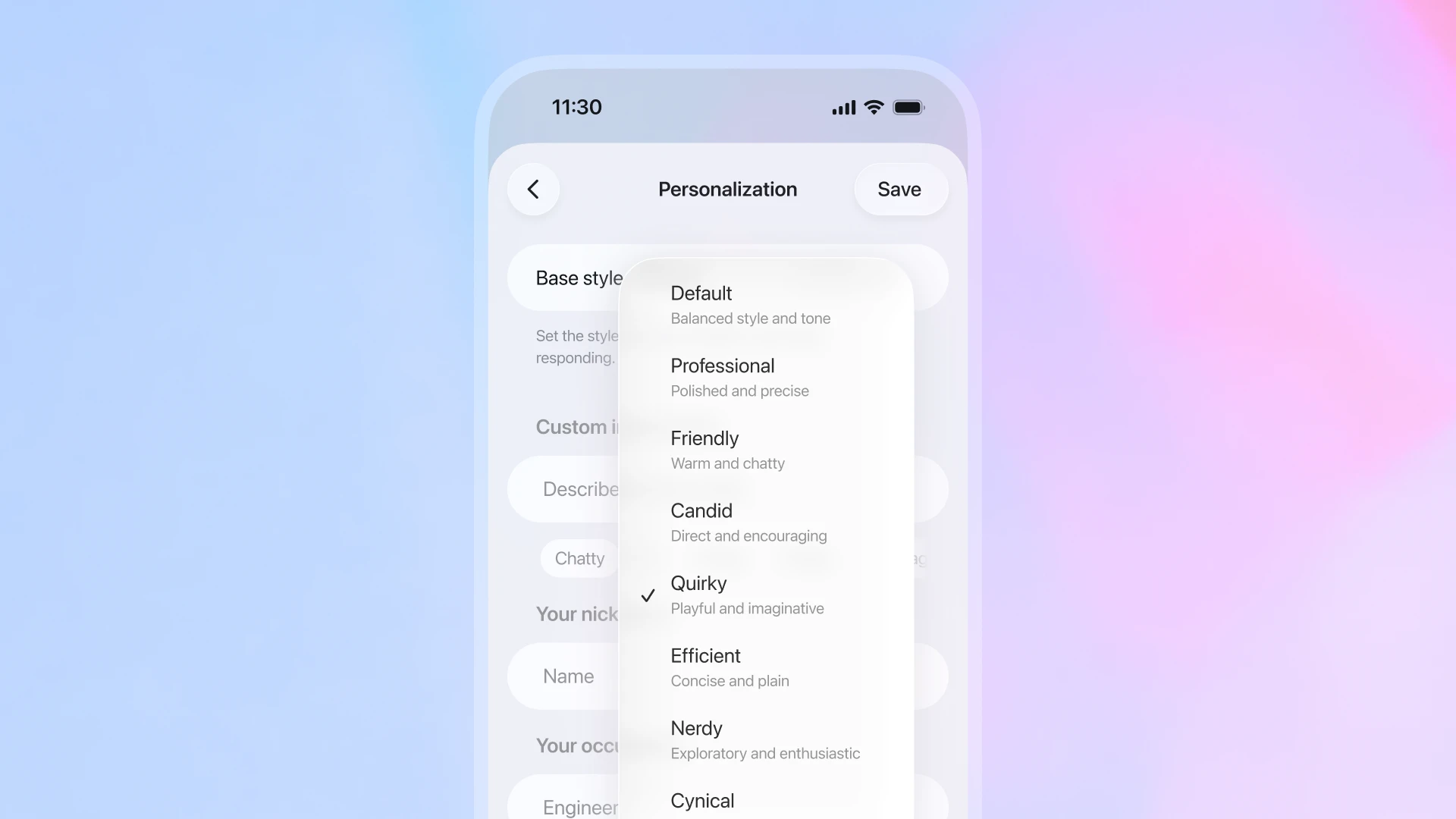
Interface móvel mostrando um ecrã de definições de 'Personalização'. O utilizador está a selecionar um estilo base para o tom e a voz do ChatGPT num menu suspenso. As opções listadas incluem: Predefinição (estilo e tom equilibrados), Profissional (educado e exato), Amigável (acolhedor e conversador), Sincero (direto e encorajador), Excêntrico (divertido e imaginativo, atualmente selecionado), Eficiente (conciso e simples), Nerd (explorador e entusiasta) e Cínico.

Estas definições de personalidade aplicam-se a todos os modelos. As opções originais Cínico e Nerd , que introduzimos no início deste ano, permanecerão disponíveis sem alterações no mesmo menu suspenso nas definições de personalização.

Para além destas predefinições, para utilizadores que desejam um controlo mais detalhado sobre a forma como o ChatGPT responde, estamos também a experimentar a capacidade de ajustar diretamente as características do ChatGPT nas definições de personalização—incluindo quão concisas, acolhedoras ou fáceis de ler são as suas respostas e a frequência com que utiliza emojis. O ChatGPT também pode oferecer-se proativamente para atualizar estas preferências durante as conversas quando perceber que estás a pedir um certo tom ou estilo, sem exigir que navegues nas definições. Podes ajustar ou remover qualquer uma destas preferências a qualquer momento.

Os estilos atualizados e as opções de tom estão a ser lançados hoje, e a capacidade de afinar características específicas começará a ser lançada gradualmente no final desta semana como uma experiência, começando com um número limitado de utilizadores. Ambos vão continuar a melhorar ao longo do tempo. Além disso, os modelos atualizados GPT‑5.1 são ainda melhores a seguir instruções personalizadas, proporcionando um controlo ainda mais preciso sobre o tom e o comportamento.

As atualizações que fizer nas definições de personalização agora entram em vigor em todos os chats de imediato, incluindo conversas em curso, para que a sua experiência se mantenha consistente. Antes, as alterações no estilo e tom base ou instruções personalizadas só se aplicavam a conversas iniciadas posteriormente.

**

As atualizações de hoje do GPT‑5.1 e as novas opções de personalização são um passo em direção a um ChatGPT que parece feito para si — mais inteligente, mais agradável de conversar e mais adaptável às suas preferências. No futuro, continuaremos a melhorar nestas dimensões — há muito mais por vir.


Autor

OpenAI