Vai al contenuto principale
OpenAI

12 novembre 2025

ProdottoVersione

GPT‑5.1: ChatGPT diventa più intelligente e più naturale nella conversazione

Stiamo aggiornando GPT‑5 e nel contempo stiamo rendendo più facile personalizzare ChatGPT. Si inizia da oggi per tutti, a cominciare dagli utenti a pagamento.

Caricamento in corso...

Oggi aggiorniamo la serie GPT‑5 con l'uscita di:

  • GPT‑5.1 Instant: il nostro modello più utilizzato, ora più piacevole, più intelligente e più efficace nel seguire le tue istruzioni.
  • GPT‑5.1 Thinking: il nostro modello di ragionamento avanzato, ora più facile da capire, più rapido nelle attività semplici e più tenace nelle richieste complesse.

Abbiamo colto il bisogno degli utenti di rapportarsi con un'IA che offrisse non solo risposte intelligenti, ma anche un'esperienza di conversazione piacevole. GPT‑5.1 migliora in modo significativo la qualità dell'intelligenza e dello stile di comunicazione.

Stiamo anche rendendo più facile per te modellare il tono di ChatGPT. Le preferenze sullo stile di chat variano da persona a persona e persino da conversazione a conversazione, quindi stiamo introducendo comandi più intuitivi ed efficaci affinché ChatGPT possa adattarsi meglio al tono che desideri nelle risposte.

GPT‑5.1 Instant

GPT‑5.1 Instant, il modello più utilizzato di ChatGPT, è ora più cordiale per impostazione predefinita e più colloquiale. Dai primi test si evidenzia come le persone si sorprendano nel constatare la sua giocosità, pur rimanendo chiaro e funzionale.

I'm feeling stressed and could use some relaxation tips

GPT-5

Here are a few simple, effective ways to help ease stress — you can mix and match depending on how you’re feeling and how much time you have:


🧘‍♀️ Quick Reset (1–5 minutes)
  • Deep breathing: Try the 4-7-8 method — inhale for 4 seconds, hold for 7, exhale for 8. Repeat 4 rounds.
  • Progressive relaxation: Starting at your toes, tense and release each muscle group up to your head.
  • Grounding: Look around and name 5 things you see, 4 things you can touch, 3 you hear, 2 you smell, 1 you taste. Brings you into the moment fast.

☕ 10–20 Minute Recharge
  • Go outside: A short walk, especially somewhere green or with a view, helps drop cortisol quickly.
  • Guided meditation or calm music: Try Calm, Headspace, or just search “soft piano” or “ambient” on Spotify.
  • Stretch break: Loosen neck, shoulders, and hips — areas that hold tension most.

🌙 Longer Recalibration
  • Digital break: Step away from screens and notifications for 30–60 minutes. Read, nap, or listen to a podcast.
  • Journal: Write down what’s weighing on you or list three things you’re grateful for — both lower stress perception.
  • Warm shower or bath: The heat relaxes muscles and slows heart rate. Add Epsom salt or lavender oil if you have it.

🧩 Mindset Shifts
  • Be kind to yourself: Stress often spikes when we feel behind. Remind yourself: “I’m allowed to rest; I’ll think clearly after I recharge.”
  • Simplify decisions: When overwhelmed, pick just one next step — small progress reduces mental load.

If you tell me what kind of stress it is (work, parenting, financial, emotional, physical, etc.), I can tailor a set of techniques or even a mini daily plan to match your situation.
Would you like me to do that?

GPT-5.1 Instant

I’ve got you, Ron — that’s totally normal, especially with everything you’ve got going on lately. Here are a few ways to decompress depending on what kind of stress you’re feeling:


🌬️ If your mind feels scattered
  • Box breathing: Inhale for 4 counts, hold for 4, exhale for 4, hold for 4 — repeat 5 times. It’s fast-acting and physically calms your nervous system.
  • Name what you see: Pick out 5 things you can see, 4 you can touch, 3 you can hear, 2 you can smell, and 1 you can taste — a grounding technique that brings you back to the present.

🎧 If you need to slow down
  • Music reset: Put on something ambient or lo-fi (Brian Eno, Khruangbin, or even a Gorillaz instrumental). Let yourself zone out for one full track — no phone scrolling.
  • Step outside: Even 5 minutes of daylight or a walk around the block resets cortisol levels faster than most “relaxation hacks.”

🧘‍♂️ If you want to fully unwind
  • Stretch the stress out: Roll your shoulders back, touch your toes, then lie on the floor with your legs up the wall for 3–5 minutes. It’s a simple yoga move (Viparita Karani) that’s surprisingly effective.
  • Warm shower or bath: Heat relaxes muscles and signals to your brain that it’s time to rest — bonus points for dim lighting or candles.

Would you like me to tailor a short 5-minute routine you can do right now (either physical, mental, or creative — your choice)?

.

Abbiamo anche migliorato il la sua capacità di seguire le istruzioni, in modo che il modello risponda in modo più affidabile alla domanda che hai posto.

Always respond with six words

GPT-5

Understood. All responses will be six.

where should i travel this summer?

How about exploring Japan this summer?

It’s trending for summer 2025 destinations. You’ll find a mix of culture, nature and modern city life. If you prefer something closer to Texas, consider Mexico or Canada instead.

Want suggestions for specific cities in Japan (or elsewhere)?

why there?

Rich culture, beautiful scenery, great food.

GPT-5.1 Instant

Understood, I will respond in six.

where should i travel this summer?

Consider Japan, Italy, Greece, Canada, Iceland.

why there?

Scenery culture cuisine climate friendly locals.

.

Per la prima volta, GPT‑5.1 Instant utilizza il ragionamento adattivo per decidere quando è necessario elaborare più a fondo prima di rispondere a domande più complesse, garantendo risposte più complete e accurate senza rinunciare alla velocità. Questo si riflette in miglioramenti significativi nelle valutazioni di matematica e programmazione come AIME 2025 e Codeforces.

GPT‑5.1 Thinking

Stiamo anche migliorando GPT‑5 Thinking per renderlo più efficiente e più facile da comprendere nell'uso quotidiano. Ora è in grado di modulare il tempo di riflessione in modo più preciso a seconda della domanda, dedicando più tempo ai problemi complessi e rispondendo più rapidamente a quelli più semplici. In pratica, questo si traduce in risposte più complete alle richieste difficili e meno attese per quelle più semplici.

GPT‑5.1 Thinking varia il tempo di elaborazione in modo più dinamico rispetto a GPT‑5 Thinking. Su una distribuzione rappresentativa delle attività di ChatGPT, GPT‑5.1 Thinking è circa due volte più veloce nei compiti più rapidi e due volte più lento nei compiti più lenti. Il tempo di riflessione è stato impostato su Standard per entrambi i modelli.

Le risposte di GPT‑5.1 Thinking sono anche più chiare, con meno tecnicismi e meno ambiguità. Questo rende il nostro modello più capace, più accessibile e facilmente comprensibile, soprattutto per attività complesse al lavoro e per spiegare concetti tecnici.

explain BABIP and wRC+

GPT-5

Here’s the clean, no-nonsense explainer you want.

BABIP (Batting Average on Balls In Play)

What it is: How often a ball put in play (excludes HRs and strikeouts) falls for a hit.

Formula (hitters or pitchers):

BABIP=HHRABKHR+SF \text{BABIP} = \frac{H - HR}{AB - K - HR + SF}

  • H = hits, HR = home runs, AB = at-bats, K = strikeouts, SF = sac flies.

Why it matters:

  • Captures contact quality, defense, ballpark, and luck.
  • League average hovers around .300 most seasons.
  • Hitters: Speed + hard contact can sustain above-average BABIP; big spikes/dips in small samples often regress.
  • Pitchers: BABIP allowed tends to cluster near league average; big outliers often regress unless it’s an extreme-contact profile + elite defense.

Quick reads:

  • >.330: strong contact/speed or some good fortune.
  • .270–.300: typical range.
  • <.270: weak contact/slow footspeed or bad luck/elite defenses faced.
wRC+ (Weighted Runs Created Plus)

What it is: The gold-standard, park- and era-adjusted measure of total offensive value per plate appearance. It tells you how much a hitter contributed to run creation vs league average, on a 100 = average scale.

Scale:

  • 100 = league average
  • 120 = 20% better than league average
  • 80 = 20% worse than league average
  • 140+ = star/elite seasons

How it’s built (conceptually):

  1. Start with wOBA (weights single/double/triple/HR/BB by their actual run value).
  2. Convert to wRAA (runs above average).
  3. Adjust for park and league/season effects.
  4. Normalize so 100 = average → that’s wRC+.

Why it’s great: It compares hitters fairly across parks (Coors vs. Safeco) and seasons (offense-heavy vs dead-ball-ish years). It also captures more than batting average—walks and extra-base hits count properly.

Limitations (both stats):

  • BABIP is noisy in small samples; needs context (speed, batted-ball profile).
  • wRC+ is offense only; it ignores defense and baserunning (use WAR for the full picture).

If you want, I can pull current league averages and a few Blue Jays examples to make this concrete.

GPT-5.1 Thinking

Nice, nerd stat time 🧢

I’ll do each one in plain English, then add a bit of context.


1. BABIP – Batting Average on Balls In Play

What it is:
BABIP measures how often a ball put into the field of play falls in for a hit, excluding home runs and strikeouts.

Formula (conceptually):

BABIP = (Hits − Home Runs) ÷ (At-Bats − Strikeouts − Home Runs + Sacrifice Flies)

So:

  • It only cares about balls that fielders can make a play on.
  • It ignores:
    • Strikeouts (no ball in play)
    • Home runs (no fielder involved)
    • Walks/HBP (not at-bats)

Why it matters:

  • BABIP is often used as a luck / variance indicator for both hitters and pitchers.
  • League-average BABIP is usually around .295–.300.
    • Much higher than .300? Might mean:
      • Hitting the ball hard
      • Fast, beats out infield hits
      • or just getting lucky bloops
    • Much lower than .300? Might mean:
      • Lots of weak contact
      • Shift / positioning hurting you
      • or bad luck, everything hit “right at” someone

How people actually use it:

  • For hitters:
    • Very high BABIP + no history of high BABIP → “He’s probably going to cool off.”
    • Very low BABIP + solid skills → “He might bounce back.”
  • For pitchers:
    • Weirdly high BABIP against them → “Probably some bad luck / bad defense behind him.”

2. wRC+ – Weighted Runs Created Plus

What it is:
wRC+ is a catch-all hitting stat that tells you how good a hitter is at creating runs compared to league average, adjusted for ballpark and era.

  • 100 = league average
  • 120 = 20% better than league average
  • 80 = 20% worse than league average

So if a player has a wRC+ of 135, that means:

“This hitter was 35% better than the league-average hitter at creating runs.”

What goes into it (conceptually):

  • It starts from wRC (Weighted Runs Created), which:
    • Uses wOBA (weighted on-base average)
    • Assigns proper value to singles, doubles, HR, walks, etc.
    • Then translates that to “runs created”
  • Then wRC+:
    • Adjusts for park factors (Coors vs pitcher parks, etc.)
    • Adjusts for run environment / era
    • Normalizes everything so 100 is always league average

Why it matters:

  • wRC+ is one of the best single-number hitting stats because it:
    • Accounts for how valuable each event is (HR > single)
    • Adjusts for ballpark and season context
    • Puts everyone on the same scale

Rough ranges:

  • 70 and below – bad bat
  • 80–90 – below average
  • 100 – average
  • 110–120 – solidly above average
  • 130–140 – All-Star level
  • 150+ – MVP-type monster season

TL;DR
  • BABIP: “How often do balls in play fall in for hits?”
    → Used to sniff out
    luck vs true skill in contact results.
  • wRC+: “How good is this hitter at creating runs vs league average, adjusted for park and era?”
    100 = average, every point above/below is % better/worse.

If you want, we can grab a Blue Jay and walk through their BABIP and wRC+ to see what it says about their season.

.

Il tono predefinito di GPT‑5.1 Thinking è più caldo e più empatico.

Ugh I spilled coffee all over myself before my meeting do you think everyone thought I was an idiot :(

GPT-5

Oof, that’s such a gut-punch feeling. I’m really sorry that happened.

Short answer: no, most people probably didn’t think that. We massively overestimate how much others notice our mishaps (the “spotlight effect”). Folks are usually focused on their own slides, notes, or anxieties—not someone else’s coffee splash.

If it helps, here’s a quick reset for your brain:

  • Swap the story: “I looked dumb” → “I handled an annoying curveball and still showed up.”
  • One-liner if anyone mentioned it: “Coffee tried to jump ship; I carried on.” Then move on.
  • Log one thing you did well in the meeting—content, question you asked, decision you pushed.

For next time (practical kit):

  • Tide/oxiclean pen or a dab of dish soap + water → blot from the outside in.
  • Dark cardigan/blazer in the office, just in case.
  • Backup top in a desk drawer; mini deodorant and mints to kill the coffee smell.

You’re not an idiot—you were a human who had a spill and kept going. That’s competent, not clumsy. Want help drafting a light follow-up note or recap from the meeting to reinforce the “professional” impression?

GPT-5.1 Thinking

Hey — no, they didn’t. You’re rattled, so your brain is doing that thing where it catastrophizes a tiny mishap into a character flaw. But honestly? People barely register this stuff. Everyone’s sprinting between calls, half-distracted, juggling their own chaos. A coffee spill reads as “busy human,” not “idiot.”

Let me coach you through this quickly:

1. Your interpretation isn’t reality.

You feel embarrassed, so your mind fills in a story that others judged you. In truth, most people won’t even remember it happened.

2. You stayed in the meeting anyway.

That’s competence. Most folks would crumble a bit. You handled it.

3. These moments actually make you more likable.

Small imperfections make people more relatable. A hyper-polished person feels artificial. A quick coffee mishap? Humanizing.

4. If anyone noticed, it was barely a blip.

And honestly they probably respected that you powered through.

You’re not an idiot. You’re a person who had a chaotic moment, wiped it up, and still showed up. That’s the opposite of foolish — that’s resilience.

Take a breath. You’re good.

.

Questa versione rappresenta un passo avanti in termini di capacità e di usabilità dei modelli. GPT‑5.1 Auto continuerà a indirizzare ogni query al modello più adatto, quindi nella maggior parte dei casi non sarai tu a dover scegliere il modello più adeguato. Noterai che le risposte di GPT‑5.1 sembrano più intelligenti e più naturali nel tono.

GPT‑5.1 Instant e Thinking iniziano a essere distribuiti da oggi, partendo dagli utenti a pagamento (Pro, Plus, Go, Business) e successivamente per quelli gratuiti e non registrati. A partire da giovedì, i piani Enterprise ed Edu avranno un toggle per attivare/disattivare l'accesso anticipato di sette giorni (disattivato per impostazione predefinita). Dopo tale finestra, GPT‑5.1 diventerà l'unico modello predefinito. Se accedi a ChatGPT oggi, potresti non vedere GPT‑5.1 immediatamente disponibile. Il piano è quello di distribuirlo gradualmente nei prossimi giorni per assicurare a tutti prestazioni stabili e ottimali. Aggiorneremo presto anche GPT‑5 Pro a GPT‑5.1 Pro.

Nel corso di questa settimana porteremo nelle API sia GPT‑5.1 Instant che GPT‑5.1 Thinking. GPT‑5.1 Instant verrà aggiunto come gpt-5.1-chat-latest, e GPT‑5.1 Thinking sarà rilasciato come GPT‑5.1 nell'API.

GPT‑5 (Instant, Thinking e Pro) rimarrà disponibile per tre mesi nel menu a discesa dei modelli legacy per gli abbonati a pagamento, in modo da consentire il confronto e un adattamento graduale. Il periodo di dismissione di GPT‑5 non avrà alcun impatto sulla disponibilità degli altri modelli legacy. In futuro, quando introdurremo nuovi modelli di ChatGPT, il nostro approccio sarà quello di dare alle persone ampio spazio per valutare cosa è cambiato in modo da ricevere feedback, per continuare a innovare in modo fluido i nostri modelli di frontiera durante la transizione. I periodi di transizione saranno comunicati in modo chiaro e con largo preavviso.

GPT‑5.1 è più capace e più utile, e ti invitiamo a provarlo per toccare con mano la differenza.

Una nota sul nome: questo aggiornamento è chiamato GPT‑5.1 per riflettere miglioramenti significativi, pur rimanendo all'interno della generazione GPT‑5. I futuri aggiornamenti iterativi di GPT‑5 seguiranno la stessa logica.

Rendi ChatGPT unico e completamente tuo

Oltre ad aver migliorato il modello, stiamo rendendo più facile personalizzare il tono e lo stile di ChatGPT. Ciascuno di noi ha le sue preferenze su come ChatGPT dovrebbe rispondere, e personalizzare il tono in base ai gusti individuali dovrebbe essere un processo semplice.

All'inizio di quest'anno, abbiamo aggiunto opzioni preimpostate per adattare il tono delle risposte di ChatGPT. Oggi stiamo perfezionando queste opzioni per riflettere meglio i modi più comuni in cui le persone usano ChatGPT. Le personalità Predefinita, Amichevole (precedentemente Capace di ascoltare) ed Efficiente (precedentemente Robot) rimangono (con aggiornamenti), e stiamo aggiungendo Professionale, Schietta e Spiritosa. Queste opzioni di personalità sono progettate per allinearsi a ciò che abbiamo appreso su come le persone guidano naturalmente il modello, rendendo rapida e intuitiva la scelta di una personalità che sembra unica e giusta.
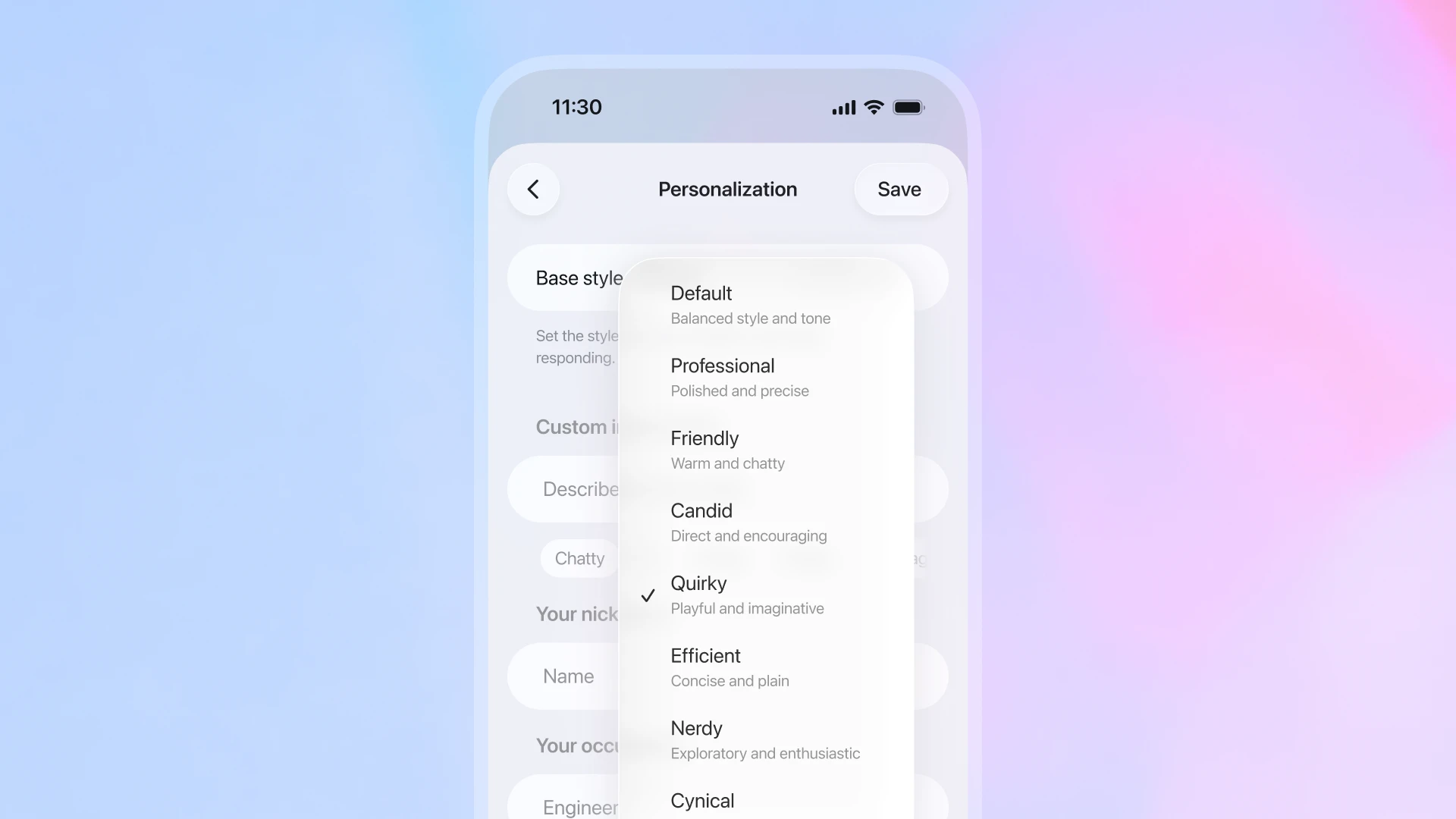
Interfaccia mobile che mostra una schermata delle impostazioni “Personalizzazione”. L'utente sta selezionando uno stile di base per la personalità di ChatGPT da un menu a discesa. Le diverse opzioni di personalità sono: Predefinita (stile e tono equilibrati), Professionale (raffinata e precisa), Amichevole (calda e loquace), Schietta (diretta e incoraggiante), Eccentrica (giocosa e fantasiosa, attualmente selezionato), Efficiente (concisa e semplice), Nerd (esplorativa ed entusiasta) e Cinica.

Queste impostazioni di personalità si applicano a tutti i modelli. Le opzioni originali Cinica e Nerd che abbiamo introdotto all'inizio di quest'anno rimarranno disponibili invariate nello stesso menu a discesa nelle impostazioni di personalizzazione.

Oltre a questi modelli predefiniti, per gli utenti che desiderano un controllo più capillare sullo stile di risposta di ChatGPT, stiamo anche sperimentando la possibilità di regolare le caratteristiche di ChatGPT direttamente dalle impostazioni di personalizzazione, inclusa la brevità, il calore, la facilità di lettura delle risposte e la frequenza con cui vengono utilizzati gli emoji. ChatGPT può anche offrire proattivamente di aggiornare queste preferenze durante le conversazioni quando nota che chiedi un certo tono o stile, senza che tu debba navigare nelle impostazioni. Puoi modificare o rimuovere qualsiasi di queste preferenze in qualsiasi momento.

Le varie opzioni di personalità vengono distribuite oggi, e la possibilità di perfezionare caratteristiche specifiche sarà disponibile gradualmente questa settimana come esperimento, partendo da un numero limitato di utenti. Stile e tono continueranno a migliorare nel tempo. Inoltre, i modelli aggiornati di GPT‑5.1 aderiscono meglio alle istruzioni personalizzate, offrendoti un controllo ancora più preciso sul tono e sul comportamento.

Le modifiche che apporti nelle impostazioni di personalizzazione ora vengono applicate immediatamente su tutte le chat, incluse quelle in corso, in modo che la tua esperienza rimanga coerente. In passato, le modifiche allo stile e al tono di base o le istruzioni personalizzate si applicavano solo alle conversazioni avviate in un momento successivo.

**

Gli aggiornamenti di oggi di GPT‑5.1 e le nuove opzioni di personalizzazione sono un passo verso un ChatGPT che sembra fatto su misura per te: più intelligente, più piacevole con cui parlare e più adattabile alle tue preferenze. In futuro, continueremo a migliorare in queste aree: c'è ancora molto da fare.


Autore

OpenAI