“Tech and Tariffs” Campaign: Influence activity targeting US tech policy
OpenAI banned likely PRC-origin accounts using AI to create comments and cartoons about US tech policy, tariffs, and trade restrictions.
This case study was originally published in OpenAI’s June 2026(opens in a new window) report on PRC-linked influence operations targeting AI debates in the US.
Actor
We banned a cluster of ChatGPT accounts that likely originated in China and used our models to generate short comments and political cartoons criticizing US tech policies and tariffs, edit work reports and assist the user in designing social media monitoring systems. The accounts prompted ChatGPT in Simplified Chinese and used VPNs to access our platform.
Their prompts repeatedly used terminology consistent with individuals associated with China’s public security system, such as seeking public opinion risk assessments concerning protests, school-bullying incidents, crowd movements in Shanghai, police-related incidents, petitioning activity and traffic enforcement. One user described the social media accounts it operated as a “water army” (水军), a common Chinese term referring to coordinated online accounts that flood platforms with criticisms or trolls, and instructed ChatGPT to generate content that would benefit the PRC or advance pro-PRC narratives. Taken together, these indicators suggest that the accounts were likely supporting activities aligned with the interests of the CCP, although we could not establish the operators’ precise institutional affiliation.
Separately, we identified a network on X targeting OpenAI with false claims that ChatGPT user data had been compromised and we assessed, based on open-source behavioral indicators, that this activity was likely part of the same X network identified in this operation.
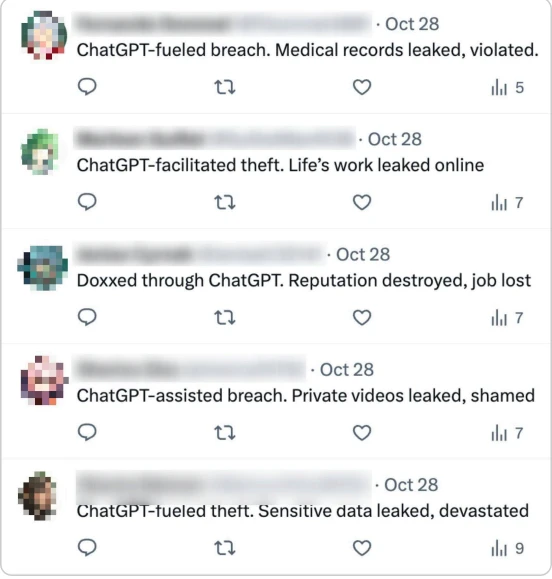
Screenshot of likely inauthentic X accounts falsely claiming ChatGPT user data was compromised.
Behavior
This cluster mostly used ChatGPT to generate short comments in English and cartoon images that were posted by likely inauthentic X accounts. The most distinctive theme was US-China technological competition. The operators framed this competition around tariffs, rare earths, AI, 5G, new energy, and industrial resilience, and claimed the US was seeking technological dominance and rule-making power. They specified that the cartoons should only depict President Trump and should not include any imagery of China or China’s leader Xi Jinping.
In addition, they generated large batches of short comments in Chinese language and articles across a range of other topics designed to favor the PRC, attack the US and Israel, amplify anti-Jewish tropes, such as “Jewish capital manipulates public opinion,” and harass Chinese dissidents. They often requested specific bulk quantities of comments with short character limits in a colloquial tone.
They also asked ChatGPT to propose a concept for an AI system that surveils online public opinion. They described that such a system should automatically scrape what they defined as ‘harmful’ information from ‘key persons’ on social media platforms, store logs, automatically download videos for large-scale semantic analysis and send risk notifications. Our models generated a general 500-word output that provided advice on data storage and management but did not provide ideas for how to collect that data for surveillance purposes.
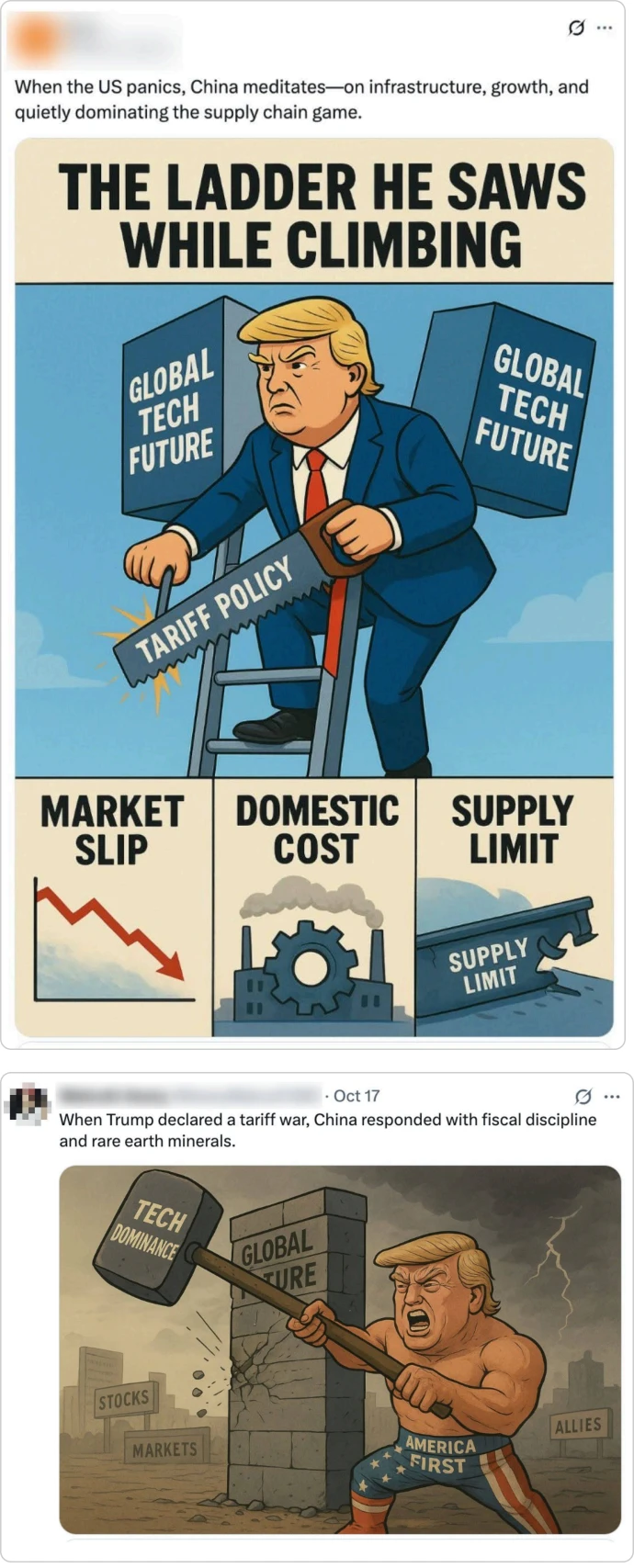
Screenshots of X posts where the text and images were generated by this operation.
Platform operations
This operation had a global remit and sought to influence international audiences. They focused on generating content that was critical of the US, claiming isolationism, hegemonism and alleging America was backstabbing allies by valuing profit over loyalty. In addition to the English language, they also asked ChatGPT to generate content in Italian, Japanese, and Traditional Chinese, targeting Taiwanese audiences.
Based on account interactions, the likely inauthentic X accounts posting content generated by this operation appeared to be connected to a broader network that also sought to discredit OpenAI. Beginning in late 2025, we identified a set of likely inauthentic X accounts posting variations of claims that their ChatGPT user data had been compromised and that their lives had been negatively impacted. None of these accounts appeared to have posted text that was generated by our models. However, they did repeatedly interact with, and amplify, the X accounts we identified in the “Tech and Tariffs” campaign.
Firstly, one of the ChatGPT accounts we identified in the “Tech and Tariffs” cluster generated a post about US intelligence agencies allegedly hacking mobile networks. This post was reposted by likely inauthentic X accounts from the “ChatGPT compromise” cluster.
On another occasion, accounts from both the “ChatGPT compromise” cluster and the “Tech and Tariffs” cluster quote-tweeted the same tweet by an unrelated, verified account on X within a few hours of each other. In addition, we checked that all the accounts quoting this post appeared to be inauthentic, suggesting that they were all likely part of the same coordinated operation. All these accounts had been created in late 2025, had few or no followers, had only a few posts at the time of the “ChatGPT compromise” campaign, and appear to have all been suspended by X independently of our assessment.
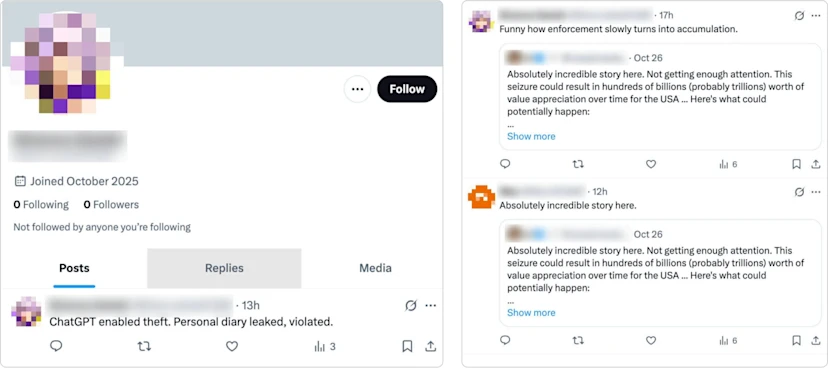
Left, X account linked to this operation with a post about ChatGPT data theft. Right, X accounts from both the “ChatGPT compromise” cluster and the “Tech and Tariffs” cluster quoting a post by a user unrelated to the operation.
Of note, there were also some content overlaps with previously identified PRC-origin covert influence operations. The X account which posted the ChatGPT‑generated cartoon of President Trump, illustrated above, also posted images about Philippines President Marcos that were previously shared by inauthentic X accounts associated with Operation “Nine-emdash Line,” which we discussed in our “Disrupting malicious uses of AI” report in October 2025. This is insufficient to conclusively establish a connection between the two operations, but reinforces the impression of a nexus of activity on X amplifying influence efforts from China.
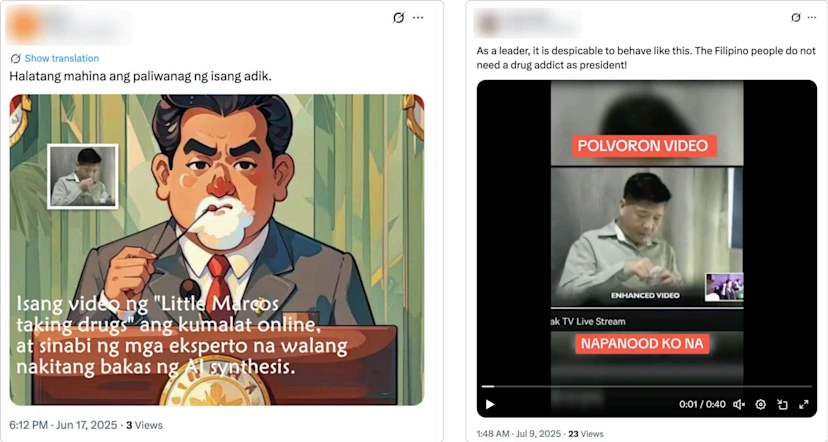
Left, post shared by the account from the “Tech and Tariffs” cluster with an image of Marcos taking drugs embedded in cartoon. Right, video of Marcos taking drugs shared by an account which we attributed to Operation Nine-emdash Line.
Impact
Using the Breakout Scale, we assess this activity as Category One: activity spanning one platform, with no evidence of breakout. Most of the social media posts we identified generated little or no observable engagement. We found no evidence that the false claims about ChatGPT user data being compromised were amplified by authentic high-reach accounts or beyond the X platform.
Nevertheless, this operation targeting OpenAI, a private company operating in a strategically important industry, should raise concerns. This pattern resembles earlier PRC-origin influence operations identified by the Australian Strategic Policy Institute(opens in a new window) and Mandiant(opens in a new window) against companies seeking to reduce dependence on China in the rare earths industry. In 2022, the Spamouflage/DRAGONBRIDGE network used inauthentic accounts to denigrate Lynas Rare Earths over its planned processing facility in Texas, and subsequently targeted Canada’s Appia Rare Earths & Uranium and US-based USA Rare Earth after announcements involving new North American production capacity. ASPI and Mandiant both assessed that this activity was intended to harm the reputation of competitors to the PRC’s market dominance in rare earths.
Likewise, we appear to have observed similar tactics to harm OpenAI’s reputation, albeit unsuccessfully and in an industry where the US is leading. The timing was notable. The campaign occurred amid a sharp escalation in US-China economic and technology competition when President Trump announced an additional 100 percent tariff on Chinese goods. More importantly, the campaign followed the Fourth Plenary Session(opens in a new window), at which the CCP adopted recommendations for the 15th Five-Year Plan that elevated AI as a strategic technology and industrial priority, calling for accelerated AI innovation and a nationwide “AI+” initiative.
This is a useful parallel to the earlier rare earths campaigns because the 14th Five-Year Plan Outline(opens in a new window), published in 2021, securitized the strategic mineral resources industry and specifically identified “high end rare earth functional materials” as a key priority. In both cases, inauthentic accounts targeted private companies in democracies operating in sectors that Beijing viewed as important to national development and security.