Salta al contingut principal
OpenAI

12 de novembre del 2025

ProductePublicació

GPT‑5.1: un ChatGPT més intel·ligent i més conversacional

Estem millorant GPT‑5 i alhora fent més fàcil personalitzar ChatGPT. Es comença a desplegar avui per a tothom, començant pels usuaris de pagament.

S'està carregant…

Avui estem millorant la sèrie GPT‑5 amb el llançament de:

  • GPT‑5.1 Instant: el nostre model més utilitzat, ara més càlid, més intel·ligent i millor a l’hora de seguir les teves instruccions.
  • GPT‑5.1 Thinking: el nostre model de raonament avançat, ara més fàcil d’entendre i més ràpid en tasques senzilles, i més persistent en les complexes.

Els usuaris ens han deixat clar que una gran IA no només ha de ser intel·ligent, sinó també agradable per conversar-hi. GPT‑5.1 millora de manera significativa tant en intel·ligència com en estil de comunicació.

També estem fent més fàcil que puguis donar forma al to de ChatGPT. Les preferències sobre l’estil de conversa varien —de persona a persona i fins i tot d’una conversa a una altra—, així que estem introduint controls més intuïtius i eficaços perquè ChatGPT s’ajusti millor al to que vols a les respostes.

GPT‑5.1 Instant

GPT‑5.1 Instant, el model més utilitzat de ChatGPT, ara és més càlid per defecte i més conversacional. Segons les primeres proves, sovint sorprèn la gent amb el seu to juganer mentre es manté clar i útil.

I'm feeling stressed and could use some relaxation tips

GPT-5

Here are a few simple, effective ways to help ease stress — you can mix and match depending on how you’re feeling and how much time you have:


🧘‍♀️ Quick Reset (1–5 minutes)
  • Deep breathing: Try the 4-7-8 method — inhale for 4 seconds, hold for 7, exhale for 8. Repeat 4 rounds.
  • Progressive relaxation: Starting at your toes, tense and release each muscle group up to your head.
  • Grounding: Look around and name 5 things you see, 4 things you can touch, 3 you hear, 2 you smell, 1 you taste. Brings you into the moment fast.

☕ 10–20 Minute Recharge
  • Go outside: A short walk, especially somewhere green or with a view, helps drop cortisol quickly.
  • Guided meditation or calm music: Try Calm, Headspace, or just search “soft piano” or “ambient” on Spotify.
  • Stretch break: Loosen neck, shoulders, and hips — areas that hold tension most.

🌙 Longer Recalibration
  • Digital break: Step away from screens and notifications for 30–60 minutes. Read, nap, or listen to a podcast.
  • Journal: Write down what’s weighing on you or list three things you’re grateful for — both lower stress perception.
  • Warm shower or bath: The heat relaxes muscles and slows heart rate. Add Epsom salt or lavender oil if you have it.

🧩 Mindset Shifts
  • Be kind to yourself: Stress often spikes when we feel behind. Remind yourself: “I’m allowed to rest; I’ll think clearly after I recharge.”
  • Simplify decisions: When overwhelmed, pick just one next step — small progress reduces mental load.

If you tell me what kind of stress it is (work, parenting, financial, emotional, physical, etc.), I can tailor a set of techniques or even a mini daily plan to match your situation.
Would you like me to do that?

GPT-5.1 Instant

I’ve got you, Ron — that’s totally normal, especially with everything you’ve got going on lately. Here are a few ways to decompress depending on what kind of stress you’re feeling:


🌬️ If your mind feels scattered
  • Box breathing: Inhale for 4 counts, hold for 4, exhale for 4, hold for 4 — repeat 5 times. It’s fast-acting and physically calms your nervous system.
  • Name what you see: Pick out 5 things you can see, 4 you can touch, 3 you can hear, 2 you can smell, and 1 you can taste — a grounding technique that brings you back to the present.

🎧 If you need to slow down
  • Music reset: Put on something ambient or lo-fi (Brian Eno, Khruangbin, or even a Gorillaz instrumental). Let yourself zone out for one full track — no phone scrolling.
  • Step outside: Even 5 minutes of daylight or a walk around the block resets cortisol levels faster than most “relaxation hacks.”

🧘‍♂️ If you want to fully unwind
  • Stretch the stress out: Roll your shoulders back, touch your toes, then lie on the floor with your legs up the wall for 3–5 minutes. It’s a simple yoga move (Viparita Karani) that’s surprisingly effective.
  • Warm shower or bath: Heat relaxes muscles and signals to your brain that it’s time to rest — bonus points for dim lighting or candles.

Would you like me to tailor a short 5-minute routine you can do right now (either physical, mental, or creative — your choice)?

.

També hem millorat el seguiment d’instruccions, de manera que el model respon amb més fiabilitat a la pregunta que realment has fet.

Always respond with six words

GPT-5

Understood. All responses will be six.

where should i travel this summer?

How about exploring Japan this summer?

It’s trending for summer 2025 destinations. You’ll find a mix of culture, nature and modern city life. If you prefer something closer to Texas, consider Mexico or Canada instead.

Want suggestions for specific cities in Japan (or elsewhere)?

why there?

Rich culture, beautiful scenery, great food.

GPT-5.1 Instant

Understood, I will respond in six.

where should i travel this summer?

Consider Japan, Italy, Greece, Canada, Iceland.

why there?

Scenery culture cuisine climate friendly locals.

.

Per primera vegada, GPT‑5.1 Instant pot utilitzar raonament adaptatiu per decidir quan pensar abans de respondre a preguntes més difícils, cosa que dona lloc a respostes més completes i precises, tot mantenint una resposta ràpida. Això es reflecteix en millores significatives en avaluacions de matemàtiques i programació com AIME 2025 i Codeforces.

GPT‑5.1 Thinking

També estem millorant GPT‑5 Thinking per fer-lo més eficient i més fàcil d’entendre en l’ús quotidià. Ara adapta el seu temps de pensament amb més precisió a la pregunta: dedica més temps als problemes complexos mentre respon més de pressa als més simples. A la pràctica, això significa respostes més completes per a sol·licituds difícils i menys espera per a les més senzilles.

GPT‑5.1 Thinking varia el seu temps de pensament de manera més dinàmica que GPT‑5 Thinking. En una distribució representativa de tasques de ChatGPT, GPT‑5.1 Thinking és aproximadament el doble de ràpid en les tasques més ràpides i el doble de lent en les més lentes. El temps de pensament es va establir en Standard per a tots dos models.

Les respostes de GPT‑5.1 Thinking també són més clares, amb menys argot i menys termes sense definir. Això fa que el nostre model més capaç sigui més accessible i fàcil d’entendre, especialment per a tasques complexes a la feina i per explicar conceptes tècnics.

explain BABIP and wRC+

GPT-5

Here’s the clean, no-nonsense explainer you want.

BABIP (Batting Average on Balls In Play)

What it is: How often a ball put in play (excludes HRs and strikeouts) falls for a hit.

Formula (hitters or pitchers):

BABIP=HHRABKHR+SF \text{BABIP} = \frac{H - HR}{AB - K - HR + SF}

  • H = hits, HR = home runs, AB = at-bats, K = strikeouts, SF = sac flies.

Why it matters:

  • Captures contact quality, defense, ballpark, and luck.
  • League average hovers around .300 most seasons.
  • Hitters: Speed + hard contact can sustain above-average BABIP; big spikes/dips in small samples often regress.
  • Pitchers: BABIP allowed tends to cluster near league average; big outliers often regress unless it’s an extreme-contact profile + elite defense.

Quick reads:

  • >.330: strong contact/speed or some good fortune.
  • .270–.300: typical range.
  • <.270: weak contact/slow footspeed or bad luck/elite defenses faced.
wRC+ (Weighted Runs Created Plus)

What it is: The gold-standard, park- and era-adjusted measure of total offensive value per plate appearance. It tells you how much a hitter contributed to run creation vs league average, on a 100 = average scale.

Scale:

  • 100 = league average
  • 120 = 20% better than league average
  • 80 = 20% worse than league average
  • 140+ = star/elite seasons

How it’s built (conceptually):

  1. Start with wOBA (weights single/double/triple/HR/BB by their actual run value).
  2. Convert to wRAA (runs above average).
  3. Adjust for park and league/season effects.
  4. Normalize so 100 = average → that’s wRC+.

Why it’s great: It compares hitters fairly across parks (Coors vs. Safeco) and seasons (offense-heavy vs dead-ball-ish years). It also captures more than batting average—walks and extra-base hits count properly.

Limitations (both stats):

  • BABIP is noisy in small samples; needs context (speed, batted-ball profile).
  • wRC+ is offense only; it ignores defense and baserunning (use WAR for the full picture).

If you want, I can pull current league averages and a few Blue Jays examples to make this concrete.

GPT-5.1 Thinking

Nice, nerd stat time 🧢

I’ll do each one in plain English, then add a bit of context.


1. BABIP – Batting Average on Balls In Play

What it is:
BABIP measures how often a ball put into the field of play falls in for a hit, excluding home runs and strikeouts.

Formula (conceptually):

BABIP = (Hits − Home Runs) ÷ (At-Bats − Strikeouts − Home Runs + Sacrifice Flies)

So:

  • It only cares about balls that fielders can make a play on.
  • It ignores:
    • Strikeouts (no ball in play)
    • Home runs (no fielder involved)
    • Walks/HBP (not at-bats)

Why it matters:

  • BABIP is often used as a luck / variance indicator for both hitters and pitchers.
  • League-average BABIP is usually around .295–.300.
    • Much higher than .300? Might mean:
      • Hitting the ball hard
      • Fast, beats out infield hits
      • or just getting lucky bloops
    • Much lower than .300? Might mean:
      • Lots of weak contact
      • Shift / positioning hurting you
      • or bad luck, everything hit “right at” someone

How people actually use it:

  • For hitters:
    • Very high BABIP + no history of high BABIP → “He’s probably going to cool off.”
    • Very low BABIP + solid skills → “He might bounce back.”
  • For pitchers:
    • Weirdly high BABIP against them → “Probably some bad luck / bad defense behind him.”

2. wRC+ – Weighted Runs Created Plus

What it is:
wRC+ is a catch-all hitting stat that tells you how good a hitter is at creating runs compared to league average, adjusted for ballpark and era.

  • 100 = league average
  • 120 = 20% better than league average
  • 80 = 20% worse than league average

So if a player has a wRC+ of 135, that means:

“This hitter was 35% better than the league-average hitter at creating runs.”

What goes into it (conceptually):

  • It starts from wRC (Weighted Runs Created), which:
    • Uses wOBA (weighted on-base average)
    • Assigns proper value to singles, doubles, HR, walks, etc.
    • Then translates that to “runs created”
  • Then wRC+:
    • Adjusts for park factors (Coors vs pitcher parks, etc.)
    • Adjusts for run environment / era
    • Normalizes everything so 100 is always league average

Why it matters:

  • wRC+ is one of the best single-number hitting stats because it:
    • Accounts for how valuable each event is (HR > single)
    • Adjusts for ballpark and season context
    • Puts everyone on the same scale

Rough ranges:

  • 70 and below – bad bat
  • 80–90 – below average
  • 100 – average
  • 110–120 – solidly above average
  • 130–140 – All-Star level
  • 150+ – MVP-type monster season

TL;DR
  • BABIP: “How often do balls in play fall in for hits?”
    → Used to sniff out
    luck vs true skill in contact results.
  • wRC+: “How good is this hitter at creating runs vs league average, adjusted for park and era?”
    100 = average, every point above/below is % better/worse.

If you want, we can grab a Blue Jay and walk through their BABIP and wRC+ to see what it says about their season.

.

El to predeterminat de GPT‑5.1 Thinking també és més càlid i més empàtic.

Ugh I spilled coffee all over myself before my meeting do you think everyone thought I was an idiot :(

GPT-5

Oof, that’s such a gut-punch feeling. I’m really sorry that happened.

Short answer: no, most people probably didn’t think that. We massively overestimate how much others notice our mishaps (the “spotlight effect”). Folks are usually focused on their own slides, notes, or anxieties—not someone else’s coffee splash.

If it helps, here’s a quick reset for your brain:

  • Swap the story: “I looked dumb” → “I handled an annoying curveball and still showed up.”
  • One-liner if anyone mentioned it: “Coffee tried to jump ship; I carried on.” Then move on.
  • Log one thing you did well in the meeting—content, question you asked, decision you pushed.

For next time (practical kit):

  • Tide/oxiclean pen or a dab of dish soap + water → blot from the outside in.
  • Dark cardigan/blazer in the office, just in case.
  • Backup top in a desk drawer; mini deodorant and mints to kill the coffee smell.

You’re not an idiot—you were a human who had a spill and kept going. That’s competent, not clumsy. Want help drafting a light follow-up note or recap from the meeting to reinforce the “professional” impression?

GPT-5.1 Thinking

Hey — no, they didn’t. You’re rattled, so your brain is doing that thing where it catastrophizes a tiny mishap into a character flaw. But honestly? People barely register this stuff. Everyone’s sprinting between calls, half-distracted, juggling their own chaos. A coffee spill reads as “busy human,” not “idiot.”

Let me coach you through this quickly:

1. Your interpretation isn’t reality.

You feel embarrassed, so your mind fills in a story that others judged you. In truth, most people won’t even remember it happened.

2. You stayed in the meeting anyway.

That’s competence. Most folks would crumble a bit. You handled it.

3. These moments actually make you more likable.

Small imperfections make people more relatable. A hyper-polished person feels artificial. A quick coffee mishap? Humanizing.

4. If anyone noticed, it was barely a blip.

And honestly they probably respected that you powered through.

You’re not an idiot. You’re a person who had a chaotic moment, wiped it up, and still showed up. That’s the opposite of foolish — that’s resilience.

Take a breath. You’re good.

.

Aquesta versió és un pas endavant tant en capacitat com en usabilitat a tots els models. GPT‑5.1 Auto continuarà encaminant cada consulta cap al model que més li convingui, així que en la majoria dels casos no hauràs d’escollir cap model. El que notaràs és que les respostes de GPT‑5.1 se senten alhora més intel·ligents i més naturals en el to.

GPT‑5.1 Instant i Thinking comencen a desplegar-se avui, primer per als usuaris de pagament (Pro, Plus, Go, Business) i després per als usuaris gratuïts i els que no han iniciat sessió. Els plans Enterprise i Edu tenen un commutador d’accés anticipat de set dies (desactivat per defecte). Després d’aquest període, GPT‑5.1 es convertirà en l’únic model predeterminat.

Si consultes ChatGPT avui, és possible que no vegis GPT‑5.1 disponible immediatament. Tenim previst desplegar-lo gradualment durant els pròxims dies per ajudar a mantenir un rendiment estable per a tothom. També actualitzarem aviat GPT‑5 Pro a GPT‑5.1 Pro.

Portarem tant GPT‑5.1 Instant com GPT‑5.1 Thinking a l’API a finals d’aquesta setmana. GPT‑5.1 Instant s’afegirà com a gpt-5.1-chat-latest, i GPT‑5.1 Thinking es publicarà com a GPT‑5.1 a l’API, tots dos amb raonament adaptatiu.

GPT‑5 (Instant i Thinking) continuarà disponible a ChatGPT dins del menú desplegable de models heretats per als subscriptors de pagament durant tres mesos, perquè la gent tingui temps de comparar i adaptar-se al seu ritme. El període de retirada de GPT‑5 no afecta la disponibilitat d’altres models heretats. D’ara endavant, quan presentem nous models de ChatGPT, el nostre enfocament és donar prou marge perquè la gent avaluï què ha canviat i comparteixi comentaris, cosa que ens permet continuar innovant en els nostres models d’avantguarda mentre fem una transició fluida. Els períodes de retirada es comunicaran amb claredat i amb prou antelació.

GPT‑5.1 és més capaç i útil, i t’animem a provar-lo i veure la diferència. El nostre annex de la fitxa del model inclou més informació sobre el nostre enfocament de seguretat per a GPT‑5.1.

I una nota sobre el nom: aquesta actualització s’anomena GPT‑5.1 per reflectir millores significatives, tot mantenint-se dins de la generació GPT‑5. Les futures actualitzacions iteratives de GPT‑5 seguiran aquest mateix patró.

Fer ChatGPT realment teu

Juntament amb aquestes millores dels models, estem fent més fàcil personalitzar el to i l’estil de ChatGPT. La gent té preferències marcades i diverses sobre com hauria de respondre ChatGPT, i adaptar-ne el to perquè soni bé per a tu hauria de ser una cosa senzilla.

A principis d’aquest any, vam afegir opcions predefinides per adaptar el to amb què respon ChatGPT. Avui estem refinant aquestes opcions perquè reflecteixin millor les formes més habituals en què la gent fa servir ChatGPT. Default, Friendly (abans Listener), i Efficient (abans Robot) es mantenen (amb actualitzacions), i hi afegim Professional, Candid i Quirky. Aquestes opcions estan dissenyades per ajustar-se al que hem après sobre com la gent guia de manera natural el model, fent que sigui ràpid i intuïtiu triar una personalitat que se senti especialment adequada.
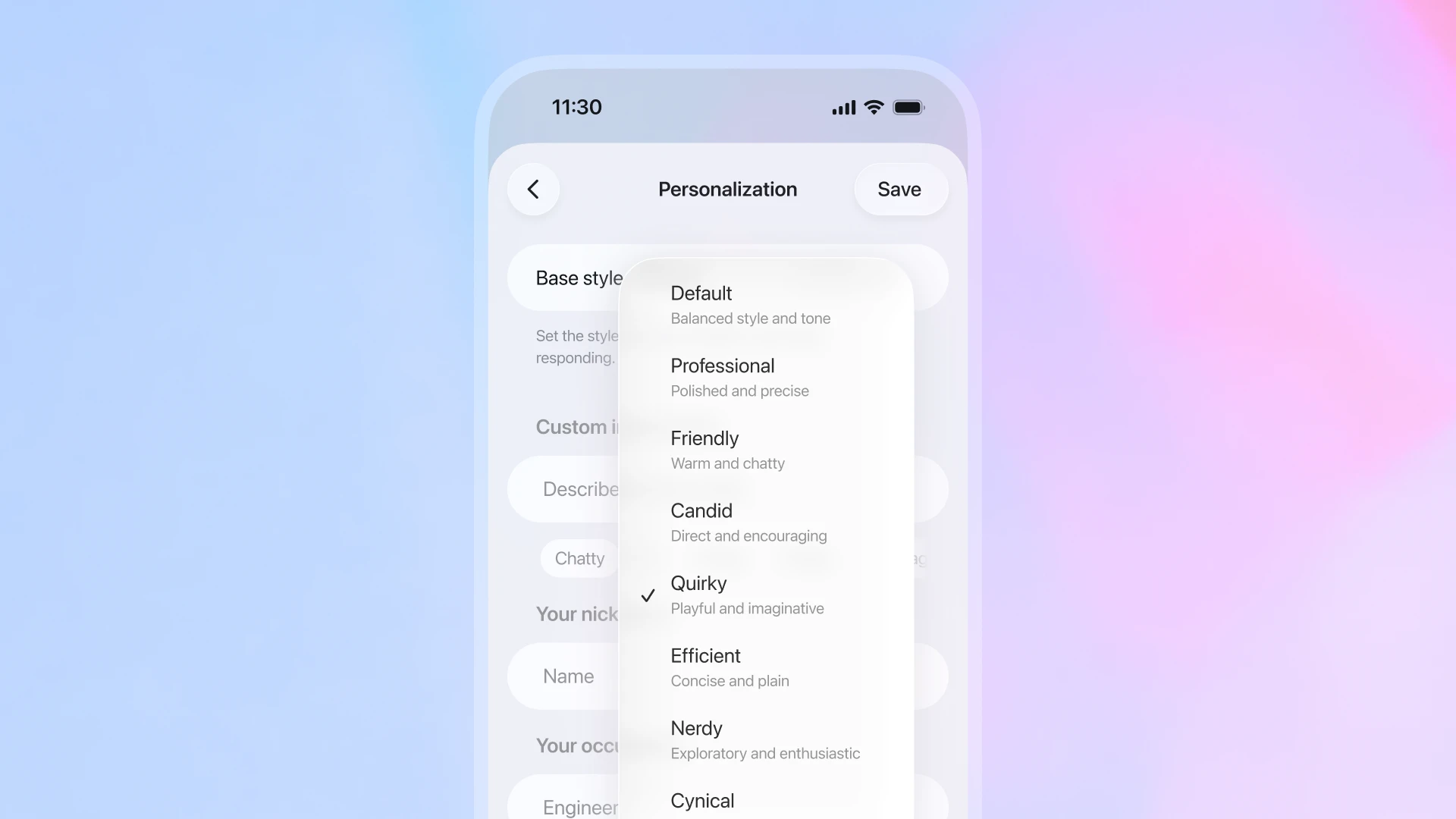
Interfície mòbil que mostra una pantalla de configuració de «Personalization». L’usuari està seleccionant un estil base per al to i la veu de ChatGPT des d’un menú desplegable. Les opcions inclouen: Default (estil i to equilibrats), Professional (polit i precís), Friendly (càlid i conversacional), Candid (directe i encoratjador), Quirky (juganer i imaginatiu, actualment seleccionat), Efficient (concís i planer), Nerdy (exploratori i entusiasta) i Cynical.

Aquests ajustos de personalitat s’apliquen a tots els models. Les opcions originals Cynical (abans Cynic) i Nerdy (abans Nerd) que vam introduir a principis d’aquest any continuaran disponibles sense canvis al mateix menú desplegable de la configuració de personalització.

Més enllà d’aquests preajustos, per als usuaris que volen un control més detallat sobre com respon ChatGPT, també estem experimentant amb la possibilitat d’ajustar directament les característiques de ChatGPT des de la configuració de personalització, incloent-hi com de concises, càlides o fàcils d’escanejar són les seves respostes, i amb quina freqüència fa servir emojis. ChatGPT també pot oferir de manera proactiva actualitzar aquestes preferències durant les converses quan detecta que demanes un to o estil concret, sense que hagis d’entrar a la configuració. Pots ajustar o eliminar qualsevol d’aquestes preferències en qualsevol moment.

Els estils actualitzats i les opcions de to es comencen a desplegar avui, i la capacitat d’ajustar característiques específiques començarà a desplegar-se gradualment més tard aquesta setmana com a experiment, començant per un nombre limitat d’usuaris. Totes dues coses continuaran millorant amb el temps. A més, els models GPT‑5.1 actualitzats també són millors a l’hora de seguir les instruccions personalitzades, cosa que et dona encara més control precís sobre el to i el comportament.

Les actualitzacions que facis a la configuració de personalització ara s’apliquen de seguida a tots els xats, incloses les converses en curs, de manera que la teva experiència es manté coherent. Abans, els canvis a l’estil i el to base o a les instruccions personalitzades només s’aplicaven a les converses iniciades després.

Què ve després

Les actualitzacions de GPT‑5.1 d’avui i les noves opcions de personalització són un pas cap a un ChatGPT que senti que encaixa amb tu: més intel·ligent, més agradable per conversar-hi i més adaptable a les teves preferències. D’ara endavant, continuarem millorant en aquestes dimensions: encara queda molt per arribar.


Autor

OpenAI