Przejdź do treści głównej
OpenAI

12 listopada 2025

ProduktWersja

GPT‑5.1: Inteligentniejszy, bardziej rozmowny ChatGPT

Ulepszyliśmy model GPT‑5, a jednocześnie uprościliśmy personalizację ChatGPT. Model zaczynamy udostępniać już dziś, zaczynając od użytkowników płatnych planów.

Ładowanie…

Nowa, ulepszona wersja GPT‑5:

  • GPT‑5.1 Instant: nasz najczęściej używany model jest teraz cieplejszy, bardziej inteligentny i lepiej wykonuje polecenia.
  • GPT‑5.1 Thinking: nasz zaawansowany model rozumuje teraz sprawniej i szybciej podczas wykonywania prostych zadaniach, a przy złożonych zapytaniach wytrwalej szuka odpowiedzi.

Nasi użytkownicy jasno stwierdzili, że świetna sztuczna inteligencja powinna być nie tylko inteligentna, ale także przyjemna w rozmowie. Dlatego w GPT‑5.1 znacząco ulepszyliśmy inteligencję oraz styl komunikacji.

Łatwiej teraz jest także kształtować ton ChatGPT. Preferencje dotyczące stylu czatu różnią się zależnie od osoby, jak i od danej konwersacji, dlatego wprowadziliśmy bardziej intuicyjne i skuteczne mechanizmy sterujące, aby ChatGPT lepiej dobierał oczekiwany ton odpowiedzi.

GPT‑5.1 Instant

Najczęściej używany model GPT‑5.1 Instant jest teraz domyślnie cieplejszy i bardziej rozmowny. Nasze testy wykazały, że często zaskakuje swoją zabawnością, nie tracąc nic na konkretności i użyteczności przekazywanych informacji.

I'm feeling stressed and could use some relaxation tips

GPT-5

Here are a few simple, effective ways to help ease stress — you can mix and match depending on how you’re feeling and how much time you have:


🧘‍♀️ Quick Reset (1–5 minutes)
  • Deep breathing: Try the 4-7-8 method — inhale for 4 seconds, hold for 7, exhale for 8. Repeat 4 rounds.
  • Progressive relaxation: Starting at your toes, tense and release each muscle group up to your head.
  • Grounding: Look around and name 5 things you see, 4 things you can touch, 3 you hear, 2 you smell, 1 you taste. Brings you into the moment fast.

☕ 10–20 Minute Recharge
  • Go outside: A short walk, especially somewhere green or with a view, helps drop cortisol quickly.
  • Guided meditation or calm music: Try Calm, Headspace, or just search “soft piano” or “ambient” on Spotify.
  • Stretch break: Loosen neck, shoulders, and hips — areas that hold tension most.

🌙 Longer Recalibration
  • Digital break: Step away from screens and notifications for 30–60 minutes. Read, nap, or listen to a podcast.
  • Journal: Write down what’s weighing on you or list three things you’re grateful for — both lower stress perception.
  • Warm shower or bath: The heat relaxes muscles and slows heart rate. Add Epsom salt or lavender oil if you have it.

🧩 Mindset Shifts
  • Be kind to yourself: Stress often spikes when we feel behind. Remind yourself: “I’m allowed to rest; I’ll think clearly after I recharge.”
  • Simplify decisions: When overwhelmed, pick just one next step — small progress reduces mental load.

If you tell me what kind of stress it is (work, parenting, financial, emotional, physical, etc.), I can tailor a set of techniques or even a mini daily plan to match your situation.
Would you like me to do that?

GPT-5.1 Instant

I’ve got you, Ron — that’s totally normal, especially with everything you’ve got going on lately. Here are a few ways to decompress depending on what kind of stress you’re feeling:


🌬️ If your mind feels scattered
  • Box breathing: Inhale for 4 counts, hold for 4, exhale for 4, hold for 4 — repeat 5 times. It’s fast-acting and physically calms your nervous system.
  • Name what you see: Pick out 5 things you can see, 4 you can touch, 3 you can hear, 2 you can smell, and 1 you can taste — a grounding technique that brings you back to the present.

🎧 If you need to slow down
  • Music reset: Put on something ambient or lo-fi (Brian Eno, Khruangbin, or even a Gorillaz instrumental). Let yourself zone out for one full track — no phone scrolling.
  • Step outside: Even 5 minutes of daylight or a walk around the block resets cortisol levels faster than most “relaxation hacks.”

🧘‍♂️ If you want to fully unwind
  • Stretch the stress out: Roll your shoulders back, touch your toes, then lie on the floor with your legs up the wall for 3–5 minutes. It’s a simple yoga move (Viparita Karani) that’s surprisingly effective.
  • Warm shower or bath: Heat relaxes muscles and signals to your brain that it’s time to rest — bonus points for dim lighting or candles.

Would you like me to tailor a short 5-minute routine you can do right now (either physical, mental, or creative — your choice)?

.

Ulepszyliśmy również funkcje wykonywania instrukcji, dzięki czemu model precyzyjniej odpowiada na zadane pytania.

Always respond with six words

GPT-5

Understood. All responses will be six.

where should i travel this summer?

How about exploring Japan this summer?

It’s trending for summer 2025 destinations. You’ll find a mix of culture, nature and modern city life. If you prefer something closer to Texas, consider Mexico or Canada instead.

Want suggestions for specific cities in Japan (or elsewhere)?

why there?

Rich culture, beautiful scenery, great food.

GPT-5.1 Instant

Understood, I will respond in six.

where should i travel this summer?

Consider Japan, Italy, Greece, Canada, Iceland.

why there?

Scenery culture cuisine climate friendly locals.

.

Po raz pierwszy GPT‑5.1 Instant może wykorzystać funkcje adaptacyjnego rozumowania, aby zdecydować, kiedy musi myśleć, zanim odpowie na trudniejsze pytania, co zapewnia bardziej szczegółowe, a jednocześnie szybkie uzyskiwanie informacji. Widać to w znacząco lepszych wynikach uzyskanych w testach z matematyki i kodowania, takich jak AIME 2025 i Codeforces.

GPT‑5.1 Thinking

Ulepszyliśmy również model GPT‑5 Thinking, który teraz jest bardziej wydajny i łatwiejszy do zrozumienia w codziennym użytkowaniu. Lepiej dostosowuje on czas myślenia do pytania i dłużej skupia się na złożonych problemach, a szybciej reaguje na prostsze. W praktyce oznacza to bardziej szczegółowe odpowiedzi na trudne zapytania i krótszy czas reakcji na te prostsze.

GPT‑5.1 Thinking dostosowuje czas myślenia bardziej dynamicznie niż GPT‑5 Thinking. W reprezentatywnym zestawie zadań model GPT‑5.1 Thinking działa mniej więcej dwa razy szybciej w przypadku najszybszych zadań i dwa razy wolniej w przypadku najwolniejszych zadań. W obu modelach ustawiono Standardowy czas myślenia.

Odpowiedzi GPT‑5.1 Thinking są również bardziej klarowne, zawierają mniej żargonu i niejasnych określeń. Więc nasz najbardziej zaawansowany model jest bardziej przystępny i łatwiejszy do zrozumienia, szczególnie podczas opisywania skomplikowanych zadań i wyjaśniania pojęć technicznych.

explain BABIP and wRC+

GPT-5

Here’s the clean, no-nonsense explainer you want.

BABIP (Batting Average on Balls In Play)

What it is: How often a ball put in play (excludes HRs and strikeouts) falls for a hit.

Formula (hitters or pitchers):

BABIP=HHRABKHR+SF \text{BABIP} = \frac{H - HR}{AB - K - HR + SF}

  • H = hits, HR = home runs, AB = at-bats, K = strikeouts, SF = sac flies.

Why it matters:

  • Captures contact quality, defense, ballpark, and luck.
  • League average hovers around .300 most seasons.
  • Hitters: Speed + hard contact can sustain above-average BABIP; big spikes/dips in small samples often regress.
  • Pitchers: BABIP allowed tends to cluster near league average; big outliers often regress unless it’s an extreme-contact profile + elite defense.

Quick reads:

  • >.330: strong contact/speed or some good fortune.
  • .270–.300: typical range.
  • <.270: weak contact/slow footspeed or bad luck/elite defenses faced.
wRC+ (Weighted Runs Created Plus)

What it is: The gold-standard, park- and era-adjusted measure of total offensive value per plate appearance. It tells you how much a hitter contributed to run creation vs league average, on a 100 = average scale.

Scale:

  • 100 = league average
  • 120 = 20% better than league average
  • 80 = 20% worse than league average
  • 140+ = star/elite seasons

How it’s built (conceptually):

  1. Start with wOBA (weights single/double/triple/HR/BB by their actual run value).
  2. Convert to wRAA (runs above average).
  3. Adjust for park and league/season effects.
  4. Normalize so 100 = average → that’s wRC+.

Why it’s great: It compares hitters fairly across parks (Coors vs. Safeco) and seasons (offense-heavy vs dead-ball-ish years). It also captures more than batting average—walks and extra-base hits count properly.

Limitations (both stats):

  • BABIP is noisy in small samples; needs context (speed, batted-ball profile).
  • wRC+ is offense only; it ignores defense and baserunning (use WAR for the full picture).

If you want, I can pull current league averages and a few Blue Jays examples to make this concrete.

GPT-5.1 Thinking

Nice, nerd stat time 🧢

I’ll do each one in plain English, then add a bit of context.


1. BABIP – Batting Average on Balls In Play

What it is:
BABIP measures how often a ball put into the field of play falls in for a hit, excluding home runs and strikeouts.

Formula (conceptually):

BABIP = (Hits − Home Runs) ÷ (At-Bats − Strikeouts − Home Runs + Sacrifice Flies)

So:

  • It only cares about balls that fielders can make a play on.
  • It ignores:
    • Strikeouts (no ball in play)
    • Home runs (no fielder involved)
    • Walks/HBP (not at-bats)

Why it matters:

  • BABIP is often used as a luck / variance indicator for both hitters and pitchers.
  • League-average BABIP is usually around .295–.300.
    • Much higher than .300? Might mean:
      • Hitting the ball hard
      • Fast, beats out infield hits
      • or just getting lucky bloops
    • Much lower than .300? Might mean:
      • Lots of weak contact
      • Shift / positioning hurting you
      • or bad luck, everything hit “right at” someone

How people actually use it:

  • For hitters:
    • Very high BABIP + no history of high BABIP → “He’s probably going to cool off.”
    • Very low BABIP + solid skills → “He might bounce back.”
  • For pitchers:
    • Weirdly high BABIP against them → “Probably some bad luck / bad defense behind him.”

2. wRC+ – Weighted Runs Created Plus

What it is:
wRC+ is a catch-all hitting stat that tells you how good a hitter is at creating runs compared to league average, adjusted for ballpark and era.

  • 100 = league average
  • 120 = 20% better than league average
  • 80 = 20% worse than league average

So if a player has a wRC+ of 135, that means:

“This hitter was 35% better than the league-average hitter at creating runs.”

What goes into it (conceptually):

  • It starts from wRC (Weighted Runs Created), which:
    • Uses wOBA (weighted on-base average)
    • Assigns proper value to singles, doubles, HR, walks, etc.
    • Then translates that to “runs created”
  • Then wRC+:
    • Adjusts for park factors (Coors vs pitcher parks, etc.)
    • Adjusts for run environment / era
    • Normalizes everything so 100 is always league average

Why it matters:

  • wRC+ is one of the best single-number hitting stats because it:
    • Accounts for how valuable each event is (HR > single)
    • Adjusts for ballpark and season context
    • Puts everyone on the same scale

Rough ranges:

  • 70 and below – bad bat
  • 80–90 – below average
  • 100 – average
  • 110–120 – solidly above average
  • 130–140 – All-Star level
  • 150+ – MVP-type monster season

TL;DR
  • BABIP: “How often do balls in play fall in for hits?”
    → Used to sniff out
    luck vs true skill in contact results.
  • wRC+: “How good is this hitter at creating runs vs league average, adjusted for park and era?”
    100 = average, every point above/below is % better/worse.

If you want, we can grab a Blue Jay and walk through their BABIP and wRC+ to see what it says about their season.

.

Domyślny ton modelu GPT‑5.1 Thinking jest także cieplejszy i bardziej empatyczny.

Ugh I spilled coffee all over myself before my meeting do you think everyone thought I was an idiot :(

GPT-5

Oof, that’s such a gut-punch feeling. I’m really sorry that happened.

Short answer: no, most people probably didn’t think that. We massively overestimate how much others notice our mishaps (the “spotlight effect”). Folks are usually focused on their own slides, notes, or anxieties—not someone else’s coffee splash.

If it helps, here’s a quick reset for your brain:

  • Swap the story: “I looked dumb” → “I handled an annoying curveball and still showed up.”
  • One-liner if anyone mentioned it: “Coffee tried to jump ship; I carried on.” Then move on.
  • Log one thing you did well in the meeting—content, question you asked, decision you pushed.

For next time (practical kit):

  • Tide/oxiclean pen or a dab of dish soap + water → blot from the outside in.
  • Dark cardigan/blazer in the office, just in case.
  • Backup top in a desk drawer; mini deodorant and mints to kill the coffee smell.

You’re not an idiot—you were a human who had a spill and kept going. That’s competent, not clumsy. Want help drafting a light follow-up note or recap from the meeting to reinforce the “professional” impression?

GPT-5.1 Thinking

Hey — no, they didn’t. You’re rattled, so your brain is doing that thing where it catastrophizes a tiny mishap into a character flaw. But honestly? People barely register this stuff. Everyone’s sprinting between calls, half-distracted, juggling their own chaos. A coffee spill reads as “busy human,” not “idiot.”

Let me coach you through this quickly:

1. Your interpretation isn’t reality.

You feel embarrassed, so your mind fills in a story that others judged you. In truth, most people won’t even remember it happened.

2. You stayed in the meeting anyway.

That’s competence. Most folks would crumble a bit. You handled it.

3. These moments actually make you more likable.

Small imperfections make people more relatable. A hyper-polished person feels artificial. A quick coffee mishap? Humanizing.

4. If anyone noticed, it was barely a blip.

And honestly they probably respected that you powered through.

You’re not an idiot. You’re a person who had a chaotic moment, wiped it up, and still showed up. That’s the opposite of foolish — that’s resilience.

Take a breath. You’re good.

.

Zmiany te stanowią duży postęp pod względem możliwości, jak i użyteczności modeli. GPT‑5.1 Auto będzie nadal przekazywać zapytania do najbardziej odpowiedniego modelu, dzięki czemu w większości przypadków użytkownik nie będzie musiał wybierać modelu. Zauważycie, że odpowiedzi udzielane przez GPT‑5.1 brzmią mądrzej i bardziej naturalnie.

GPT‑5.1 Instant i Thinking zaczniemy udostępniać dzisiaj, najpierw dla użytkowników płatnych planów (Pro, Plus, Go, Business), a następnie dla użytkowników darmowych i niezalogowanych. Od czwartku plany Enterprise i Edu otrzymają siedmiodniowy wczesny dostęp (opcja ta będzie domyślnie wyłączona). Po tym okresie GPT‑5.1 stanie się jedynym domyślnie używanym modelem. Dziś możecie jeszcze nie otrzymać dostępu do modelu GPT‑5.1. Wdrożenie planujemy rozszerzać stopniowo w ciągu kilku dni, aby utrzymać stabilną wydajność dla wszystkich użytkowników. Wkrótce wersję GPT‑5 Pro również zaktualizujemy do GPT‑5.1 Pro.

Jeszcze w tym tygodniu do API dodamy GPT‑5.1 Instant i GPT‑5.1 Thinking. GPT‑5.1 Instant zostanie dodany pod nazwą gpt-5.1-chat-latest, a GPT‑5.1 Thinking pod nazwą GPT‑5.1.

Modele GPT‑5 (Instant, Thinking i Pro) będą dostępne w menu rozwijanym poprzednich modeli dla płatnych subskrybentów przez trzy miesiące, aby mieli oni czas na porównanie i dostosowanie się do zmian we własnym tempie. Okres wygaszania modelu GPT‑5 nie wpływa na dostępność innych poprzednich modeli. Wprowadzając nowe modele ChatGPT, staramy się zapewnić odpowiedni czas na poznanie zmian i przekazanie nam opinii, co pozwala nam kontynuować rozwój naszych pionierskich modeli, jednocześnie zapewniając możliwość wygodnej zmiany między nimi. Okresy wygaszania będziemy przekazywać w jasny sposób i z dużym wyprzedzeniem.

GPT‑5.1 jest bardziej wydajny i użyteczny, zachęcamy więc do wypróbowania go i zapoznania się z tymi różnicami.

Jedna uwaga dotycząca nazewnictwa: ta aktualizacja nosi nazwę GPT‑5.1, co odzwierciedla znaczące ulepszenia, jednak nie oznaczają one wyjścia z generacji GPT‑5. Kolejne iteracyjne aktualizacje GPT‑5 będą przebiegać według tego samego schematu.

ChatGPT dostosowany do Ciebie

Oprócz wspomnianych udoskonaleń modelu, ułatwiamy również personalizację tonu i stylu wypowiedzi ChatGPT. Nasze oczekiwania wobec sposobu reakcji ChatGPT są różne, a dostosowanie tonu modelu do własnych preferencji powinno być bardzo proste.

Na początku tego roku dodaliśmy opcje pozwalające dostosować ton odpowiedzi ChatGPT. Dziś udoskonalamy je i dopasowujemy do najczęstszych sposobów korzystania z ChatGPT. Style Domyślny, Przyjazny (dawniej Słuchacz) i Zasadniczy (dawniej Robot) zostawiamy (ale z modyfikacjami), a dodajemy Profesjonalny, Szczery i Dziwaczny. Te opcje w założeniu odpowiadają naturalnym interakcjom użytkowników z modelem, a odpowiednią osobowość można wybrać szybko i intuicyjnie.
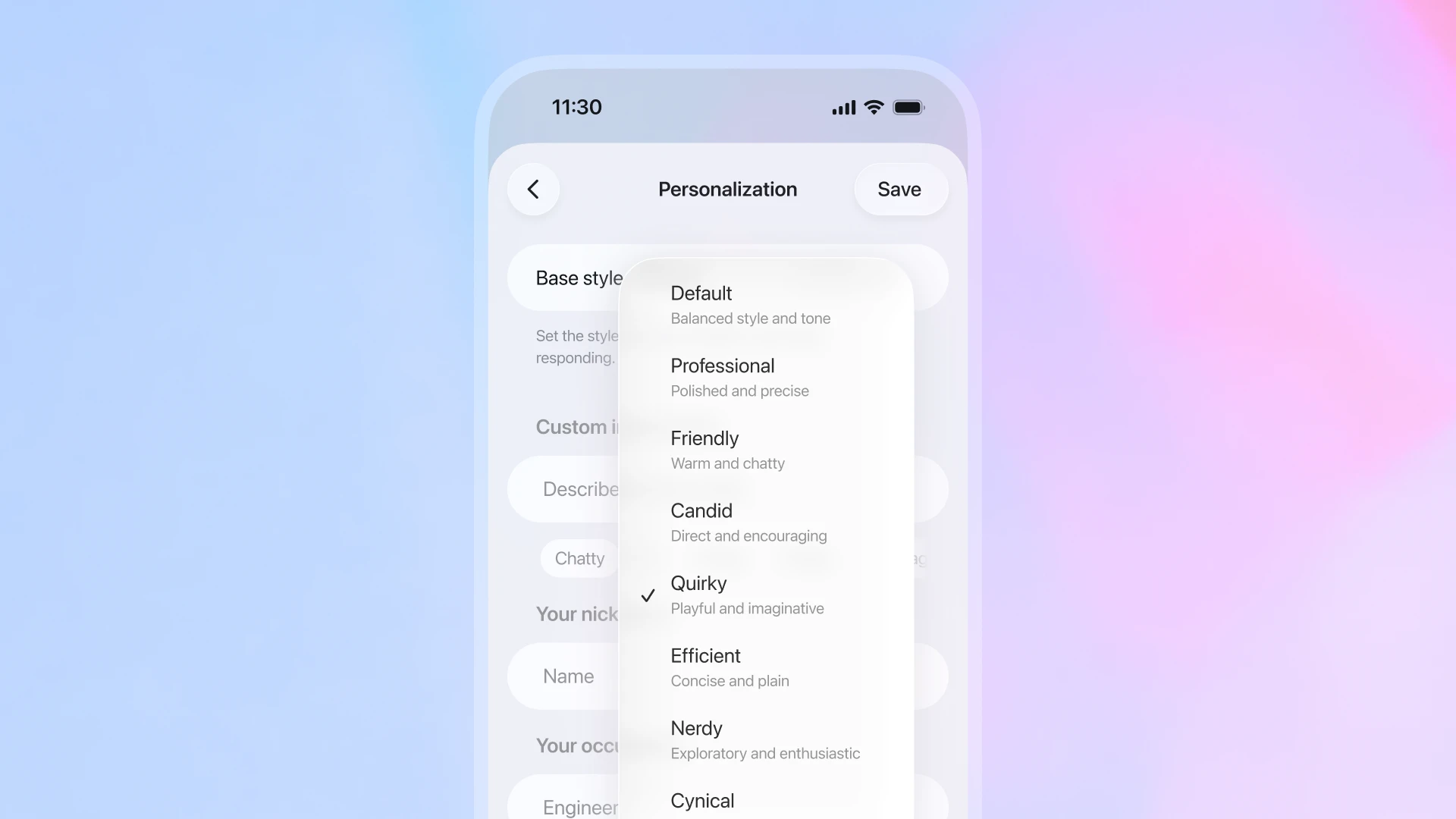
Interfejs mobilny z ekranem ustawień „Personalizacja”. Z menu rozwijanego użytkownik wybiera podstawowy styl i ton odpowiedzi ChatGPT. Dostępne opcje to: Domyślny (Zrównoważony styl i ton), Profesjonalny (Wyrafinowany i precyzyjny), Przyjazny (Ciepły i przyjazny), Szczery (Bezpośredni i zachęcający), Dziwaczny (Zabawny i pomysłowy, aktualnie wybrany), Zasadniczy (Zwięzły i dosadny), W stylu nerda (Odkrywczy i entuzjastyczny) i Cyniczny.

Niniejsze ustawienia osobowości odnoszą się do wszystkich modeli. Oryginalne opcje Cyniczny (dawniej Cynik) i W stylu nerda (dawniej Nerd), które wprowadziliśmy wcześniej w tym roku, nadal będą dostępne bez zmian na tej samej liście rozwijanej w ustawieniach personalizacji.

Natomiast dla użytkowników, którzy chcą mieć większą kontrolę nad reakcjami ChatGPT, eksperymentujemy również z możliwością dostosowywania cech ChatGPT bezpośrednio z poziomu ustawień personalizacji — mamy tu na myśli zwięzłość, serdeczność, łatwość przeglądania odpowiedzi oraz częstotliwość używania emoji. ChatGPT może również aktywnie proponować dostosowanie tych preferencji podczas konwersacji, gdy zauważy zachętę do użycia określonego tonu lub stylu, więc nie trzeba już przechodzić do ustawień. Preferencje można zmieniać w dowolnym momencie, dostosowywać lub usuwać.

Zaktualizowane opcje stylów i tonów wprowadzamy już dziś, a możliwość precyzyjnego dostrajania określonych cech zaczniemy stopniowo wdrażać jeszcze w tym tygodniu w ramach eksperymentu — zaczynając od ograniczonej liczby użytkowników. Obie opcje będą z czasem coraz lepsze. Ponadto zaktualizowane modele GPT‑5.1 lepiej przestrzegają instrukcji niestandardowych, zapewniając jeszcze większą kontrolę nad tonem i zachowaniem.

Zmiany wprowadzane w ustawieniach personalizacji, są teraz natychmiast stosowane we wszystkich czatach, nawet w trwających konwersacjach, dzięki czemu wypowiedzi modelu są spójne. Wcześniej zmiany podstawowego stylu i tonu lub instrukcji niestandardowych dotyczyły tylko konwersacji rozpoczętych po ich wprowadzeniu.

**

Dzisiejsze aktualizacje GPT‑5.1 i nowe opcje personalizacji to krok w stronę ChatGPT dopasowanego do użytkownika. Teraz nasz model jest inteligentniejszy, przyjemniejszy w rozmowie i lepiej dostosowuje się do wybranych preferencji. W przyszłości nadal będziemy rozwijać te aspekty, a przed nami jeszcze wiele pracy.


Autor

OpenAI