Improving GPT‑5.6 Sol in ChatGPT—and expanding access to GPT‑5.6 Luna for free users
Our mission is to ensure that artificial general intelligence benefits all of humanity. We’re introducing updates to ChatGPT that improve everyday conversations while expanding access for Free users.
For Plus and Pro users, we’re updating GPT‑5.6 Sol in Chat to be more reliable with facts and provide more focused answers. A new slider lets you choose how much thought ChatGPT puts into each response.
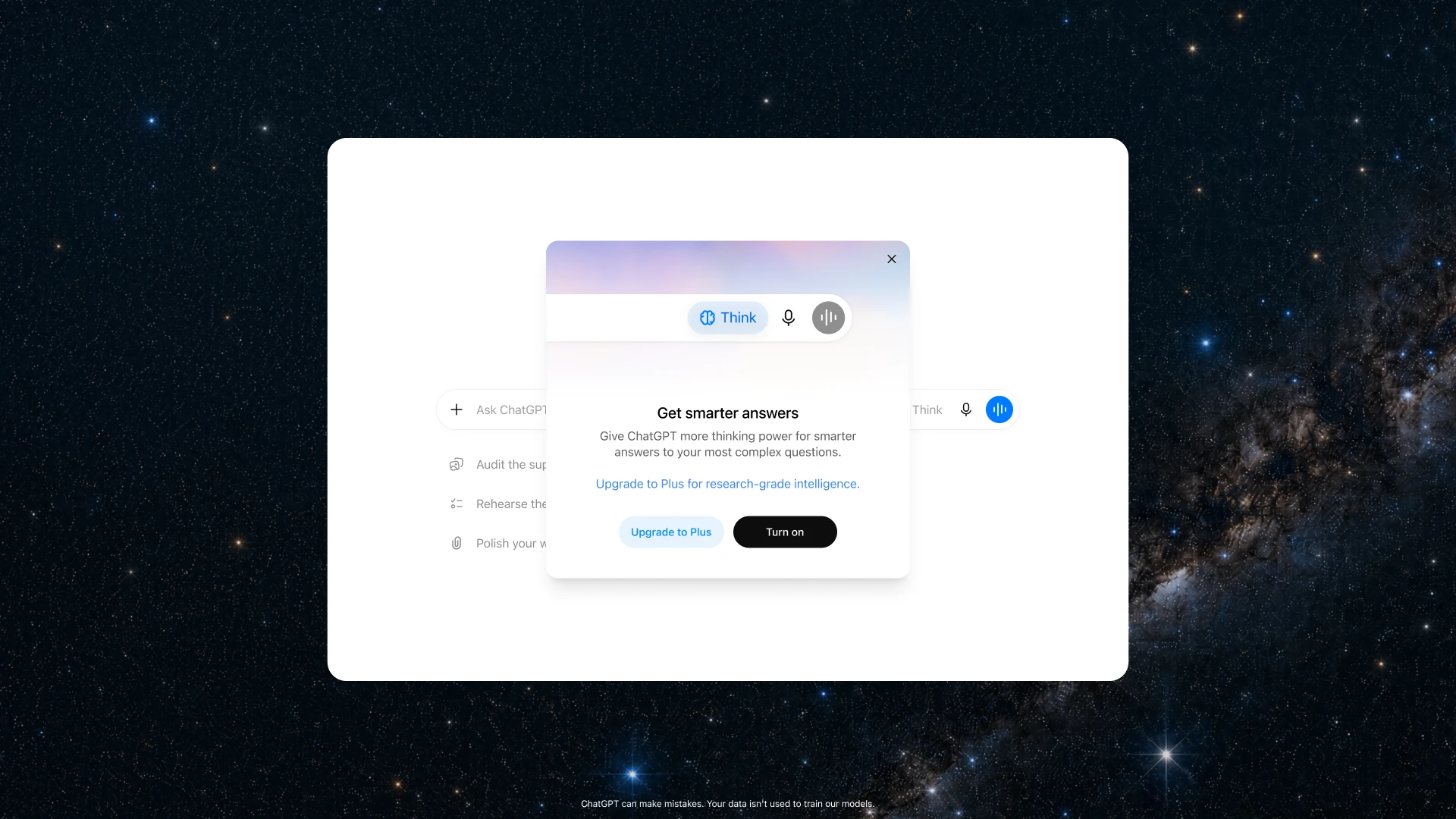
For Free users, we're updating the default model to GPT‑5.6 Luna and expanding access with unlimited text chats. For questions that need more thought, a new Think button lets you access higher reasoning for harder questions.
Every week, 1 billion people turn to ChatGPT for everything from quick questions and web searches to planning, research, advice, and complex decisions. We’ve updated GPT‑5.6 Sol to better support that full range. It delivers more focused answers, adapts its level of detail to the question, avoids unnecessary formatting, and offers a helpful correction when simply agreeing wouldn’t be useful. For Plus and Pro users, the same model now powers both Instant responses and deeper reasoning, creating one consistent experience.
The updates to GPT‑5.6 Sol in ChatGPT are designed to give you more direct responses, use tighter formatting, and avoid extra detail when it does not help.
For a quick question, that means a direct answer with the context you need. For more involved work like multi-step planning, research or writing, it means a fuller response that keeps the main recommendation clear.
GPT-5.5 Instant
GPT-5.6 Sol

GPT‑5.6 Sol is the stronger answer because it answers the real question first, identifies wind rather than rain as the main issue, and keeps only the details the rider needs. After the 5:30 follow-up, it updates the recommendation without repeating the full forecast.
A useful answer needs to get the facts right. The new GPT‑5.6 Sol is designed to make fewer mistakes—especially when answers depend on dates, numbers, sources, rules, or assumptions—by better using the sources it finds to answer your question.
In an internal evaluation of financial, medical, and legal prompts requiring factual detail, responses containing at least one factual error were about 62% less common with GPT‑5.6 Luna and 68% less common with GPT‑5.6 Sol than with GPT‑5.5 Instant.
With this update, we’re also bringing ChatGPT’s Instant and Thinking experiences closer together, creating a more consistent tone and behavior across different kinds of conversations. When you move from Instant to higher effort, it should feel like the model is taking extra time for a more comprehensive answer—not like you’re switching to a different model with its own tone or style.
Plus and Pro users can use the new slider in ChatGPT on web, mobile, and desktop to choose how much thought ChatGPT puts into an answer. Keep it quick for everyday questions, or move the slider up for planning, research, writing, coding, or decisions that need more thought.
We’re expanding access to our latest models for free users with unlimited text chats using GPT‑5.6 Luna, plus a new Think button for harder questions.
For questions that require deeper reasoning, Free users can tap the new Think button to give GPT‑5.6 Luna more time to work through the answer.
Plus and Pro users can access the updated version of GPT‑5.6 Sol and the new slider in ChatGPT starting today.
GPT‑5.6 Luna will become the default model for Free and Go users this week. Starting next week, they’ll also have unlimited text chats and access to a new Think button for harder questions (subject to abuse guardrails). Limits will still apply for file uploads, images and other tools.
Because this version of GPT‑5.6 Sol is optimized for everyday chats, it will only be available in the Chat experience in ChatGPT. The version of GPT‑5.6 Sol that powers Work and Codex is not changing as part of this release.
You can find more detail on safety training and evaluations in our system card(opens in a new window), which outlines additional measures we’ve introduced to support users we believe are under 18. For these users, we trained the model to avoid romantic roleplay, age-restricted challenges, and presenting itself as a substitute for real-world relationships. In addition, we applied age-appropriate boundaries around sexual content, eating disorders and body-image risks, age-restricted goods, dangerous activities, and graphic violence. Finally, the model encourages connection with trusted people when a teen may need support. We reinforced this training with system-level protections and have added new evaluations for how our models perform for users under 18, and are continuing to improve model responses in this area.
This is a concrete step toward more abundant intelligence: making our latest models more widely available, improving the usefulness and reliability of the answers people get, and letting free users keep text chats going without a rate limit. Access shapes opportunity, and this update gives more people the ability to keep asking, develop an idea, and get help when they need it.