How to connect AI usage to business value
Understand how teams use ChatGPT Work and Codex, see the work behind the spend, and connect it to measurable outcomes.
As more teams use AI, admins and business leaders need to understand where it creates value and where to invest next. Usage and spend tell part of the story, but admins also need to see what people use AI for and what it helps them accomplish.
Analytics in the ChatGPT Admin Console bring together usage and cost data, task insights, and outcome metrics across ChatGPT Work and Codex.
Here’s how admins can use these tools to understand adoption, support teams, and assess business value.
Usage analytics show where adoption is growing and spend is concentrated, helping admins focus support, review costs, and assess capacity requests. The Usage view brings together active users, credits, and token usage across ChatGPT Work and Codex. For example, filtering by group or user can reveal where adoption is low, giving admins a reason to review starting workflows and training needs with the team owner.
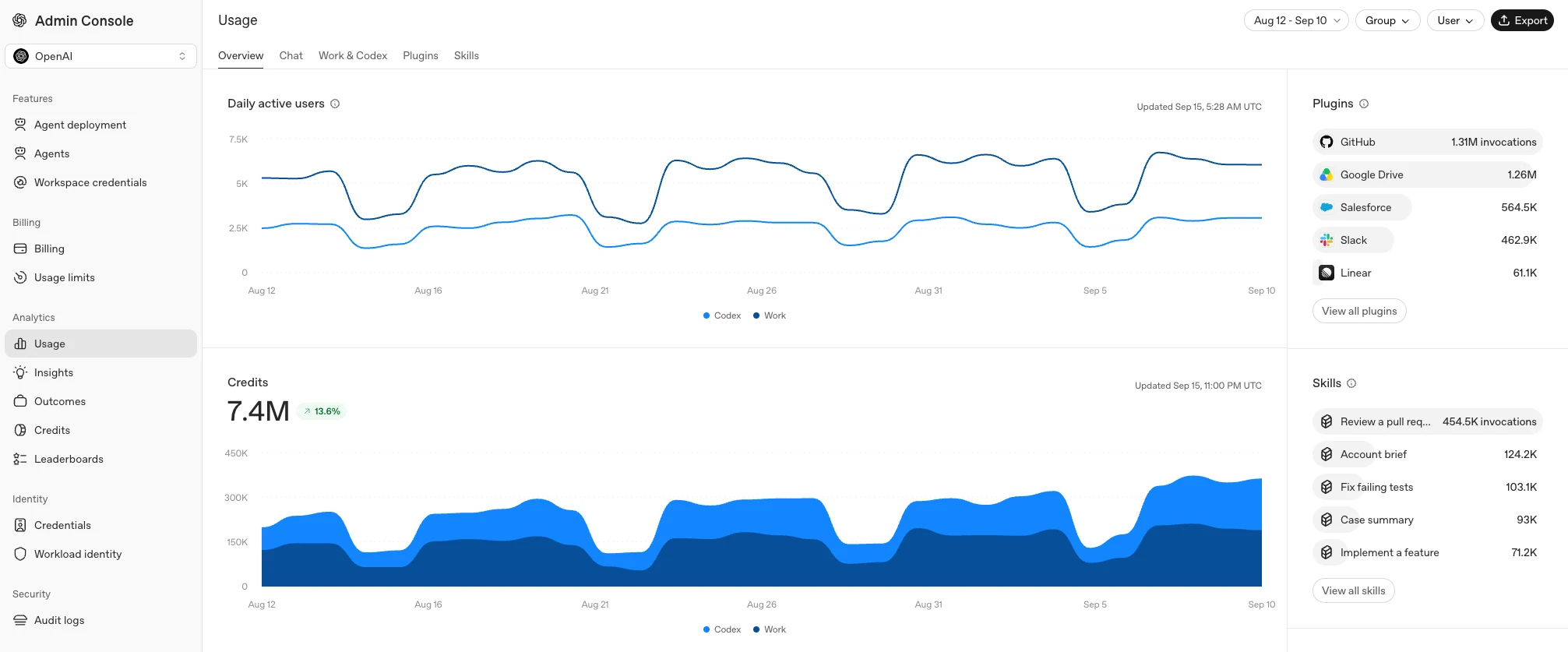
The Usage overview shows active users and credit trends across ChatGPT Work and Codex. All screenshots use illustrative demo data.
The task classifier in Insights helps admins understand what work AI supports by grouping a sample of messages into use cases and tasks. Software engineering, for example, includes feature development and code maintenance, while sales & revenue include account research and planning. The Overview tab shows the mix of work at a glance; the Use cases tab provides a detailed table with task breakdowns. Admins can filter by group to see how teams use AI, then work with business owners to decide which workflows and outcomes to evaluate.
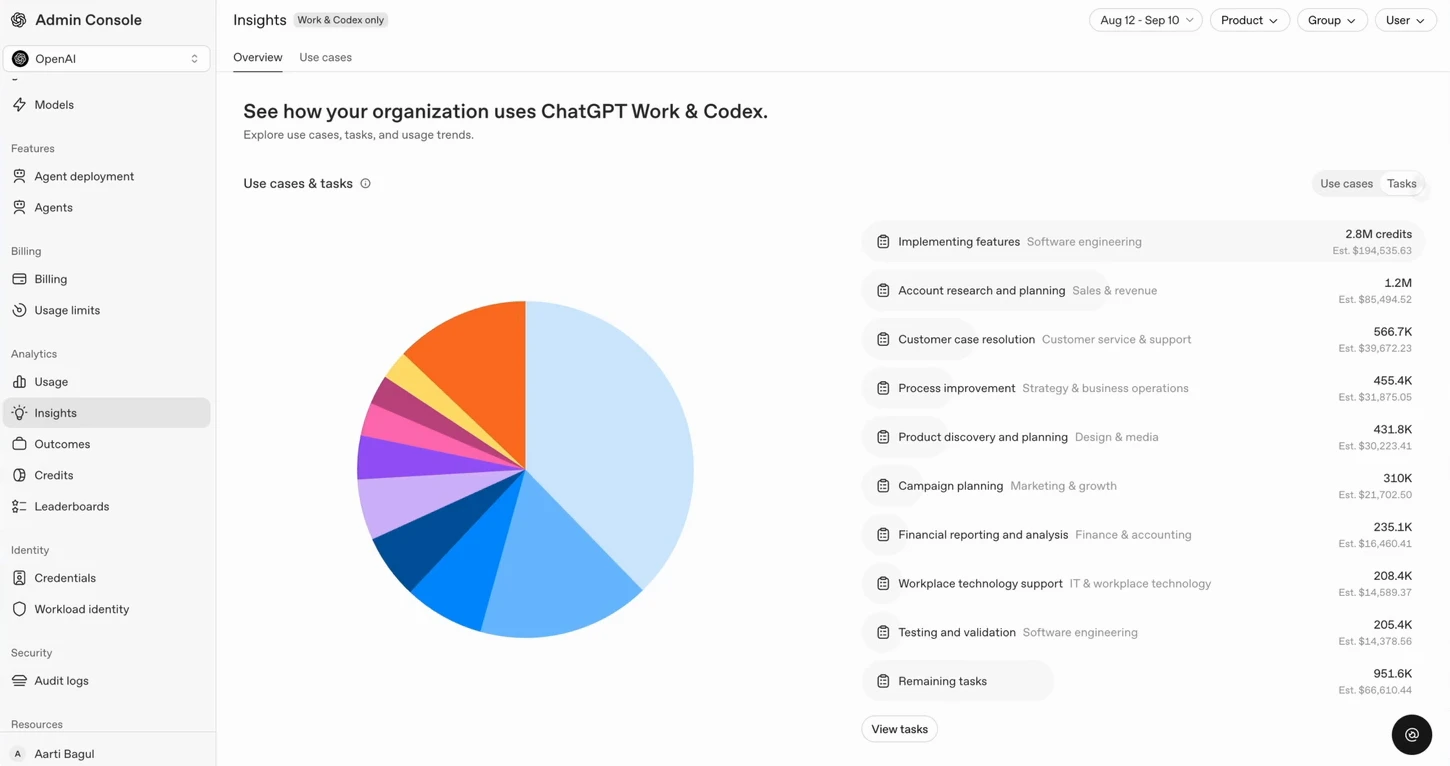
The Insights overview shows how credits are distributed across tasks, from implementing features to account research.
For the sales team shown below, account research and planning is the largest use of credits—a starting point for discussing how AI changes account preparation.
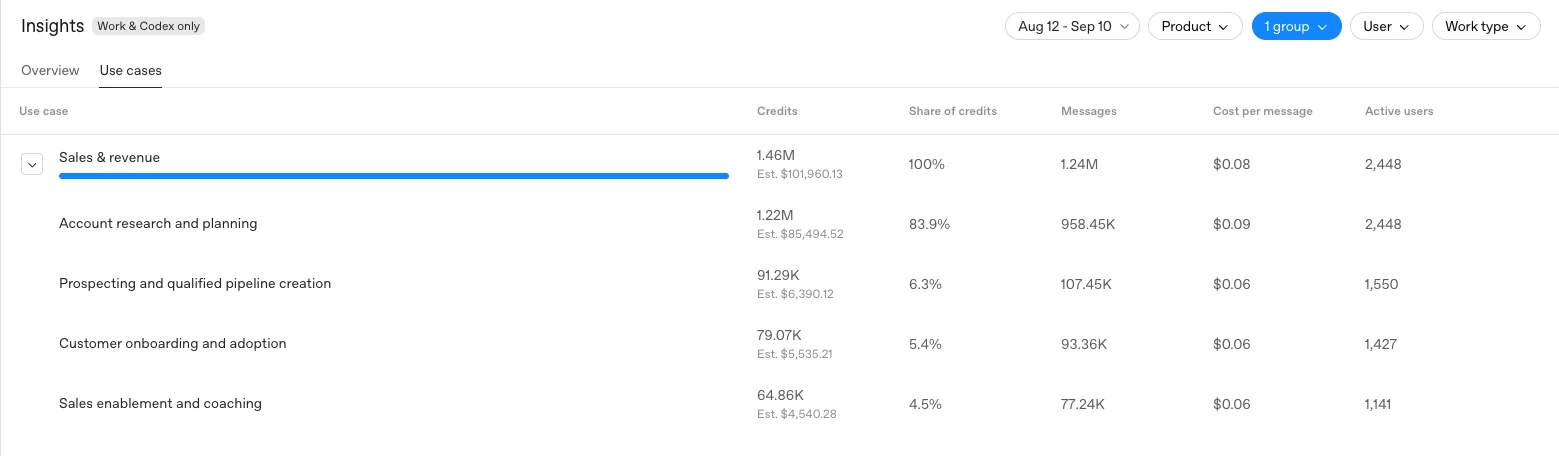
The Use cases table breaks down a team’s work by task, with credits, messages, and active users.
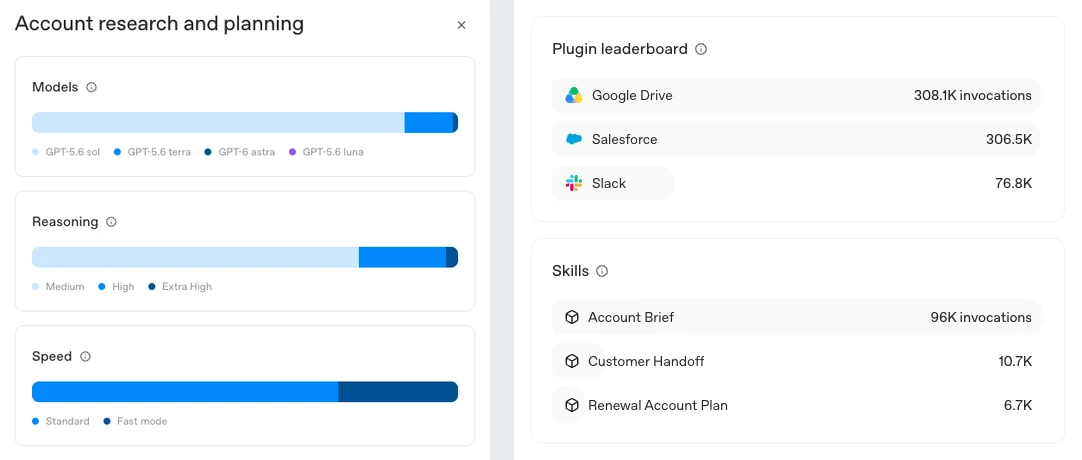
In task details, the Models, Reasoning, and Speed breakdowns show each setting’s share of credits for a task. This helps admins assess whether the setup fits the work and target training on model selection. A routine brief, for example, may be worth testing with a faster or lower-cost setup, comparing quality and the time spent reviewing and correcting it.
The Plugin leaderboard and Skills view show which tools support a task, helping admins focus training and decide which workflows to maintain or share. Low use of a relevant plugin may point to an access or training need; a frequently used skill may need a clear owner and regular updates.
The Outcomes view shows Codex contributions to merged commits and lines of code, alongside code-review activity. Trends and available group, user, or repository filters help admins and engineering leaders understand adoption and decide where to expand access or support teams.
If Codex contributes to a growing share of merged code, engineering leaders can compare that trend with review time, defects, and rework to assess whether it is helping the team ship software more effectively.
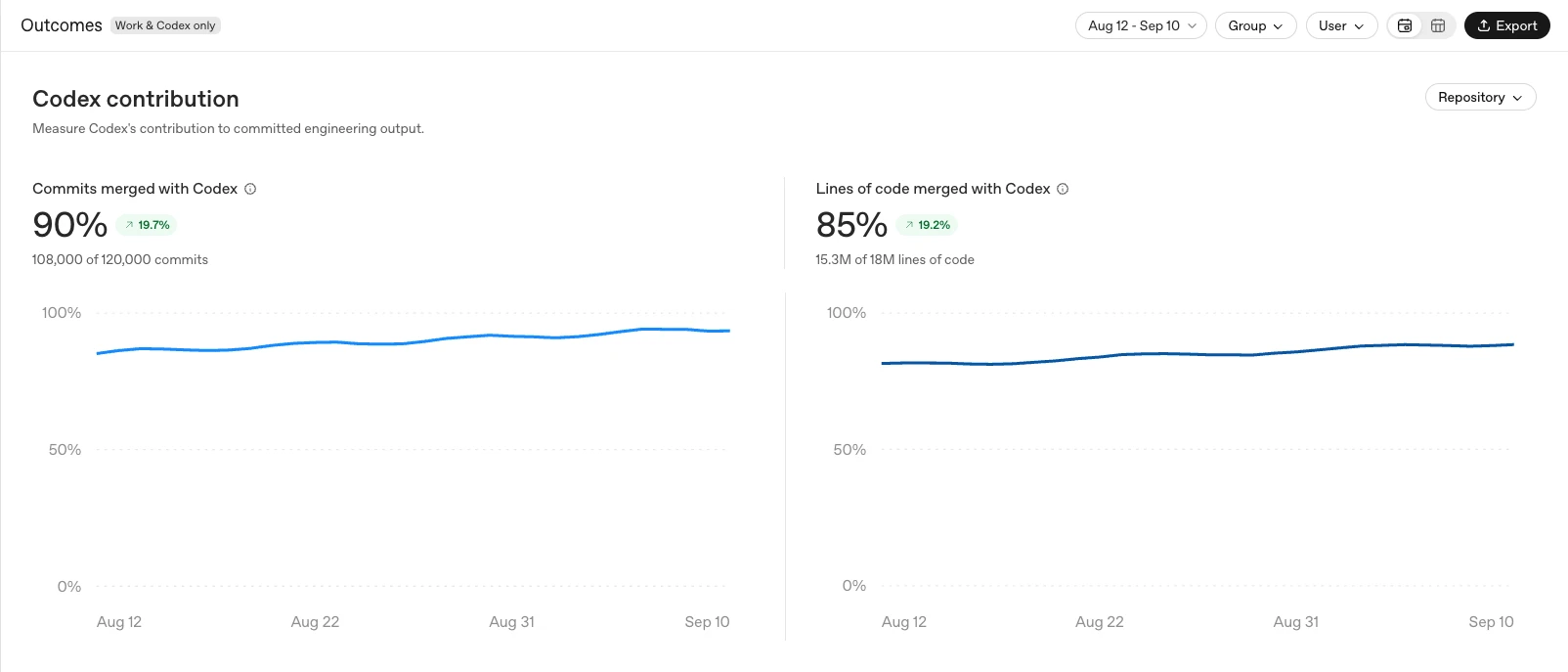
The Outcomes view tracks the share of merged commits and lines of code with Codex contributions over time.
The Admin plugin in ChatGPT Work lets admins compare adoption, spend, and tasks, then turn findings into reports for budget and rollout decisions. It can also create finished work, such as a leadership deck with charts, key findings, and recommended next steps, ready to share with cross-functional stakeholders.
With the Admin API, teams can automate reports in their own dashboards and combine analytics with business-system data. For example, a support dashboard could show credit use alongside ticket resolution time.
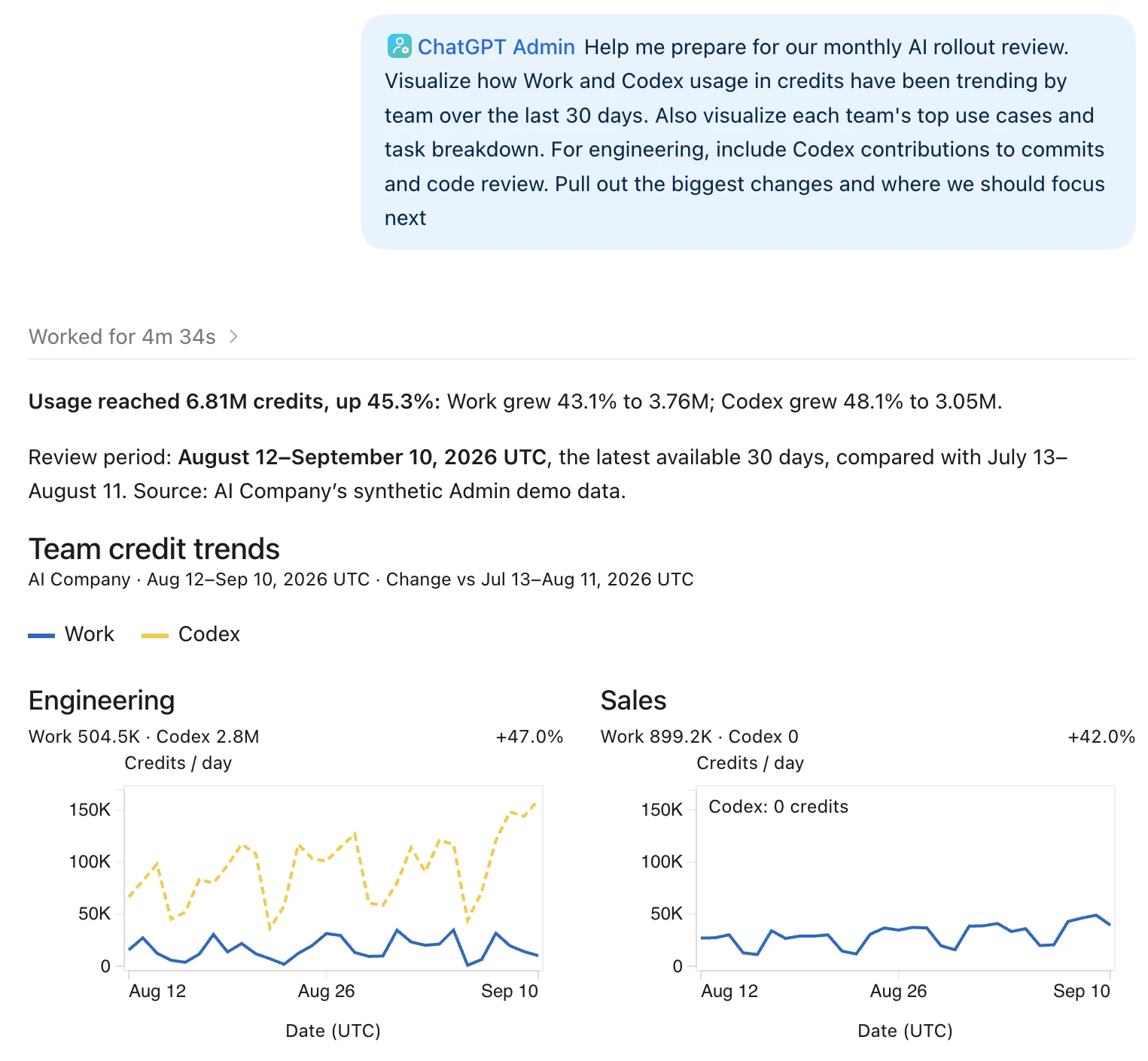
The Admin plugin compares team credit trends and summarizes changes for a monthly rollout review.
Usage and task data are a starting point for admins to investigate value with business owners. Business owners add the context needed to assess it: what changed in the workflow, whether results improved, and what that improvement is worth. Together, they can connect product activity to measures such as delivery time, quality, or profitability.
Suppose the task classifier in the Admin Console shows that account research is common in a sales group. The admin checks whether model choices fit the task, provides training where a CRM plugin is underused, and shares a skill for consistent account plans. The sales owner then compares preparation time and plan quality with the team’s baseline. If time is saved, they track how much goes into customer conversations, which conversations become qualified opportunities, and which opportunities become sales. Revenue and contribution margin on that business help show whether the extra capacity produces a financial benefit.
To explore the value of a workflow, start with a few questions:
- What would you like to improve? Choose an outcome that matters to the team, such as faster preparation, better-quality work, lower costs, or more sales.
- How does the process look today? Establish a starting point: how often the team does the task, how long it takes, and what a good result looks like.
- What changes with AI? Compare results over a defined period. Include the time spent reviewing and correcting the work so that faster completion still meets the team’s quality standards.
- What does this make possible for the team? Time saved might mean more conversations with customers. Better-quality work might mean fewer corrections. Talk with the team to understand where those improvements matter most.
- Is the benefit worth the investment? Compare what the team gains with what you’re spending on AI, setup, and ongoing support. That can help you decide what to expand and where the team could use more help.
Illustrative annual ROI: sales account research
Imagine a team of sellers, each preparing two account briefs per week. Every brief brings together account history, industry research, and a point of view for the next conversation.
What changes with AI?
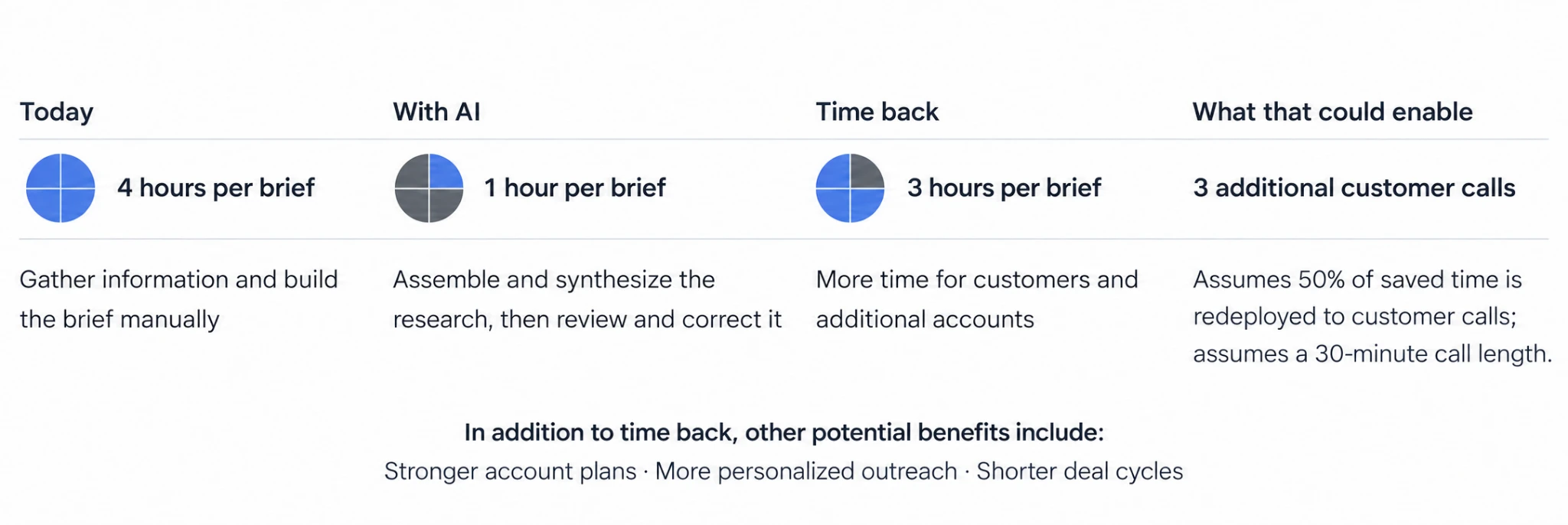
What does that add up to?
Annual time saved
20 sellers × 2 briefs per week × 3 hours saved × 46 weeks = 5,520 hours
Estimated annual capacity value
Assume the team puts 50% of that time into productive work, valued at a fully loaded employee cost of $75 per hour. Sellers could use that time to connect with new prospects, follow up on opportunities, and spend more time with customers.
5,520 hours × 50% × $75 = $207,000
Total first-year costs
Assume $60,000 for AI, setup, training, and ongoing support.
($207,000 − $60,000) ÷ $60,000 = 245% illustrative ROI.
The value of a workflow can extend beyond productivity. In sales, better account research and a shared understanding of the customer can support deeper conversations, stronger relationships, and new opportunities. Teams can then measure whether those improvements lead to additional business outcomes, like accelerated deal cycles or increased win rate.
All figures are hypothetical. ROI reflects estimated capacity value and excludes potential benefits from higher win rates, larger deal sizes, or other sales outcomes.
From shipping software to running live events, customers are putting AI to work on tasks that matter to their businesses:
1Password uses Codex to build, review, and test software so engineers can ship features faster. It estimates 553% ROI and $0.8M in annual engineering capacity value, using Codex to build production-ready features and internal tools faster while maintaining rigorous security policies.
ATV Big Air Tour uses ChatGPT Work to check event listings, plan inventory, and improve its website’s visibility. Listing reviews fell from eight hours to one hour a week, and inventory work from two to three days to two to three hours, giving the team more time to focus on the tour and its customers.
Playco uses GPT‑6 Astra through OpenAI’s API to build and test playable game prototypes. The team created three themed prototypes from one foundation and reported 50% fewer manual fixes than with the previous model, helping developers test and compare more ideas.
Open Insights in the Admin Console and choose a common task that supports a business priority. Review it with a business owner, agree on a baseline and the outcome to measure, and set a date to review progress. Use the results to decide whether to expand the workflow, improve how teams use it, or test a different approach. Learn more(opens in a new window) in our docs.