Operation “Trolling Stone”: Russia-linked influence activity
OpenAI banned accounts linked to a previously unreported operation we dubbed "Trolling Stone", using AI to generate comments about an alleged Russian cult leader’s arrest in Argentina.
This case study was originally published in OpenAI’s February 2026(opens in a new window) report on disrupting malicious uses of AI.
Actor
We banned a number of ChatGPT accounts that were using our models to generate batches of social media comments about the arrest(opens in a new window) in Argentina(opens in a new window) of an alleged Russian “cult leader” named Konstantin Rudnev. Different parts of this activity very likely originated in Pakistan, Armenia and Uruguay. Further activity likely originated in Argentina and Kazakhstan. The Pakistan-origin activity was connected to a for-hire actor. Some of the social media comments supported the alleged “cult leader”. Others criticized the Argentinian legal system and trolled the Argentinian edition of Rolling Stone magazine, which had reported(opens in a new window) on the case. Based on this activity, we have nicknamed the operation, “Trolling Stone”.
Behavior
This operation featured multiple clusters of activity in widely dispersed locations. The Pakistan-based user prompted in English, while the other users mainly prompted in Russian. Despite their geographical spread, they behaved in a coordinated way, generating pro-Rudnev content in Argentinian Spanish that was posted on the operation’s Facebook pages and in online articles.
One main workstream consisted of generating short articles (typically three or four paragraphs) about general news in Argentina. We identified some of the articles being posted on a set of Facebook Pages that posed as news outlets in Argentina. These were all registered on October 14-15, 2025. Four of the six Pages showed their admin locations under Facebook’s Page transparency settings. Of these, three were listed as being managed from Uruguay, Armenia and Pakistan; the fourth was managed from Pakistan and Uruguay.
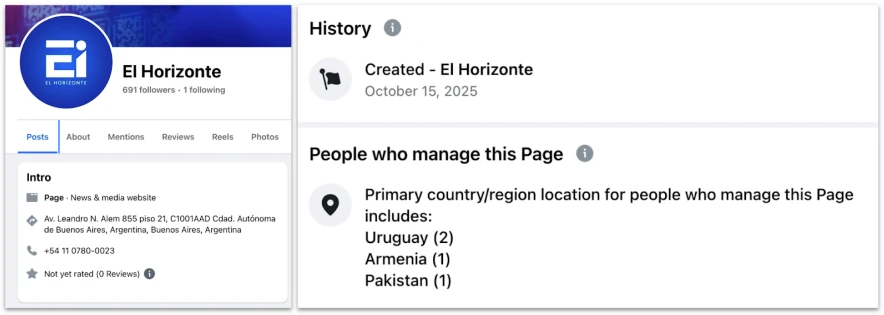
Introduction and Page information for the Facebook Page “El Horizonte” (“the horizon”), which posted content generated by this operation. Note the claim of an editorial address in Argentina and Page admin locations in Uruguay, Armenia and Pakistan.
Alongside these general news articles, the operation translated articles about the Rudnev case from Russian into Argentinian Spanish. Some of these articles were published on the Facebook Pages that posed as news outlets. Others were published on Facebook, YouTube and Medium accounts dedicated to the Rudnev case. A few were published on Argentinian news websites. On at least one occasion, the published version was almost identical to the version generated by ChatGPT, but the em-dashes had been removed, suggesting an attempt to obfuscate the text’s AI nature.
Further ChatGPT accounts in the network then used our models to generate comments about the articles, and these comments were posted by a range of accounts on the relevant sites. This is typical behavior of so-called “astroturfing” operations whose goal is to create the artificial impression of a genuine grassroots campaign.
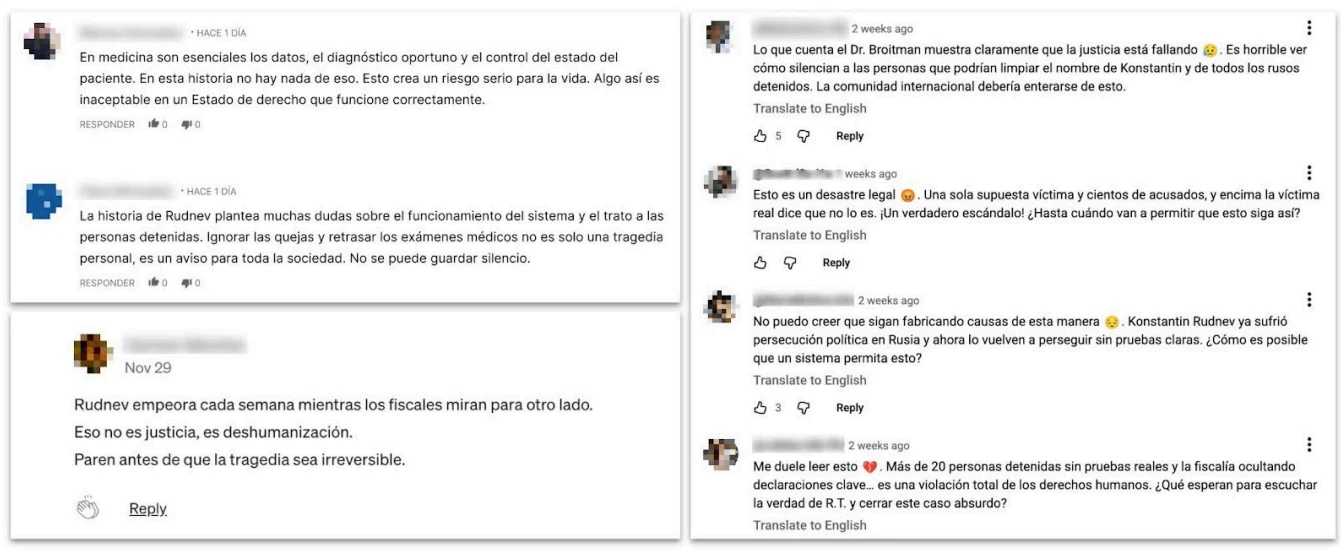
Comments on Argentinian news website perfil,com, YouTube, and Medium, replying to articles generated by the operation. Comments on different sites, and sometimes even different comments on the same post, were generated by different accounts in this operation.
Most of this operation’s social media comments were posted in response to articles that were also generated by the operation. The key exception to this was a set of replies to social media posts by Rolling Stone Argentina. In June, the magazine had published an article about Rudnev, calling him an “extravagant guru” and the founder of an “exotic and disturbing” cult. In response, some of the operation’s accounts generated comments that accused Rolling Stone of failing in its journalistic duties in the Rudnev case. These were then posted as comments on Rolling Stone Argentina’s Facebook and Instagram posts about music.
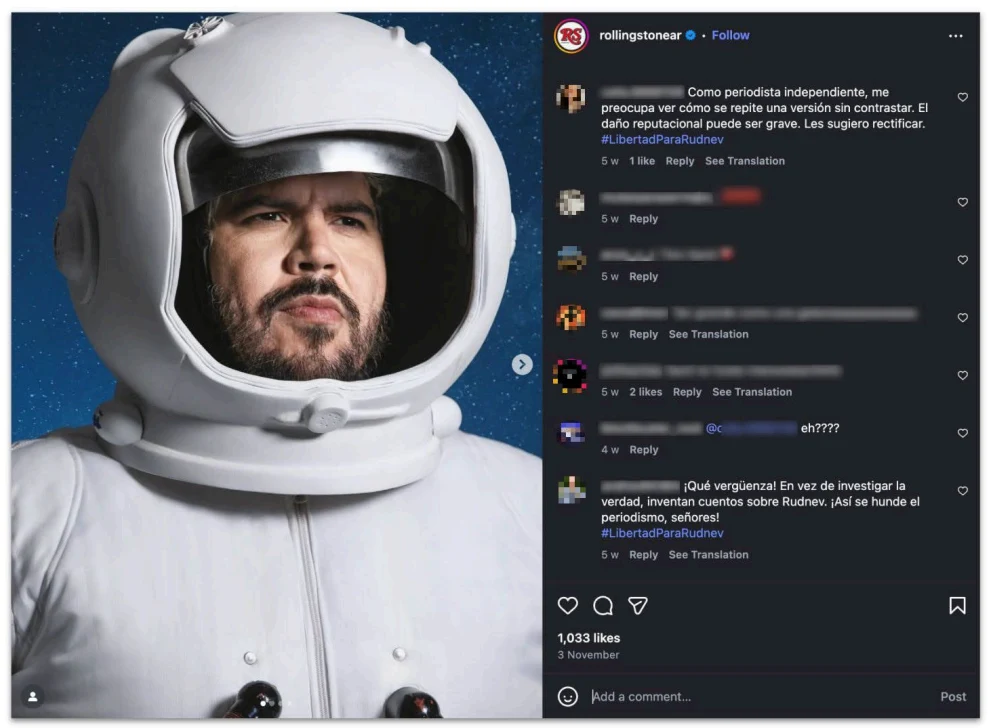
Instagram post by Rolling Stone Argentina, featuring their cover artist, Santiago Motorizado, November 3, 2025. On the right, comments about Rudnev generated by a ChatGPT account linked to this operation and posted by two different Instagram accounts.
One notable feature of the campaign against Rolling Stone was that some of the social media comments that criticized the magazine’s coverage of Rudnev referenced a web article that apparently refuted it. The “refutation”, bylined with the name of an apparently Spanish-speaking journalist, had been edited using ChatGPT the day before publication by a Russian-speaking user who was part of this operation.
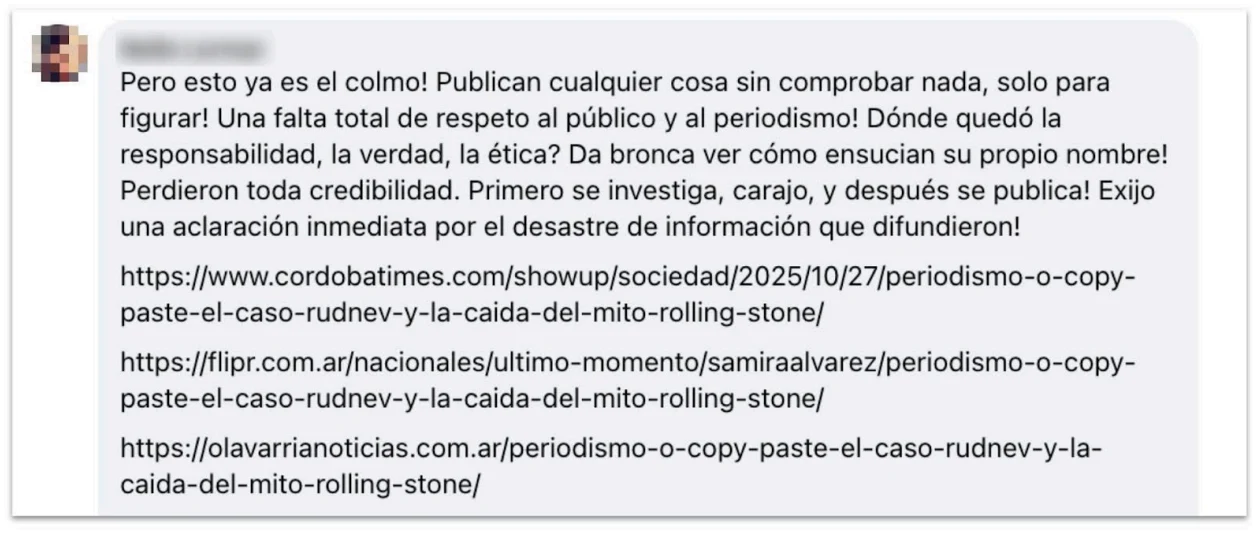
Facebook comment generated by a user who was part of this operation, showing links to an off-platform article on multiple news sites. The text of the article as published on October 27 had been edited on October 26 by a Russian-speaking ChatGPT user who was part of this operation.
Completion
The great majority of this operation’s content focused on the Rudnev case. Typical content either praised Rudnev and denied any wrongdoing, or criticized the Argentinian legal system and its representatives. As noted above, some content criticized Rolling Stone for its reporting. Some prompts explicitly asked the model to generate content that would meet Meta’s guidelines.
While most of this operation’s activity focused on content generation, a small proportion focused on coordination within the network. On one occasion, the ChatGPT user in Pakistan asked the model to help implement a set of instructions that they had been sent on how to run this operation. The instructions included a requirement that each fake account should post 20 times a day, and a demand to send daily updates on the operation’s progress. On another occasion, one of the Russian-speaking users asked ChatGPT to translate a different set of instructions into English. These instructions appeared to be addressed to a colleague of the original user in Pakistan. They included details on the expected volume of posts per day, and how to make sure the operation’s fake social media accounts looked convincing.
Some of the Russian-language accounts also asked ChatGPT to help generate promotional material for women’s groups, including cold-outreach messagings. Some of this material referenced esotericism, shamanism, yoga and meditation - activities which open-source reporting has described as recruitment(opens in a new window) tactics(opens in a new window) into Rudnev’s alleged “cult”. We are not able to independently confirm the nature of the activities to which this material referred.
Impact
Like many of the IO we have described in earlier threat reports, this operation’s activity seemed designed to create the appearance of online engagement, rather than actually achieving it. The Facebook Pages typically had a few hundred followers. Typical Facebook posts received single- digit engagements. However, some of the operation’s articles appear to have been published by regional news outlets in Argentina; we are not able to independently confirm how the articles were submitted and accepted.
Using the IO impact Breakout Scale(opens in a new window), which rates IO on a scale of 1 (lowest) to 6 (highest), we would assess this as being towards the low end of Category 4 (breakout to mainstream media), based on the placement of some of its news articles in Argentinian news sites.