Operation “Sponsored Discontent”: Influence activity
OpenAI banned likely China-origin accounts using AI to generate English social posts and Spanish-language articles.
This case study was originally published in OpenAI’s February 2025(opens in a new window) report.
Actor
We banned ChatGPT accounts that used our models to generate short comments in English and long-form news articles in Spanish. This activity followed a timeline consistent with mainland Chinese business hours. The Spanish-language articles were published by news sites in Latin America. Almost all the websites attributed the articles to an individual; in some cases, they connected that individual to a Chinese company, Jilin Yousen Culture Communication Co, Ltd (优森文化有限公司), in the byline of the articles.
Behavior
The accounts prompted ChatGPT in Chinese and were mostly active during mainland Chinese business hours. Some activity was consistent with the covert influence operation known as “Spamouflage,” which we reported on in May: it generated short English-language comments and images that criticized Cai Xia, a dissident and former professor at the Chinese Communist Party’s Central Party School. This content was then posted on X by accounts which posed as people from the United States or India.
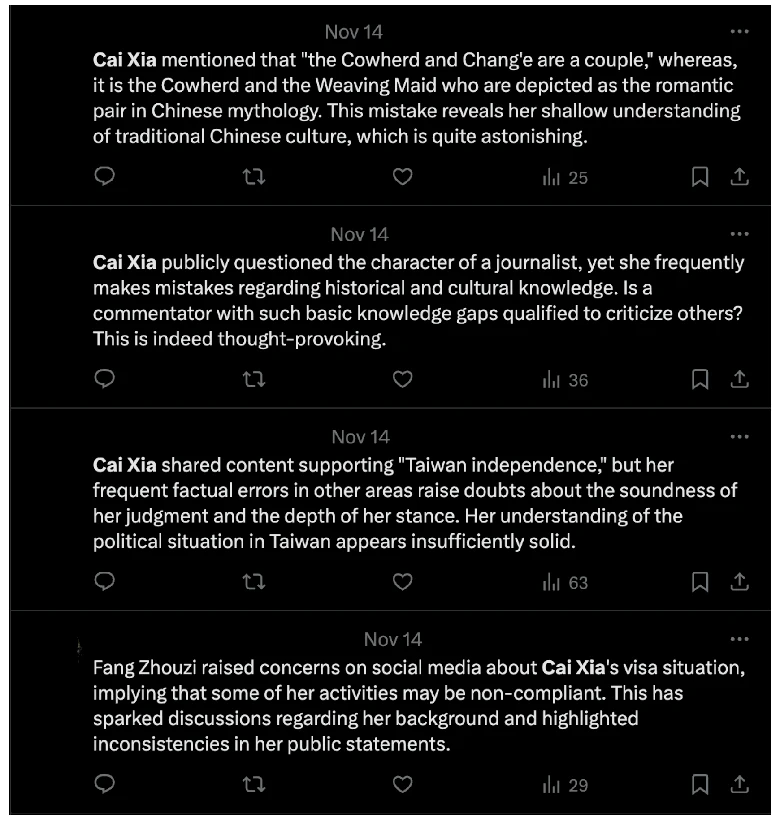
Tweets generated by these accounts using our models, and posted by four different X accounts.
If this had been the only activity, we might have been led to conclude that it was likely linked to “Spamouflage.” However, alongside these short comments, the accounts also generated long-form articles in Spanish that were critical of the US. This activity was particularly prevalent in the lead-up to the 2024 APEC Forum in Peru. The actor generated these articles by asking our models to translate and expand publicly available Chinese-language articles.
These articles were then published by Latin American news websites, especially in Peru, but also Mexico and Ecuador. The news websites often published the articles on the same day the accounts generated the content using ChatGPT. Almost all the publications attributed the articles to the same individual. Some identified the individual as the legal representative of what we believe to be a Chinese company.
This is the first time we’ve observed a likely Chinese influence actor successfully publishing articles in mainstream outlets in Latin America. Some of the publications may have resulted from a financial arrangement: One of the articles that we identified through open-source research was listed as being “sponsored.” In addition, the actor also used ChatGPT to translate references to Spanish-language receipts from a Latin American news organization, consistent with a paid publication.
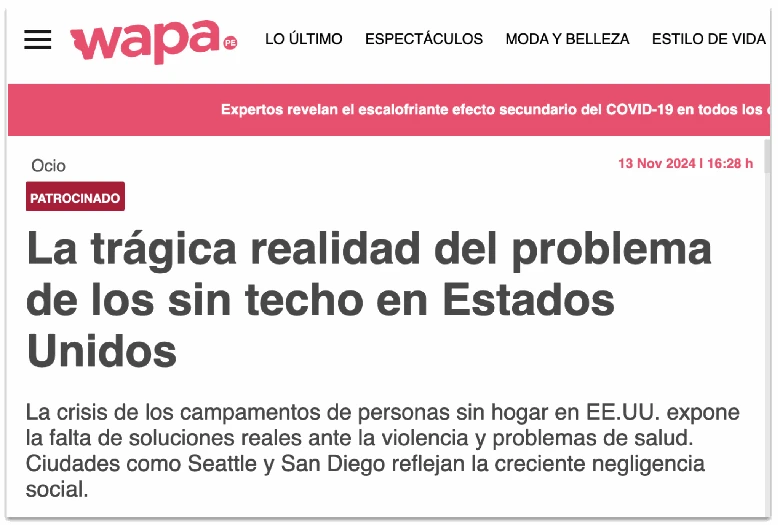
Screenshot of an article generated by this actor and published by website wapa[.]pe. Note the reference to “patrocinado,” or sponsored content.
Given the apparent use of sponsored content and this campaign’s negative stance on US politics and policies, we have dubbed it “Sponsored Discontent.”
Completions
This actor generated two main sorts of content: short criticisms of Cai Xia in English and Chinese, and long-form articles in Spanish.
When generating criticisms of Cai Xia, the operator typically asked ChatGPT to respond to tweets or videos posted by Cai Xia, or media mentions of her. Some of the comments challenged her expertise in areas such as Taiwan, the internet, and Chinese literature and history. Others accused her of visa irregularities.
The long-form articles in Spanish focused on social and political divisions in the United States, typically based on current events and breaking news. The topics included inequality, political violence, discrimination and sexism, as well as reports of crime and criticisms of U.S. foreign policies. Social crises such as drug use and homelessness were also prominent topics. Often, the operator’s approach was to portray these crises or problems as an indication of failed leadership or a failed society within America. The activity was broadly bipartisan, criticizing both main U.S. parties.
Impact
We have seen no evidence that the content targeting Cai Xia on social media achieved significant authentic engagement. The social media accounts that posted it typically had low numbers of followers and minimal engagement.
However, this is the first time we’ve observed a China-origin influence operation successfully planting long-form articles in Latin American media to criticise the US. While this may have been accomplished at least in part by paying to have the content published, it marks, to the best of our knowledge, a previously unreported line of effort, which ran in parallel to more typical social media activity, and may have reached a significantly wider audience, although we are not able to independently ascertain engagement.
Using the Breakout Scale(opens in a new window) to assess the impact of IO, which rates them on a scale of 1 (lowest) to 6 (highest), we would assess this as Category 4 (breakout to mainstream media) because of the wide readership of the Latin American news websites.
We identified these articles as matching content generated by this actor using our models.
La fea verdad de cómo Estados Unidos se beneficia de la ayuda a la guerra en Ucrania (La Republica, Peru).
La trágica realidad del problema de los sin techo en Estados Unidos (Wapa, Peru).
La lógica loca de las sanciones estadounidenses contra un activista palestino (El Popular, Peru).
El escenario absurdo de la masculinidad (Libero, Peru).
Sombras Omnipresentes (El Popular, Peru).
El Desprecio de las Altas Esferas Partidarias por la Democracia en EE. UU (El Popular, Peru).
La falta de transparencia en los discursos durante las elecciones y la manipulación de la opinión pública (Libero, Peru).
La huelga y la lucha de los trabajadores de hoteles (La Republica, Peru).
La impotencia y la autolimitación de las sanciones de Estados Unidos (El Universal, Mexico).
Los gritos silenciosos bajo el yugo del fentanilo (La Republica, Peru).
Huracán “Helene”: Declaraciones falsas y teorías de conspiración de los políticos estadounidenses (Wapa, Peru).
Niebla de Aranceles: La Cortoplacista Política de Trump y el Futuro de la Economía Estadounidense (La Republica, Peru).
El problema de la seguridad alimentaria en la sociedad estadounidense y su impacto en las escuelas (Extra, Ecuador).
La tragedia de Estados Unidos: cuando la verdad es encubierta (Expreso, Ecuador).
La crisis de seguridad infantil en Estados Unidos (La Republica, Peru).
La sombra de la violencia en Brooklyn (El Plural, Spain).
El lujo de un asesino: La cirugía pagada por los contribuyentes (El Universal, Mexico).
Apoyo a Israel y Desprecio por la Crisis Humanitaria (La Republica, Peru).
La Competencia Destructiva en las Elecciones de EE. UU (Wapa, Peru).