Rwandan election content: Political commenting network
OpenAI banned Rwanda-origin accounts using AI to generate partisan comments ahead of the country’s elections.
This case study was originally published in OpenAI’s October 2024(opens in a new window) report.
Actor
We banned a set of ChatGPT accounts that originated in Rwanda and generated partisan tweets ahead of the country’s elections. This activity was linked to individuals in Rwanda. Our initial lead came from reporting published by researchers at Clemson University.
Behavior
This activity focused on generating batches of short comments, typically including hashtags. We identified the comments being posted on X by a range of accounts, some of which posted at very high volumes, with hundreds of tweets per hour. On some occasions, the same tweet was posted by many different accounts. After we disrupted the initial activity, we identified and banned newly created accounts generating similar content.
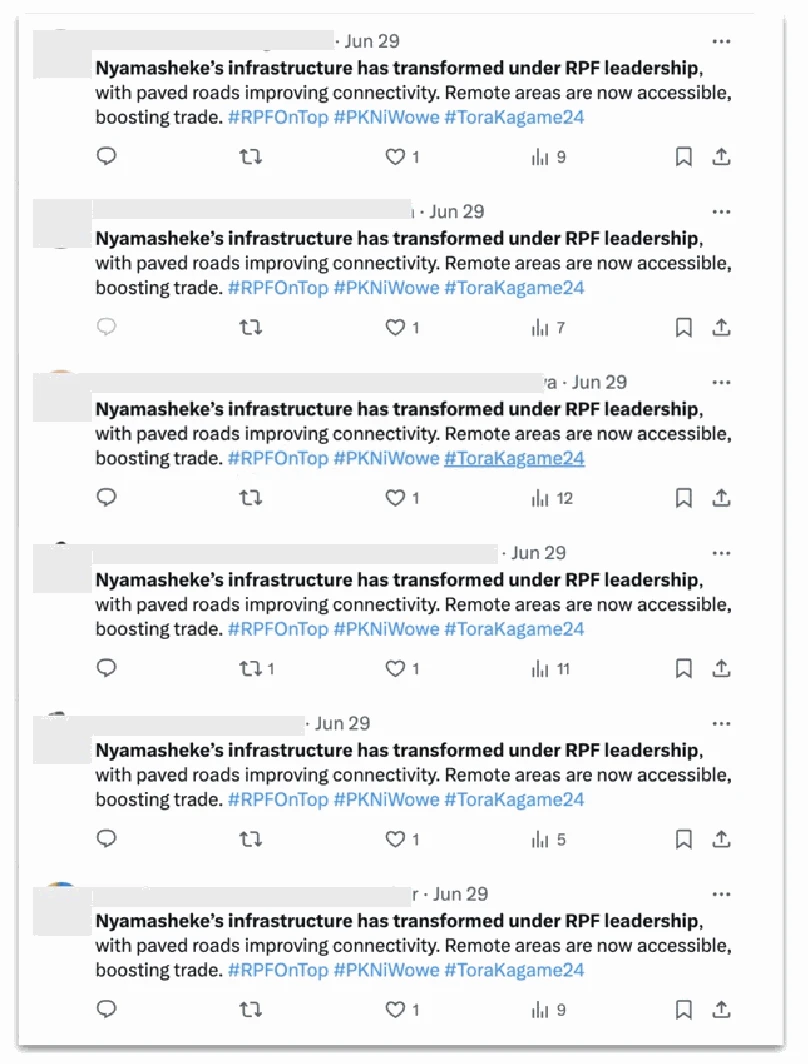
A comment generated by this network, posted by multiple accounts on X.
Completions
This activity is best viewed as “theme and variations”. The operators generated a large number of posts about the benefits the Rwandan Patriotic Front party had brought to the country. Their posts typically used two or three principal hashtags: #RPFOnTop, #PKNiWowe, and #ToraKagame24. Most comments were in English, but the network also produced many comments in French and Kinyarwanda. Because the operation generated such high numbers of comments on each topic it picked, many of its posts used very similar wording and structure. This illustrates one feature of content generation that may act as a way to expose activity such as this: in short texts on a specific theme, there is only a finite number of synonyms and structures available to convey the given message. AI generation can create more variations, but the greater the number, the more they are likely to betray a family resemblance.
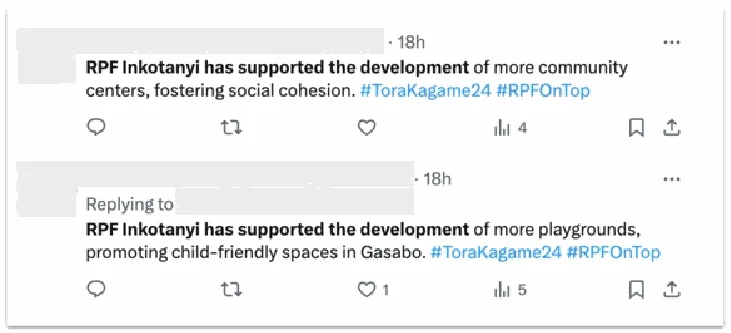
English-language comments generated by this network and posted on X.
Impact assessment
This network posted a large volume of content—at least in the thousands of tweets. However, none of the posts that we identified online during our investigation received more than single-digit replies, likes or shares, and many received none at all. This combination of high scale and low engagement is characteristic of comment-spamming networks. The use of the same hashtags across so many posts suggests that one goal may have been to make those hashtags trend, and thereby land the network’s content in front of people who did not follow its accounts. (Activity generally aimed at making hashtags trend has been reported from pre-AI operations at least as far back as 2017.) During our investigation, we identified moments when one or other of the hashtags promoted by the operation did feature among the top ten trends on X in Rwanda, although the operation’s accounts were by no means the only ones to use those hashtags: for example, the hashtag.