Operation “No Bell”: Coordinated criticism of the US and allies
OpenAI banned accounts linked to a previously unreported, likely Russia-origin operation we dubbed "No Bell", using AI to produce criticism of the US and its allies for audiences across Africa.
This case study was originally published in OpenAI’s February 2026(opens in a new window) report on disrupting malicious uses of AI.
Actor
We banned a ChatGPT account that was generating long-form articles and social media content about geopolitics in Africa. We began investigating this operation following a lead from Meta. The account likely originated in Russia. One of the long-form articles advocated that the president of Angola should win the Nobel Peace Prize; the ChatGPT user stated explicitly that this was intended to antagonize the team of US President Donald Trump. Based on this, we have dubbed it “No Bell”.
Behavior
The ChatGPT account’s main activity was generating social media posts and long-form commentary articles about geopolitics in sub-Saharan Africa. The user mainly prompted in English, but sometimes input Russian-language instructions that they attributed to their manager. These instructions included edits and detailed feedback on some of the articles.
Some of the user’s content was posted on Facebook Pages that posed as news outlets in African countries including South Africa, Ghana, Kenya and Angola. Meta banned these Pages. Under Facebook’s transparency settings, a few of the Pages showed their admin locations, which included Russia and Ukraine. One Page focused on Kenya showed that it had originally been called “Farmtown5” and had then changed its name to “Kenya Watchtower”, suggesting that it had been acquired and repurposed from a supplier unrelated to the operation. We also identified references to previously removed Pages targeting Zambia and Namibia.
Transparency settings for one of the Facebook Pages in the Transparency settings for the Page “Kenya Watchtower”, network, showing the admin locations. The ChatGPT user generated showing the name change. The ChatGPT user generated content that was posted by this Page. Meta banned this Page content that was posted by this Page. Meta banned this Page.
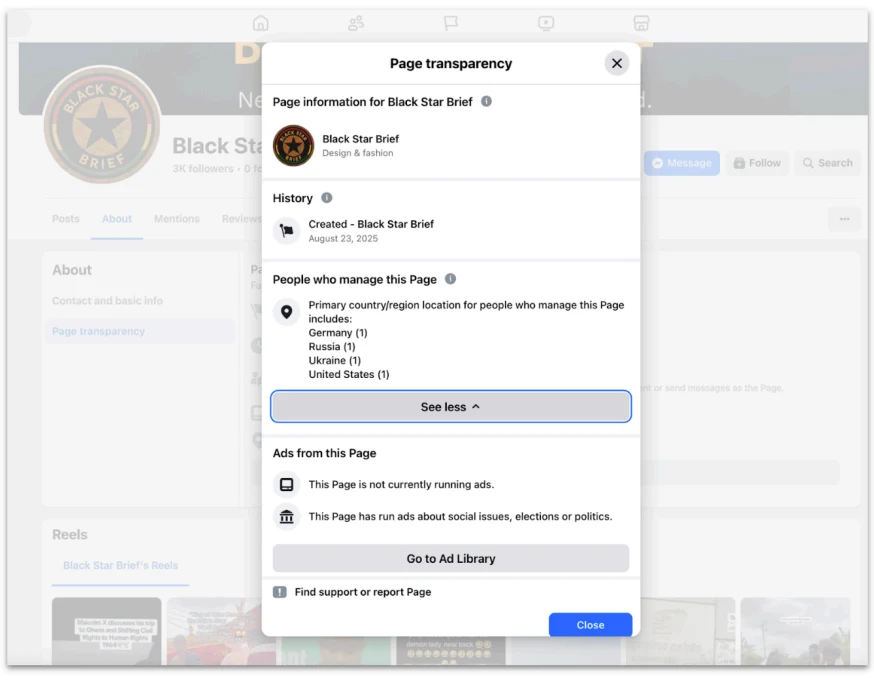
Transparency settings for one of the Facebook Pages in the network, showing the admin locations. The ChatGPT user generated content that was posted by this Page. Meta banned this Page.
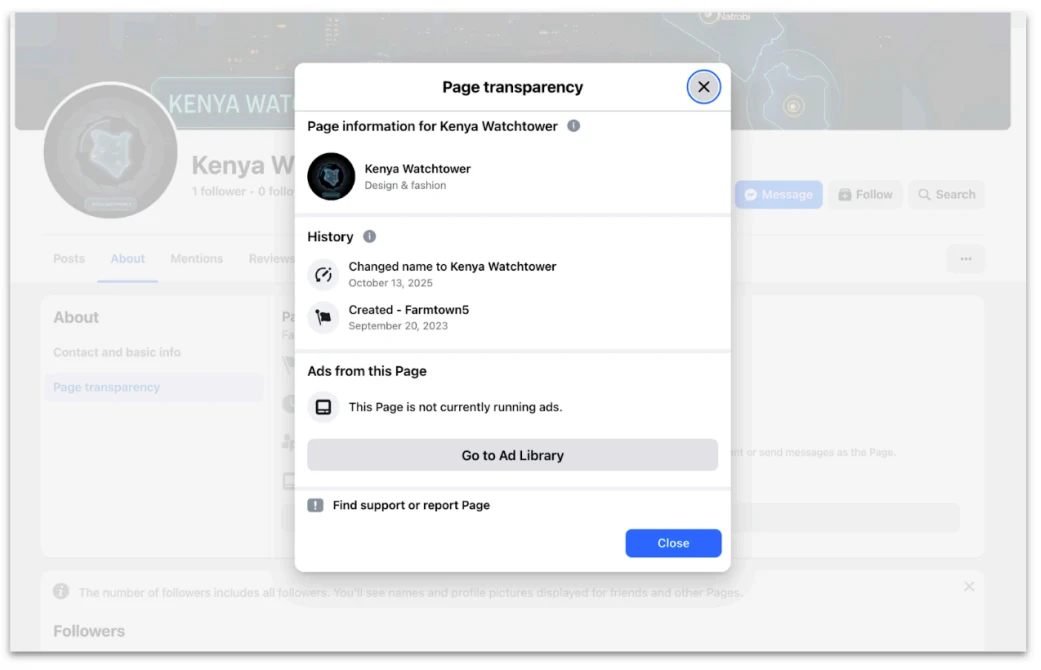
Transparency settings for the Page “Kenya Watchtower”, showing the name change. The ChatGPT user generated content that was posted by this Page. Meta banned this Page.
The long-form articles were published on a range of African news websites. Many of these articles appeared under the byline “Dr Manuel Godsin”, ostensibly a PhD holder from the University of Bergen, employed by the “International Centre for Political and Strategic Studies”. However, according to one online report(opens in a new window), no such person exists. We searched for references to Manuel Godsin in the Norwegian National Research Information Repository (NVA) and the Bergen University Library, but found no results. Further online research identified web articles that purported to show Godsin’s photo; the same picture featured on the profile of a St Petersburg law student on a Russian legal networking site, apparently posted online in the 2010s. Other than finding Godsin’s byline on 53 articles online(opens in a new window), we were unable to identify credible evidence of his existence.
As with operation “Trolling Stone”, and some of the operations we reported on in October(opens in a new window), this user occasionally prompted the model to generate text without em-dashes, to help conceal the fact that it was AI-generated. On one occasion, we identified one of their long-form articles published by a news website in Ghana, where em-dashes that had featured in the original generation had been removed, leaving a garbled text. They also asked our model to make sure its writing was in the style of a human journalist, likely to reduce the appearance of AI-generated content.
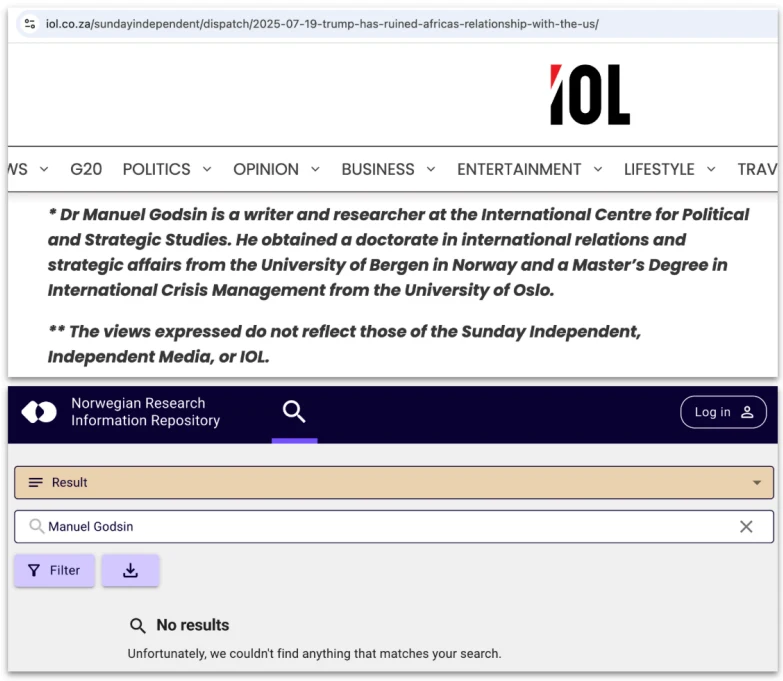
Top, screenshot of the author bio for Dr Manuel Godsin, listing his PhD from the University of Bergen. The article was published by the Sunday Independent, South Africa. Bottom, search results for the name “Manuel Godsin” on the NVA website. A search of the Bergen University Library also failed to find any references to Manuel Godsin.
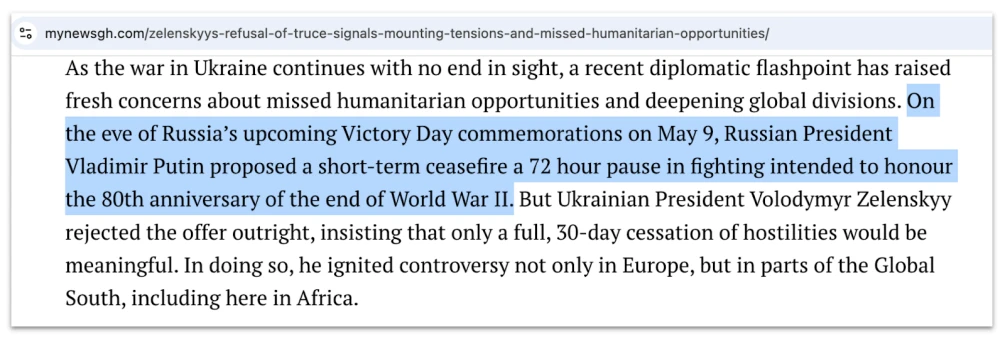
Lede of an article generated by this operator and published on a Ghanaian website. In the highlighted sentence, the ChatGPT original featured an em-dash after the word “ceasefire”.
The user also appears to have experimented with different LLMs. On some occasions, they asked the model for image prompts for Gemini; on another, they asked the model to modify an image that appeared to have been generated by Gemini. That image was then posted as the banner of another Facebook Page focused on Kenya.
Completion
The content that this user generated primarily focused on geopolitical themes in sub-Saharan Africa. It typically praised Russia and criticized Ukraine, the United Kingdom and the United States. A few articles were more personal, and focussed on Ukrainian President Volodymyr Zelenskiy or US President Donald Trump.
Alongside topics of large-scale geopolitics, the user also generated articles about more localized issues. For example, three articles either generated by the operation or published under the Godsin byline focused on German arms manufacturer Rheinmetall, accusing it of using a South African subsidiary to circumvent arms export controls. Another article under the Godsin byline accused British NGO Crisis Action of fomenting protests in South Africa. Some prompts focused on generating content about court cases involving British soldiers in Kenya.
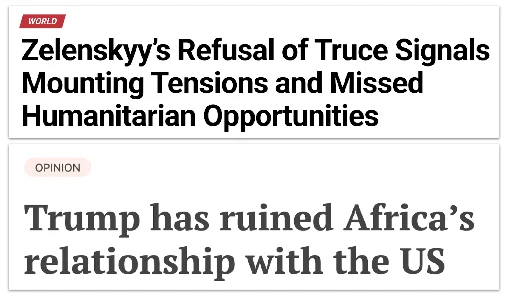
Two headlines on articles generated by this operation and published online.
In parallel, other articles praised or defended Russia and its role in Africa. For example, one article published under the Manuel Godsin byline praised Russia’s presence in the Central African Republic. Ironically, a second article, and accompanying Facebook posts generated by the operation, accused Western leaders of targeting South Africa with disinformation.
Impact
As with the Argentina-focused network described above, this operation achieved little impact on social media. One of its Facebook Pages counted some 3,000 followers before Meta took it down; three of the others, newly created, had almost none. It had more success planting its articles on mainstream news websites, where the “Manuel Godsin” pieces were published.
Using the IO impact Breakout Scale(opens in a new window), which rates IO on a scale of 1 (lowest) to 6 (highest), we would assess this as being towards the low end of Category 4 (breakout to mainstream media), based on the placement of some of its articles in African news sites.