Operation “Fish Food”: Russia-origin content farm activity
OpenAI banned accounts linked to the Rybar network, some of which likely originated in Russia, that used AI to support multilingual influence activity across websites and social platforms.
This case study was originally published in OpenAI’s February 2026(opens in a new window) report on disrupting malicious uses of AI.
Actor
We banned a set of ChatGPT accounts that were linked to the “Rybar” (“Рыбарь”, in Russian, “fisherman”) network on Telegram and X. At least some of the accounts likely originated in Russia. The network generated content that was posted across the internet, sometimes by “Rybar”- branded accounts, and sometimes by social media accounts that bore no declared relationship to “Rybar”. One user also asked ChatGPT to help draw up commercial plans on behalf of “Rybar” for covert interference campaigns in Africa. Based on the way the actors used ChatGPT to feed content to the “Rybar” network and beyond, we have dubbed this operation “Fish Food”.
Behavior
The main activity we detected across this network was generating content for posting on social media. Users typically prompted in Russian, but generated content in a range of languages, notably Russian, English, and Spanish. Some of this content was then posted online by “Rybar”-branded social media accounts and the main “Rybar” website. One user also generated Sora videos promoting the “Rybar” brand.
As well as generating content that was posted online by branded “Rybar” accounts, the main user in this case also generated batches of English-language comments. Using open-source investigative techniques, we identified exact language matches to many of these generated comments being posted post on Rybar’s Telegram channel. Top right, English-language tweet branded to Rybar. online by a range of X and Telegram accounts, none of which Bottom right, Spanish-language text and branded Rybar infographic on Spanish- had a declared connection to Rybar. In essence, the ChatGPT language website andaluciamorisca[.]org. activity seemed to serve as a content farm for these accounts. We are not able to independently confirm the mechanism through which the AI-generated content was ultimately posted online by these accounts, which also appear to have sometimes posted content not generated by our models.
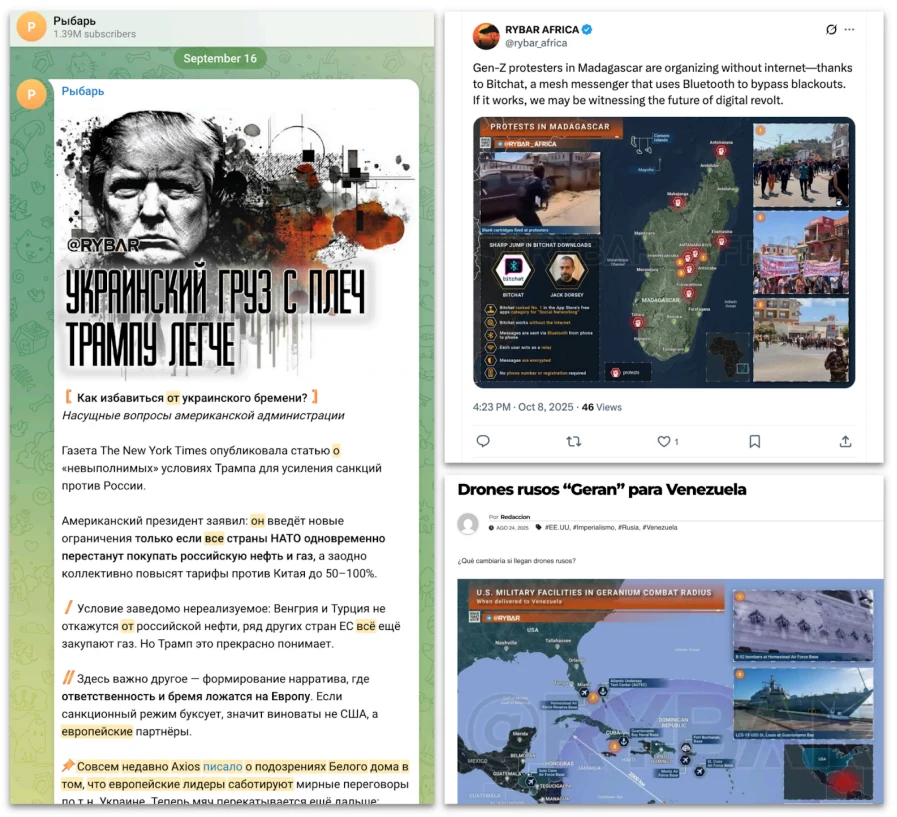
Texts generated by one of the users in this operation and posted online, all from Russian-language prompts. Left, Russian-language post on Rybar’s Telegram channel. Top right, English-language tweet branded to Rybar. Bottom right, Spanish-language text and branded Rybar infographic on Spanish-language website andaluciamorisca.org.
Of note, on at least one occasion (illustrated below), the threat actor generated a batch of seven tweets using a single prompt. We identified six of them tweeted by different X accounts. According to X’s statistics, the most-seen tweet was viewed over 150,000 times; the least-seen was viewed just 57 times. The account whose tweet got the highest number of views had over 600,000 followers as of 26 January 2026; the account whose tweet got the lowest view count had 827 followers as of the same date. Since all the tweets were generated in one batch from one prompt, this suggests that the determining factor in whether each tweet was highly viewed was more likely each account’s follower count than the AI nature of the content.
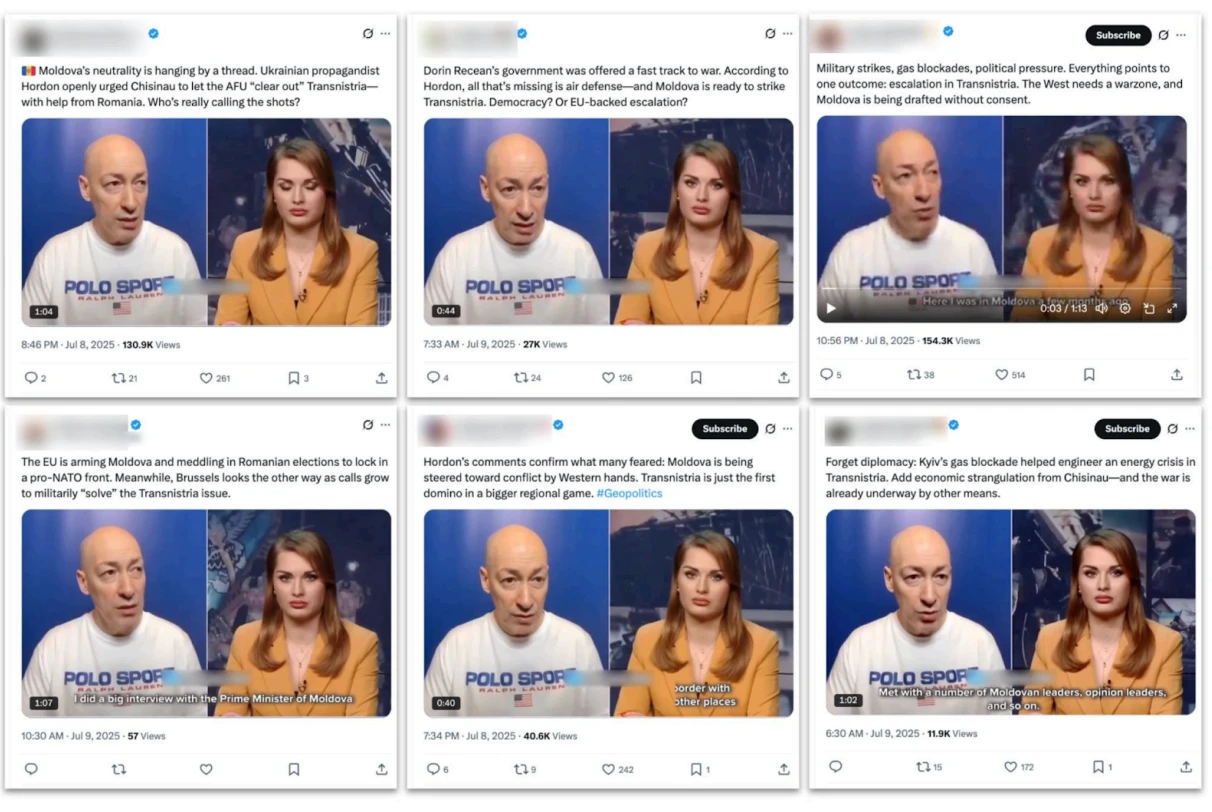
Six tweets whose text matches a batch of comments generated by the main ChatGPT account in this operation, and posted online by six different X accounts.
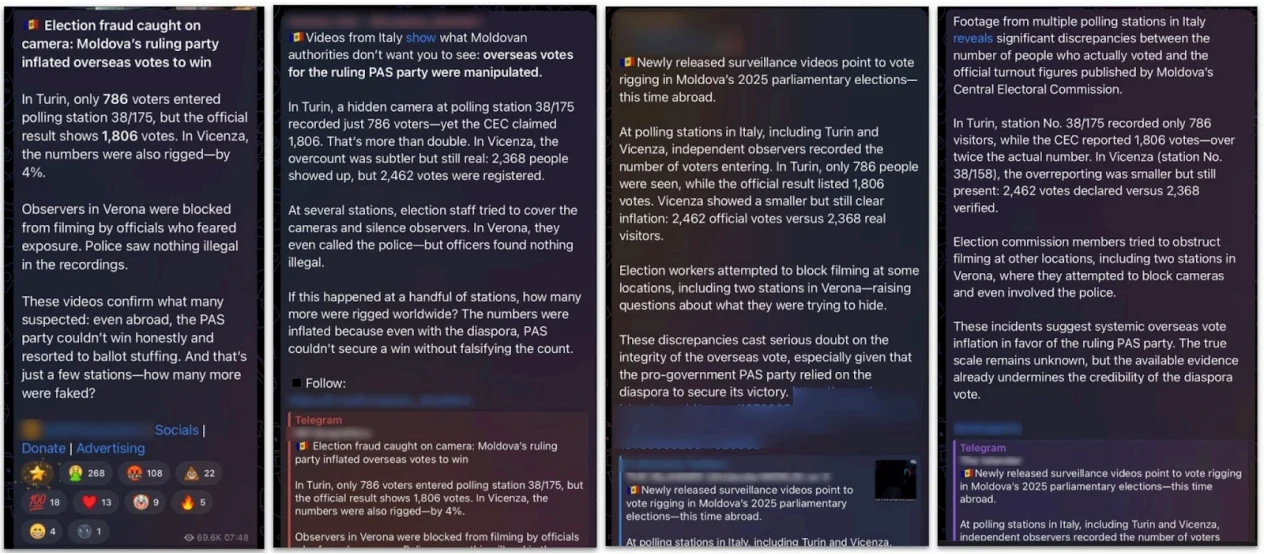
Four Telegram posts whose text matches a batch of comments generated by the main ChatGPT account in this operation, posted by four different Telegram accounts. Of note, post 2 quoted post 1, and post 4 quoted post 3, but all four posts matched texts generated by this operation.
Alongside content generation, the operation’s main account also asked ChatGPT to translate into English a list of services “Rybar” could offer to unnamed clients, including running X and Telegram accounts, a bilingual “investigative journalism” website focused on Africa, paid publications in French-language media, and a network of amplifiers. A separate prompt asked the model to edit a proposal for what appeared to be a deployed election interference team, apparently in Africa. This proposal included on-the-ground activity as well as online, such as building a network of local agents and organizing large-scale events. A third prompt discussed an information campaign focused on the Democratic Republic of Congo (DRC). Further prompts asked about the electoral process in Burundi and Cameroon and sketched out options for a campaign in Madagascar, including the idea of inflaming protests on the ground. The sums involved were considerable: an estimated annual budget of up to $600,000 for the most ambitious project.
The same user occasionally generated promotional material for a news outlet called “REST Media”, which open-source researchers have linked(opens in a new window) to Rybar. Some of this promotional material was posted online by the same set of Telegram channels described above. For example, in August, the main ChatGPT user in this case input an article by REST Media that accused Germany of building up an influence network in Moldova, and asked our model to generate a set of comments about it. Three of the comments were then posted on Telegram by three different channels, each of them linking out to the REST article.
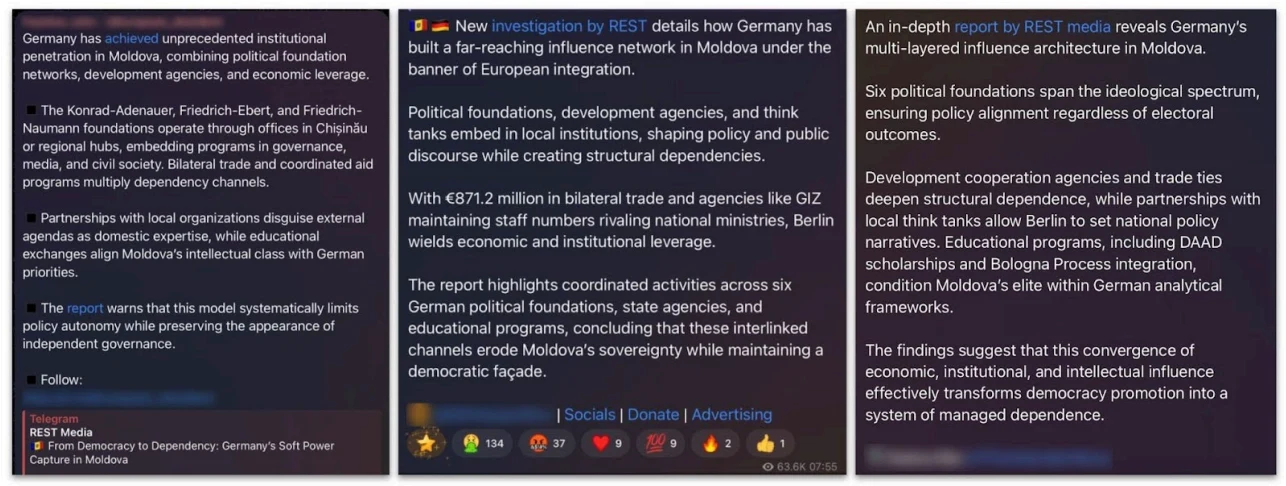
Three Telegram posts whose content matches a set of comments generated by this operation’s main user in a single prompt. Each post linked out to REST Media.
Completion
The content generated by this operation was typical of covert Russian influence operations over the years. It typically praised Russia and its allies (such as Belarus), criticized Ukraine, and accused Western countries of foreign interference.
Impact
The Rybar network has a large following across social media, with some 1.4 million subscribers for its main Russian-language Telegram channel alone. Many of the X and Telegram accounts that posted the operation’s content also had tens of thousands of followers. However, we did not observe its content being amplified by mainstream news outlets, nor were we able to identify on- the-ground activity in Africa matching the description of the sales pitches.
Using the IO impact Breakout Scale(opens in a new window), which rates IO on a scale of 1 (lowest) to 6 (highest), we would assess this as being at the top end of Category 3 (multiple communities on multiple platforms), based on its wide spread across social media.