Operation “Date Bait”: AI-enabled scam targeting loveseekers
OpenAI banned accounts that very likely originated in Cambodia and used AI for scam outreach to Indonesian loveseekers, including translation and engagement.
This case study was originally published in OpenAI’s February 2026(opens in a new window) report on disrupting malicious uses of AI.
Actor
We banned a cluster of ChatGPT accounts and one API customer that were using our models to run a semi-automated romance and task scam likely defrauding hundreds of victims a month. This activity very likely originated in Cambodia and aligns with recent public reporting(opens in a new window) on Chinese-led criminal scam operations in the country. In isolated cases, individual users self-identified as scam workers in Cambodia, such as when asking the model for tax advice and stating their occupation as “scammer”.
Behavior
The network used ChatGPT and API access to our models to conduct a scaled, semi-automated romance task scam, following a structured workflow and operating model reminiscent of cold- outreach sales programs .
1. Ping: At the top of the funnel, the operation used its ChatGPT accounts to generate promotional texts for a high-end dating and escort service called “Klub Romantis”. These texts were then posted on social media as paid ads. The scammers targeted Indonesian men interested in luxury lifestyle content, using ad keywords including “golf”, “yachts”, and “fine dining”. The ads included links to an AI chatbot instructed to pose as a flirtatious receptionist. The purported receptionist asked targets to choose from a menu of types of women and relationships before directing them to Telegram using a tracking URL and promo code.

The “Klub Romantis” logo, created by a scammer in this network using ChatGPT.
2. Zing: Once on Telegram, the operation blended human operators using ChatGPT with API-powered automation. Receptionist personas continued the conversation using increasingly romantic and sexually-explicit language, and then offered targets to join online dating platforms called “LoveCode” and “SexAction”. The platform showed profiles of purported “available girls” and a feed of AI-generated announcements congratulating fictitious clients for completing “missions,” unlocking bonuses, and winning prizes.

An image of a fake receptionist for the “LoveCode” dating platform created by a scammer using ChatGPT.
After building trust, the receptionist persona handed the conversation over to a “mentor,” who used ChatGPT to generate and translate emotionally manipulative messages pressuring targets to complete a sequence of “tasks” or “missions.” Each successive task required increasingly large payments via bank transfers or digital payment wallets, such as purchasing a “VIP An image of a fake receptionist card,” supporting a “chosen girl” in a competition, or paying a for the “LoveCode” dating platform created by a scammer hotel deposit using ChatGPT .
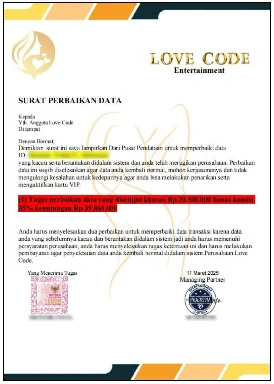
Copy of a letter shared with ChatGPT by a scammer telling a victim they must pay Rp 20,500,000 ($12,000) to rectify a fictitious data processing error in the Love Code system but will receive a 35% “bonus” of Rp 39,860,000. Redactions by OpenAI investigators.
3. Sting: At the final stage, the scammers attempted to collect a larger payment, which they described as the “kill”, by inventing additional fees such as “compensation settlements” or “verification deposits.” Judging by the messages the scammers pasted into ChatGPT, once the victim sent the maximum possible amount, the scammers blocked them on Telegram and marked the case as closed Copy of a letter shared with ChatGPT by a scammer telling a victim they must pay Rp 20,500,000 ($12,000) to rectify a fictitious data processing error in the Love Code system but will receive a 35% “bonus” of Rp 39,860,000. Redactions by OpenAI investigators.
Completion
In addition to the romance scam activity, the operation also used our models to assist them in their day-to-day business operations. This included asking ChatGPT for guidance on how to complete technical tasks, such as integrating the OpenAI API or updating the fake dating service website, analyzing financial accounts, and generating daily reports assigning each target a “kill” value calculated by the scammers - the estimated amount to target in a final extraction.
In other cases, the scammers asked ChatGPT to translate messages between Chinese-speaking supervisors and Indonesian-speaking scam center workers, and tracking performance across departments called “Lead Generation”, “Reception Team”, and “Supervisor Team”.
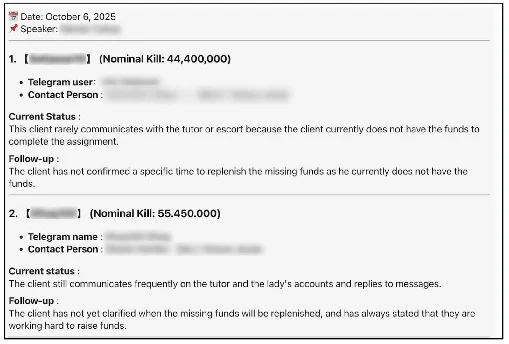
Translated excerpt of a ChatGPT‑generated scammer status report showing the identity and status of each victim, assigned staffing, and the estimated “kill” value in Indonesian Rupiah. Redactions by OpenAI investigators.
Impact
Assessing the impact of this network requires care. Our primary source of evidence is the scammers’ own inputs. Those inputs suggest that the scammers may have been interacting with hundreds of targets at a time, and generating thousands of dollars a day. However, we are not able to independently verify whether these claims were accurate.
OpenAI’s policies strictly prohibit use of output from our tools for fraud or scams. We are dedicated to collaborating with industry peers and authorities to understand how AI is influencing adversarial behaviors and to actively disrupt scam activities abusing our services.