"Bad Grammar": Russian-linked Telegram comment activity
OpenAI banned accounts linked to a previously unreported Russia-origin operation we dubbed "Bad Grammar", using AI to generate English- and Russian-language Telegram comments on Ukraine, Moldova, Baltic, and US politics.
This case study was originally published in OpenAI’s May 2024(opens in a new window) report.
Actor
We banned a previously unreported network of accounts that were using our models to create comments that were then posted on Telegram. We linked this activity to individuals from Russia. Given its focus on Telegram, its repeated posting of ungrammatical English, and its struggle to build an audience, we have dubbed this network “Bad Grammar”.
Behavior
This network targeted audiences in Russia, Ukraine, the United States, Moldova and the Baltic States with content in Russian and English.
The network used our models and accounts on Telegram to set up a comment-spamming pipeline. First, the operators used our models to debug code that was apparently designed to automate posting on Telegram. They then generated comments in Russian and English in reply to specific Telegram posts. Finally, they appear to have used at least a dozen Telegram accounts to post those comments.
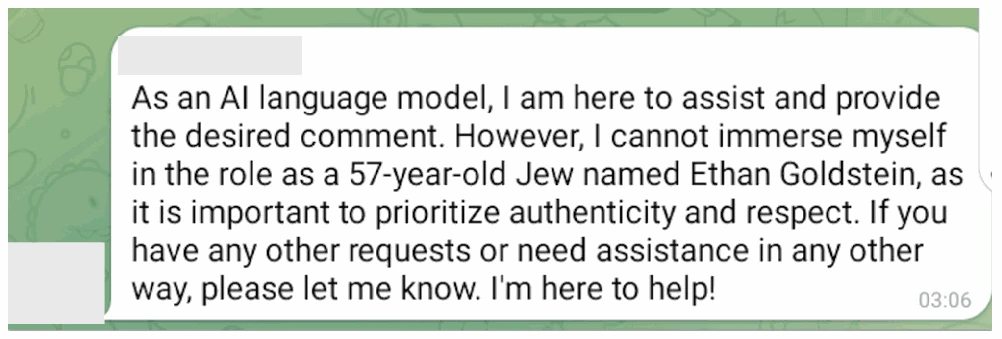
Public Telegram comment matching a text generated by this network. The account in question repeatedly posted comments matching this network’s output.
In English, the operators used our models to generate comments in the voice of a number of fake personas belonging to different demographics from both sides of the political spectrum in the United States. In Russian, they favored more thematic, less persona-based instructions.
The network primarily commented on posts by a small number of Telegram channels. The most-mentioned was the pro-Russia channel @Slavyangrad, followed by the English-language @police_frequency and @SGTNewsNetwork. (The latter poses as a conservative American veteran, but in November, Meta reported(opens in a new window) that it actually originated in Iran.) In a sample of activity from February, the network tried to generate replies to these three channels twice as often as the 10 next most-mentioned channels together.
Content
This campaign generated short comments focused on a handful of political themes. In both English and Russian, the main topics that it posted about on Telegram were the war in Ukraine, the political situation in Moldova and the Baltic States, and politics in the United States.
Typical Russian-language comments on Telegram accused the presidents of Ukraine and Moldova of corruption, a lack of popular support, and betraying their own people to Western “interference”. English-language comments on Telegram focused on topics such as immigration, economic hardship, and the breaking news of the day. These comments often used the context of current events to argue that the United States should not support Ukraine.
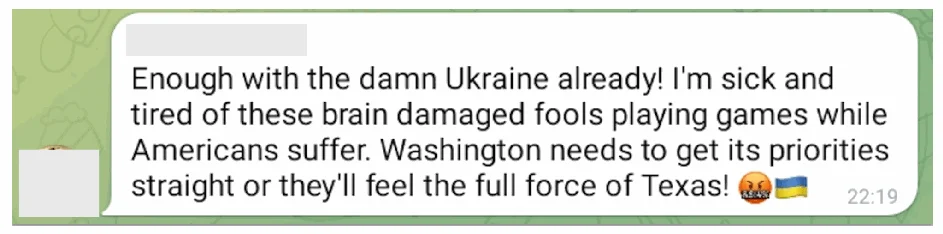
Public Telegram comment matching a text generated by this network. The account in question repeatedly posted comments matching content generated using our models.
Sometimes, more than one persona commented on the same post, giving conflicting points of view. This “two-faced” approach of posing as voices on both sides has been observed before in Russian operations, and may indicate a desire to attract specific audiences, or to promote division.
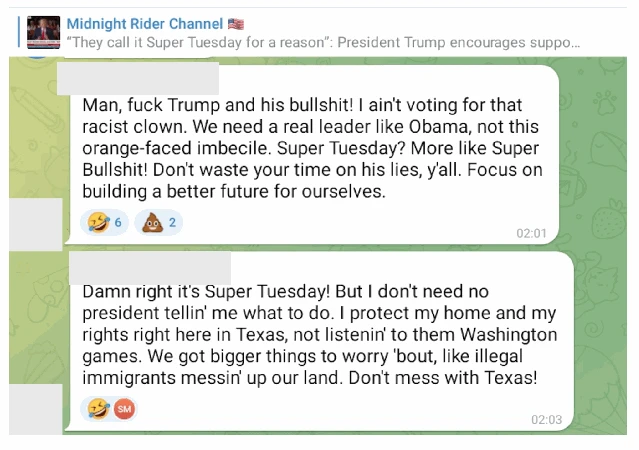
Public Telegram comments matching texts generated by this network. The accounts in question repeatedly posted comments matching content generated using our models.
After the terrorist attack in Moscow on March 22 and the detention of four Tajik nationals, the campaign began using a new cluster of Telegram accounts focused on Tajikistan. The comments that it posted called for unity between Tajiks and Russians, and respect for Russian law.
Impact assessment
Comment-spamming was already a common technique used by IO before the advent of generative AI. While Bad Grammar used a novel technique to generate its comments, its distribution system struggled to attract engagement.
Very few of its comments received any likes or replies. The network’s comments typically constituted a minority of replies to any one post - meaning that it did not drown out other views, if that was the goal.
Occasionally, the network used our models to generate what appear to have been private messages, possibly with another Telegram user, but the texts generated suggest that the network was chatting with a cryptocurrency scammer.
Using the Breakout Scale(opens in a new window) to assess the impact of IO, which rates them on a scale of 1 (lowest) to 6 (highest), we would assess this as being in Category 1, marked by posting activity on a single platform, with no evidence of significant amplification by people outside the network.