Chatham scales its capital markets expertise with OpenAI
Chatham Financial uses Codex and GPT‑5.6 to build technology and redesign workflows, cutting trade validation from 30 minutes to under 4.
Chatham Financial(opens in a new window) advises clients on complex capital markets decisions, where accuracy and auditability are paramount. As AI capabilities advanced, the firm saw an opportunity to turn proven processes into governed, repeatable workflows and software, reducing the time spent on routine execution, so its experts can focus more on client needs.
Today, Chatham uses Codex to build internal and client-facing tools and GPT‑5.6 to power AI features. This work spans employee-built applications, its next-generation capital markets operating system Chatham Onyx, and its reengineering consulting service Process Zero, which accelerated trade validation from 30 minutes to under 4.
“We are not approaching AI simply as a faster way to run every process. With OpenAI, we can start with the outcome we want, identify where judgment matters, and design the best way to deliver it using the capabilities now available.”
Through Process Zero, Chatham reengineers workflows around outcomes. For each workflow, the firm identifies the minimum inputs and evidence required, determines where human judgment is essential, and decides how AI and AI-built tools should support the work.
Trade validation is an early example. Chatham’s Controls and Data Integrity team protects the accuracy of transaction data by validating that each system record reflects what the client authorized and what was executed.
Using Codex, Chatham developed a trade validation application that gathers supporting transaction evidence, compares key terms, and flags discrepancies for review. Chatham is comparing the app’s results with those of experienced reviewers.
“In early measurement, the application reduced review from approximately 30 minutes to under 4 minutes. Just as important, we are validating its performance against real transactions and experienced reviewers before we expand automation. Ultimately, we will be able to produce easily auditable and more accurate results faster.”
Chatham plans to extend the application to additional trade types and automate more of the workflow while maintaining appropriate controls and professional oversight.
Chatham’s client-facing AI work grew from its own operating experience. Chatham’s employees use ChatGPT and Codex in research, analysis, drafting, software development, and other daily activities. AI has become a practical tool widely adopted across the firm.
Employees have also become builders through Chatham Vibes, an internal platform for creating applications tailored to their work. Employees build with a range of models, and the AI features inside Vibes applications run on GPT‑5.6 Terra by default, with GPT‑5.6 Sol as an optional upgrade based on per-app configuration.
These applications increasingly support client-facing workflows. One helps teams review maturing-cap trades and prepare pricing workbooks and client communications. Others support workflows such as producing fixed-income rate sheets, preparing hedging dashboards, and reviewing trade confirmations. Chatham professionals bring the market context, client understanding, and judgment to evaluate the work, refine it where needed, and determine what reaches the client.
Chatham Onyx brings assets, debt, and derivatives into an environment where clients and advisors can work from connected, governed data and use AI without losing traceability to the underlying source.
Chatham uses Codex across the Onyx development lifecycle. Teams use it to help plan, build, test, document, and review software, shortening the path from a concept to a durable product capability.
“Codex is helping our teams turn product vision into working capabilities more quickly, while our standards for accuracy, security, and accountability remain the same.”
The Onyx platform leverages GPT‑5.6 Sol, GPT‑5.6 Terra, GPT‑5.4, and GPT‑4.1. Tasks like simple analysis and non-production testing are routed to the most cost-effective models, while GPT‑5.6 is used for complex tasks that need to maximize accuracy and value.
One example is ChatFIN, which summarizes patterns in historical market data, helps users understand their portfolios, and locates and links to legal documents for debt, derivative, and lease terms.
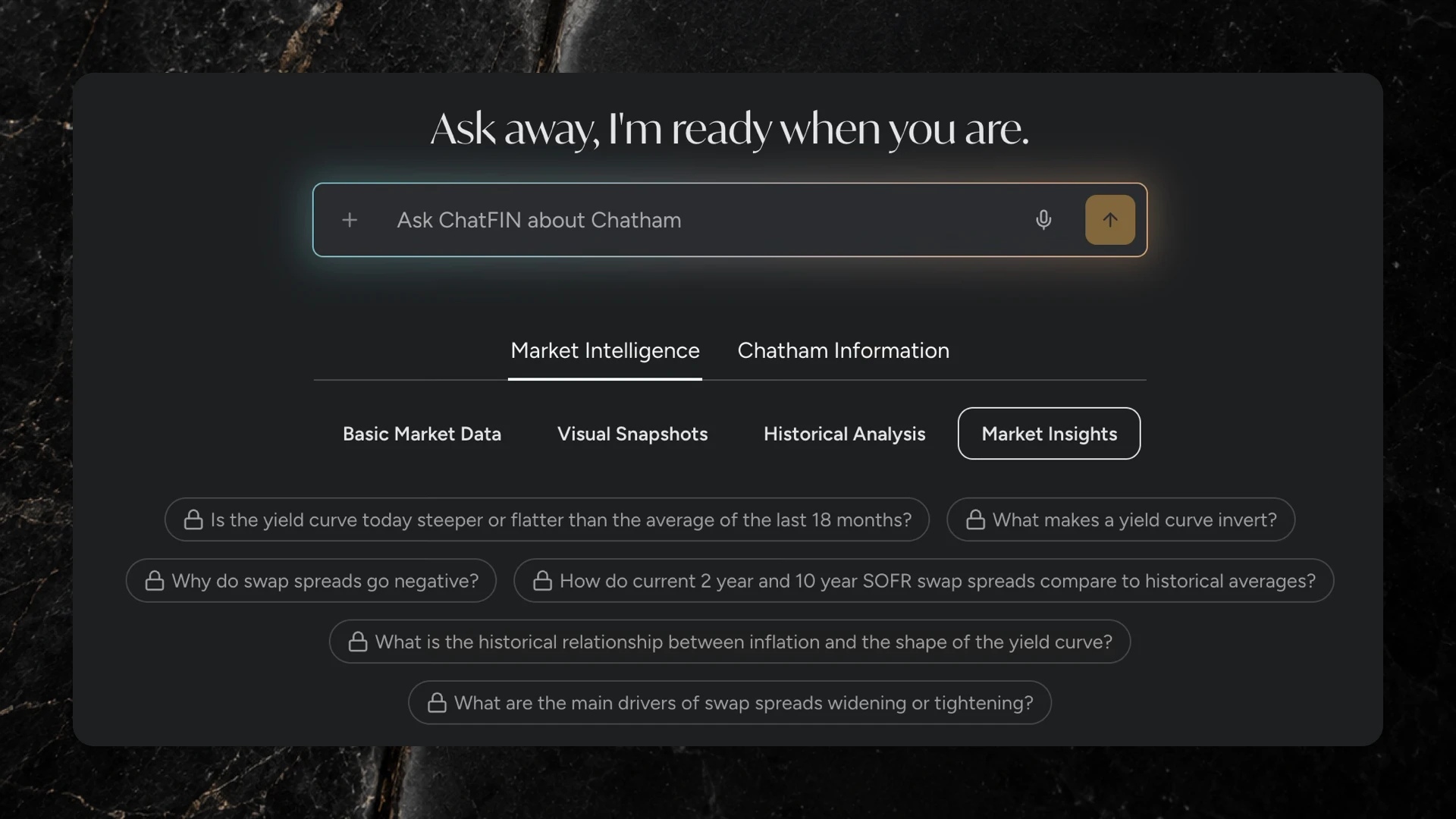
These capabilities help clients and advisors access information and insights, while Chatham’s advisors bring the subject matter expertise needed to interpret that information and apply it to each client.
Chatham is using OpenAI to perform structured comparisons, organize evidence, identify exceptions, and help teams explore information more efficiently. As a result, advisors can spend less time assembling information and more time interpreting it, managing difficult cases, and advising clients.
Next, Chatham plans to expand trade validation across additional products, continue refining employee-built applications, and use Codex to help develop new capabilities for Onyx.
“Our constraint has never been expertise. It is the hours our experts spend getting to the point where they can apply it. OpenAI is helping us take those hours back, and the further we go, the more time our experts can spend applying their judgment where it creates the most value for clients.”