What building an AI-native finance function taught me
Five lessons for CFOs redesigning work around artificial intelligence.
Finance has become a real-time function. To me, the opportunity is much bigger than closing the books faster or refreshing a forecast more often. It is about seeing the business as it changes, helping leaders act sooner, and giving finance teams more time to shape what happens next.
When I joined OpenAI two years ago, there was only a small finance team supporting a company growing at extraordinary speed. We needed to build the function from the ground up and make AI fundamental to how we work, make decisions, and support the business.
I also saw a familiar starting point. Closing the books and updating forecasts still involved manual, recurring work: finding information, explaining what changed, and assembling the inputs for a decision. We had access to the most advanced AI tools in the world, and we were still learning how to redesign finance around them.
So we set two bold ambitions: a zero-day close and automated, continuously updated forecasting.
The idea behind a zero-day close is to give leaders a real-time, reconciled, and traceable view of the company’s financial position. Continuous forecasting builds on that foundation, showing how the business is changing, what could happen next, and which decisions could alter the outcome.
We are still building toward both ambitions. The work has already changed how our team operates. It has pushed us beyond the limitations of static spreadsheets, manual searches for supporting records, and presentations toward live tools built on the full context and data of the business. It has also given finance professionals the ability to build the tools their work requires and carry their expertise further.
For me, that is the real promise of an AI-native finance function: a team that understands what is happening as it happens, helps leaders see the choices ahead, and gives the business more time to act while the outcome can still change.
Getting there requires more than adopting new technology. It requires redesigning work around the decisions that matter, giving people room to experiment, building clear accountability into every workflow, and measuring the dependable work AI completes to provide a clear ROI.
Here are five practical lessons from our experience that every CFO can apply.
The first step was broad access. People need the freedom to explore AI in the context of their own work. Access creates the most value when it is paired with structured experimentation around real problems.
We brought sales engineers into a finance hackathon and asked the team to bring work they wanted to transform. One result was IR-GPT, a custom GPT grounded in the approved materials our investor relations team uses to answer diligence questions. We also began building custom GPTs for areas including procurement and tax.
The hackathon turned AI from an abstract capability into a working tool. In a single day, people could identify a recurring task, build a solution, test it with colleagues, and improve it. The use cases came from the people closest to the work, while technical experts helped them move faster.
For CFOs, the lesson is simple: you need bottom-up experimentation and top-down strategy. Put secure, capable AI in people’s hands and let those closest to the work identify better ways of getting things done. At the same time, focus leadership attention and resources on the changes that will matter most to the business. The real opportunity comes when both meet: practical ideas from the front lines applied to your biggest priorities.
Finance teams spend enormous energy assembling the inputs to a decision. A forecast review might require people to find the latest data, reconcile spreadsheets, explain variances, build charts, prepare documents, and turn those documents into slides. The analysis eventually reaches the decision-maker, but much of the team’s time has already gone into assembling it.
AI changes the unit of work. Finance leaders can redesign the full path from source data to decision.
Consider the close. Every CFO knows the monthly process: actuals in one system, purchase orders in another, accruals in a spreadsheet, and the explanation for a variance buried in a message thread.
We are working toward a different operating model. The ambition behind a zero-day close is to connect approved spending plans, general-ledger actuals, purchase orders, accruals, and transaction details in a continuously reconciled view. Each variance can be traced to the underlying activity. AI can prepare an initial explanation and flag the exceptions that require attention. Finance validates the numbers, applies judgment, and owns the final sign-off.
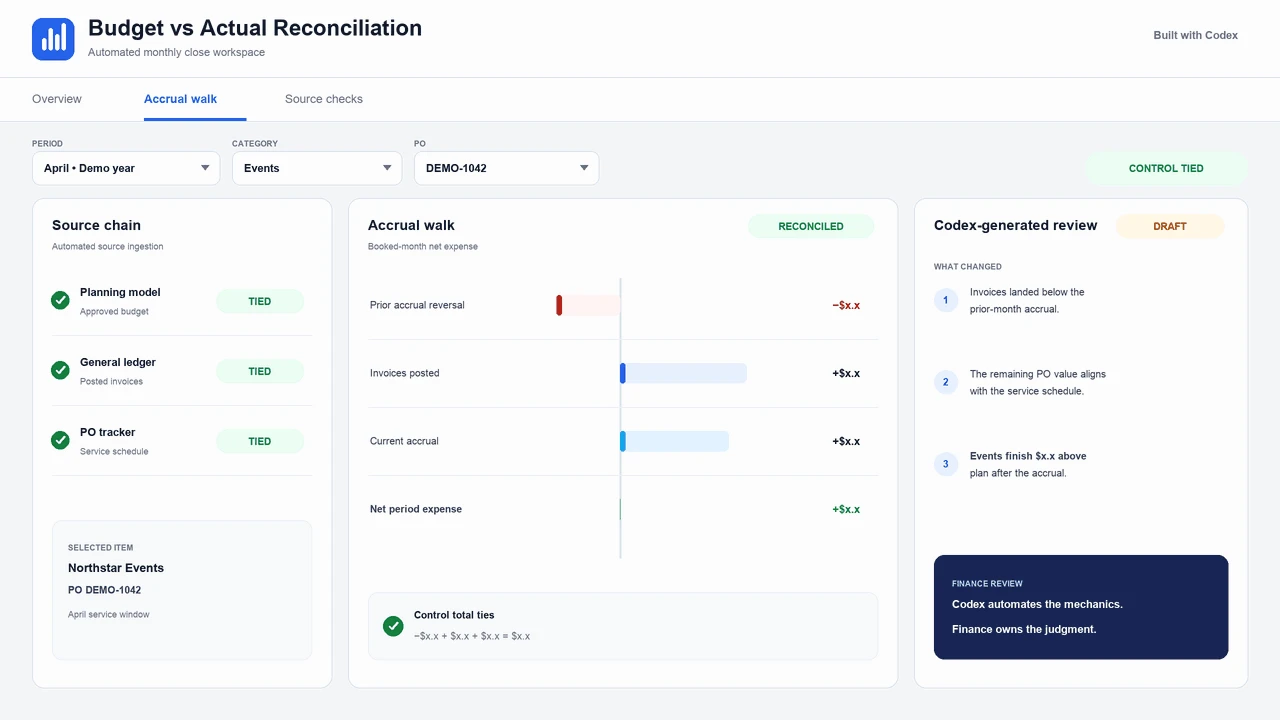
Budget-versus-actuals reconciliation: approved inputs, source checks, and a finance-owned review
The close does not disappear. What begins to disappear is the scramble to reconstruct the business after the period ends.
That reconciled foundation can power a continuously updated forecast. Our team is building workflows that bring together statistical models, sales conversations, account-level evidence, operating data, and finance judgment.
We are moving beyond the limitations of spreadsheets into more interactive tools that bring the statistical forecast, supporting evidence, and scenarios into one live view. Leaders can see what changed, why it changed, and which decisions could change the outcome. When a new customer commitment is missing from the baseline, the system can surface the supporting evidence and show how an adjustment would affect the quarter or year. Finance can inspect the assumptions, compare scenarios, and decide whether to update the approved forecast.

Interactive forecasting and scenario planning
That same view can help leaders make better capital-allocation decisions. A finance team can see where marketing spend is producing a return, where results are tapering, and what reallocating the next dollar could mean.
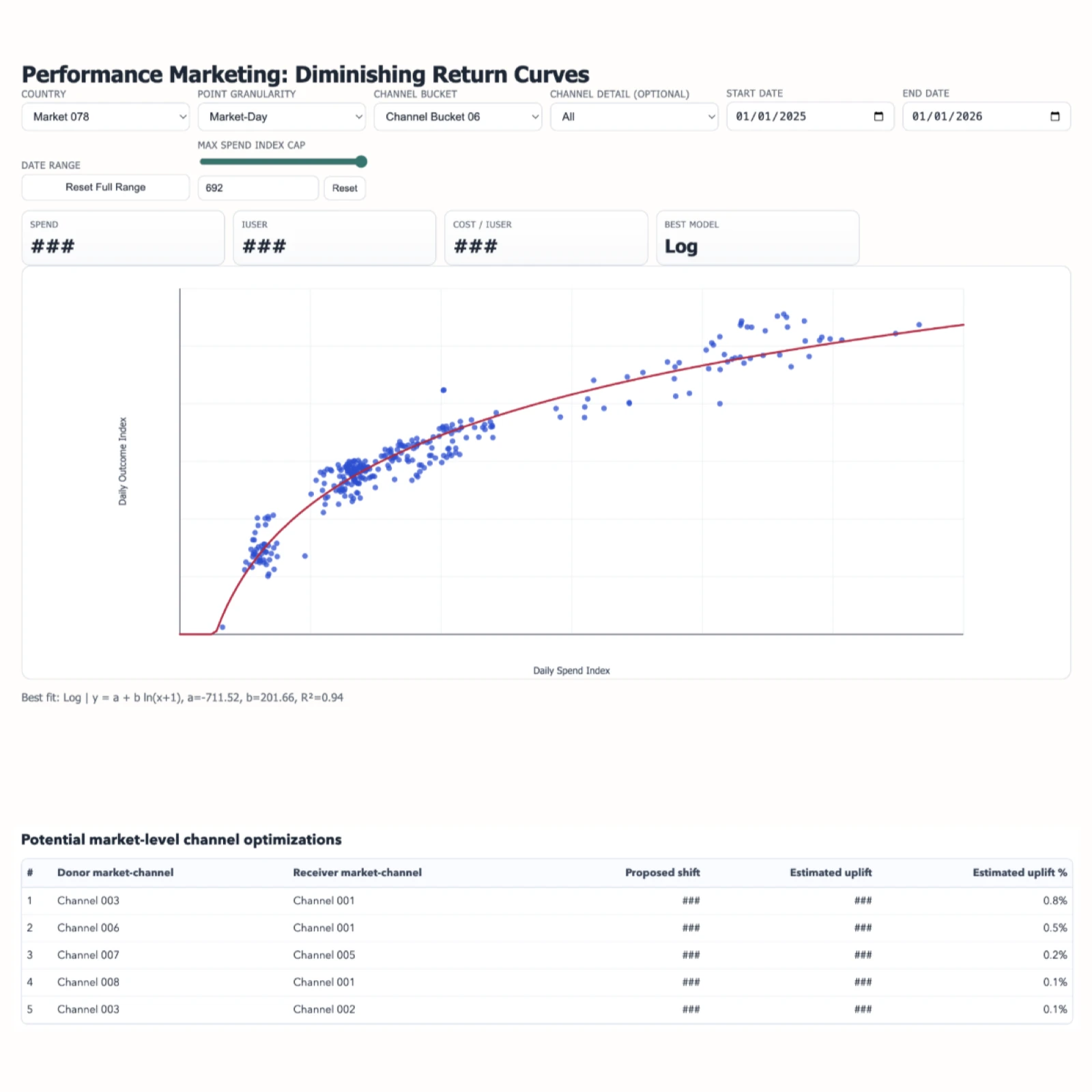
Dynamic capital allocation: diminishing-return curves highlight where investment should be rebalanced
Automated forecasting is the destination. A continuously refreshed view, faster scenario analysis, and clear finance ownership are how we get there.
The broader lesson is to begin with a consequential decision and work backward. Map the data, tools, approvals, and handoffs required to support it. Then determine which parts AI can analyze, coordinate, or complete. This improves the speed and quality of the entire decision cycle.
The bigger transformation is that finance professionals can now build the tools their work requires.
Recent OpenAI research shows that 40% of finance professionals’ specialized AI use involves work outside traditional finance, and 22% involves engineering-related tasks.
Everyone on my team is building custom AI dashboards and tools with ChatGPT Work and Codex. The work is moving from static Excel models and PowerPoint decks toward live dashboards that sit on top of the full context and data of the business. These tools can carry an analysis forward, respond to follow-up questions, and update as the underlying information changes.
One teammate supporting our advertising business had never coded. He used Codex to build a tool that turns our monthly advertising forecast into weekly and daily plans. It accounts for weekdays and holidays, compares forecasts, and keeps every number tied to the approved model. Marketing leaders can quickly see what changed, where to invest, and what additional spending could return.
The people who understand the problem can now shape the solution. Building these tools also prompts them to reconsider the usual way of doing the job. A finance professional can create the decision-making infrastructure the business needs, test it with colleagues, and improve it as the work evolves.
Finance teams are not becoming less specialized. They are gaining the ability to carry their expertise further.
IR-GPT taught us an important lesson about control. Investor diligence questions can require an analyst to search across prior materials, draft a response, check consistency, and coordinate review. With a custom GPT grounded in approved sources, work that previously took hours, and sometimes continued overnight, can now produce a strong first draft in seconds.
The human role remains central. Our investor relations team reads the draft, adds judgment and context, and checks that our answers remain consistent across investors. AI accelerates the work. People own the result.
That is the right model for finance. CFOs should work with IT and governance teams to define which data an AI system can access, which actions it can take, when approval is required, and when an issue should be escalated. Every output should connect to a reliable source. Every forecast should carry a clear explanation. Every change to an approved baseline should require finance authorization.
The brief craze of “tokenmaxxing” has come and gone. It is now straightforward to set usage limits, budget controls, role-based access, model-routing rules, and approval thresholds. CFOs can manage AI usage with the same discipline they bring to any variable expense while giving teams room to build and experiment.
Clear accountability creates the confidence required to move faster. As synthesis, reconciliation, and preparation accelerate, finance professionals gain more time to challenge assumptions, advise the business, and exercise judgment.
CFOs need a scorecard for AI grounded in operating performance. Buying more seats or using more tokens doesn’t tell you much. What matters is whether the work gets done well and what it really costs.
For each workflow, ask four questions:
- Did AI complete work that mattered?
- What did it cost, including employee time, review, and rework?
- Was the result good enough to use?
- Did it help us move faster or make a better decision?
For a finance team, useful work might mean a forecast updated, a variance explained, an audit request completed, or a board question answered. For the close, the scorecard might include cycle time, the share of transactions reconciled automatically, the number of exceptions requiring review, and the time required to explain a variance. For forecasting, it could include forecast accuracy, refresh frequency, time required to produce a new scenario, and the quality of the decisions the forecast supports.
The cheapest model isn’t always the most economical. If a better model gets to a reliable answer with fewer attempts and less review, it may cost less overall.
Finance sits at the center of strategy, capital, data, risk, and performance. That gives CFOs a unique view of how the company works and a powerful mandate to lead its AI transformation.
An AI-native finance function is defined by faster cycles, stronger controls, better decisions, and more time for judgment. The path begins with a meaningful workflow and expands through evidence: give people the tools, help them rebuild the work, keep accountability clear, and measure the outcome.
The zero-day close and continuous forecast express a broader ambition: a finance team that understands what is happening as it happens, shows leaders what could happen next, and helps the company make better decisions sooner.
The result is a finance team with greater capacity and a CFO with a clearer view of the business. It also creates a working model for how the entire company can turn intelligence into durable value. As I always say, you can’t be what you can’t see. If we want our finance teams to embrace what’s possible with AI, we have to show them what it looks like—and as CFOs, that starts with us.
My finance team shared what this looks like in practice, you can watch that recording here(opens in a new window).