Sari la conținutul principal
OpenAI

O bază mai solidă pentru memoria ChatGPT

Îmbunătățirea sintezei memoriei în ChatGPT pentru prospețime, continuitate și relevanță.

Se încarcă…

Astăzi începem să lansăm un sistem mai capabil și mai scalabil pentru sintetizarea memoriei, dezvoltat pentru a aborda provocările legate de învechire, corectitudine și scalabilitate pe care le observăm atunci când memoria este aplicată sutelor de milioane de utilizatori și orizonturilor de timp de mai mulți ani din ChatGPT.

Memoria este ceea ce ajută ChatGPT să îți învețe preferințele, proiectele și constrângerile, permițând conversațiilor viitoare să pornească de la un context comun, nu de la zero.

În ultimii doi ani, memoria a devenit o parte esențială a experienței ChatGPT, ajutând ChatGPT să îți înțeleagă mai bine contextul, astfel încât să te poată ajuta să îndeplinești obiective importante în timp. Acest lucru este esențial pentru a face ChatGPT mai util: să te cunoască, să te ajute și să facă mai multe pentru tine.

Această actualizare este disponibilă astăzi pentru utilizatorii Plus și Pro din SUA și va fi lansată în alte țări și pentru utilizatorii Free și Go în următoarele săptămâni.

Cum a evoluat memoria

Memoria a fost lansată inițial în aprilie 2024 (cunoscută și ca memorii salvate). Funcția îți permitea să îi ceri ChatGPT să rețină informații și să le folosească în conversațiile viitoare.
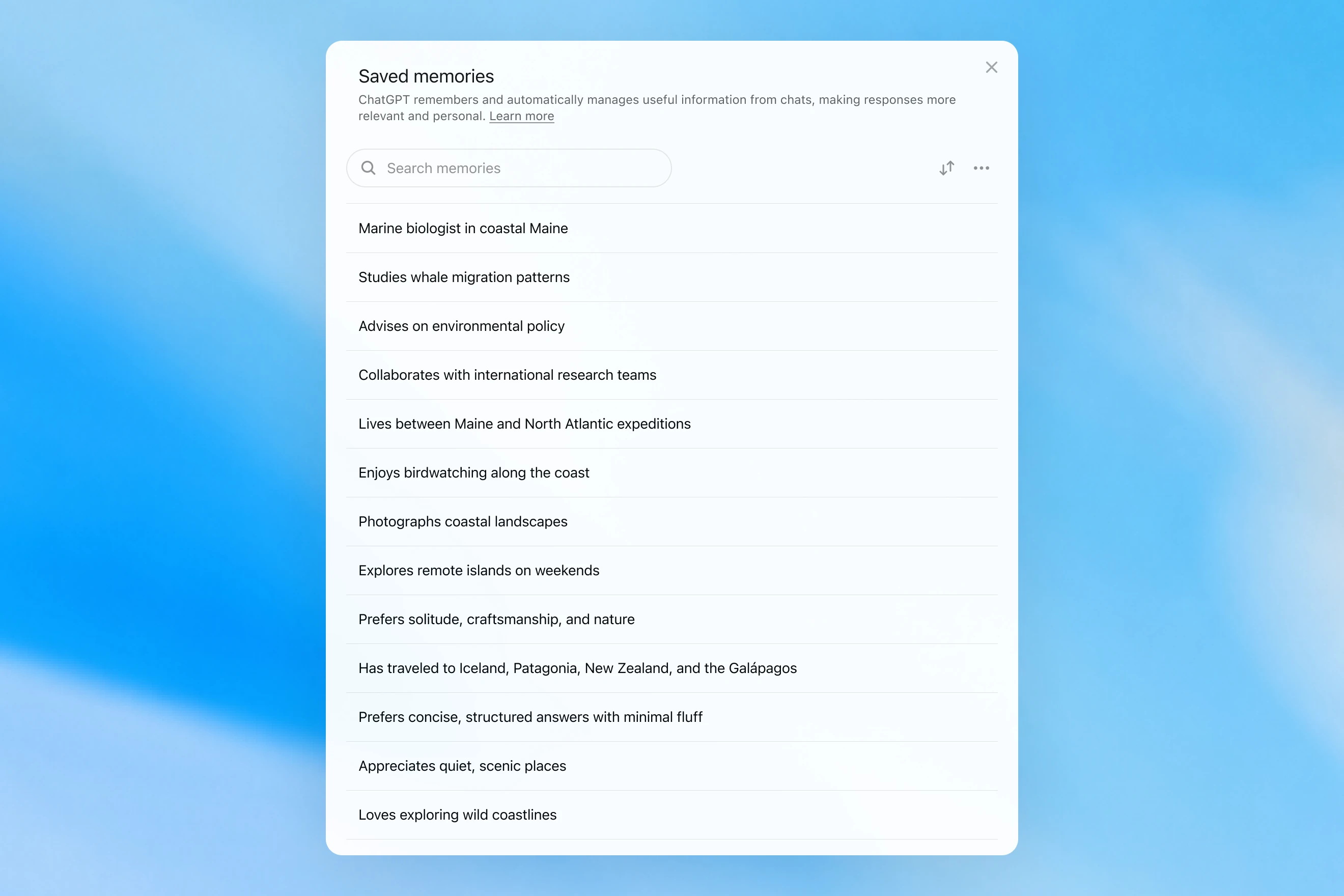
Saved memories modal showing a searchable list of personal details, including work, interests, travel, and response preferences.

Memoriile salvate erau scrise doar în timpul conversației și se bazau pe indicii puternice pentru a decide când să declanșeze memoria, cum ar fi instrucțiunea „ține minte că voi călători la Singapore în iulie”. În practică, interacțiunea cu acest sistem putea semăna cu o discuție cu cineva care își lua câteva notițe, dar uita tot ce nu era scris. De asemenea, memoriile salvate tind să se învechească în timp și, în cele din urmă, să devină incorecte sau irelevante.

În aprilie 2025, am actualizat memoria ChatGPT oferind modelului capacitatea de a consulta contextul conversațiilor din afara listei de memorii salvate; acest lucru a fost realizat prin introducerea primei versiuni de dreaming — o metodă prin care ChatGPT poate organiza automat memoriile în fundal, consultând istoricul conversațiilor.
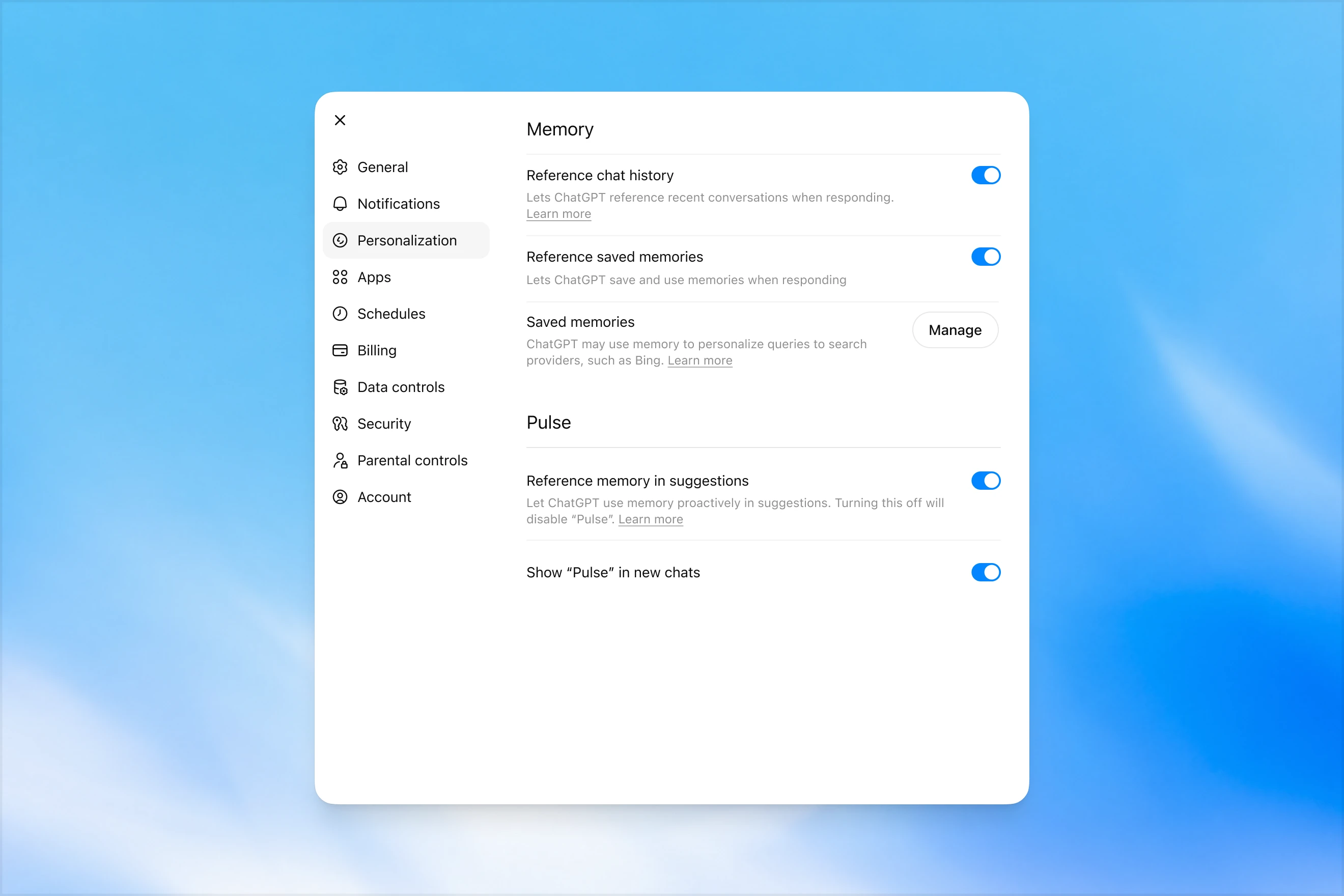
Memory settings page in ChatGPT showing options to reference chat history, use saved memories, manage saved memories, and enable Pulse memory suggestions.

Spre deosebire de memoriile salvate, dreaming folosește un proces de fundal care îi permite ChatGPT să învețe din multe conversații și să sintetizeze starea memoriei ChatGPT pentru a oferi mereu conversațiilor tale cel mai actual și mai relevant context. Dreaming face, de asemenea, mai ușor ca memoria să includă contextul care apare natural în conversație, fără a se baza pe cereri explicite de a reține ceva.

În ultimul an, dreaming a completat memoriile salvate pentru a crea o îmbunătățire majoră a capacității ChatGPT de a personaliza răspunsurile și de a compensa învechirea memoriilor salvate. Cu toate acestea, din punct de vedere istoric, nu a fost niciodată suficient ca sistem de memorie de sine stătător.

Astăzi lansăm o arhitectură de memorie semnificativ mai capabilă și mai eficientă din punct de vedere al calculului, construită pe baza dreaming.

Memoriile sintetizate prin dreaming pot fi revizuite printr-un rezumat al lor, vizibil pe pagina de rezumat al memoriei. Din rezumatul memoriei, poți vedea rapid aspectele principale ale lucrurilor pe care ChatGPT le știe despre tine, poți adăuga sau actualiza informații despre tine și poți oferi instrucțiuni despre ce subiecte ar trebui să aducă în discuție ChatGPT și când. Dacă vrei să aprofundezi o anumită zonă pentru a afla mai multe, discută pur și simplu cu modelul.
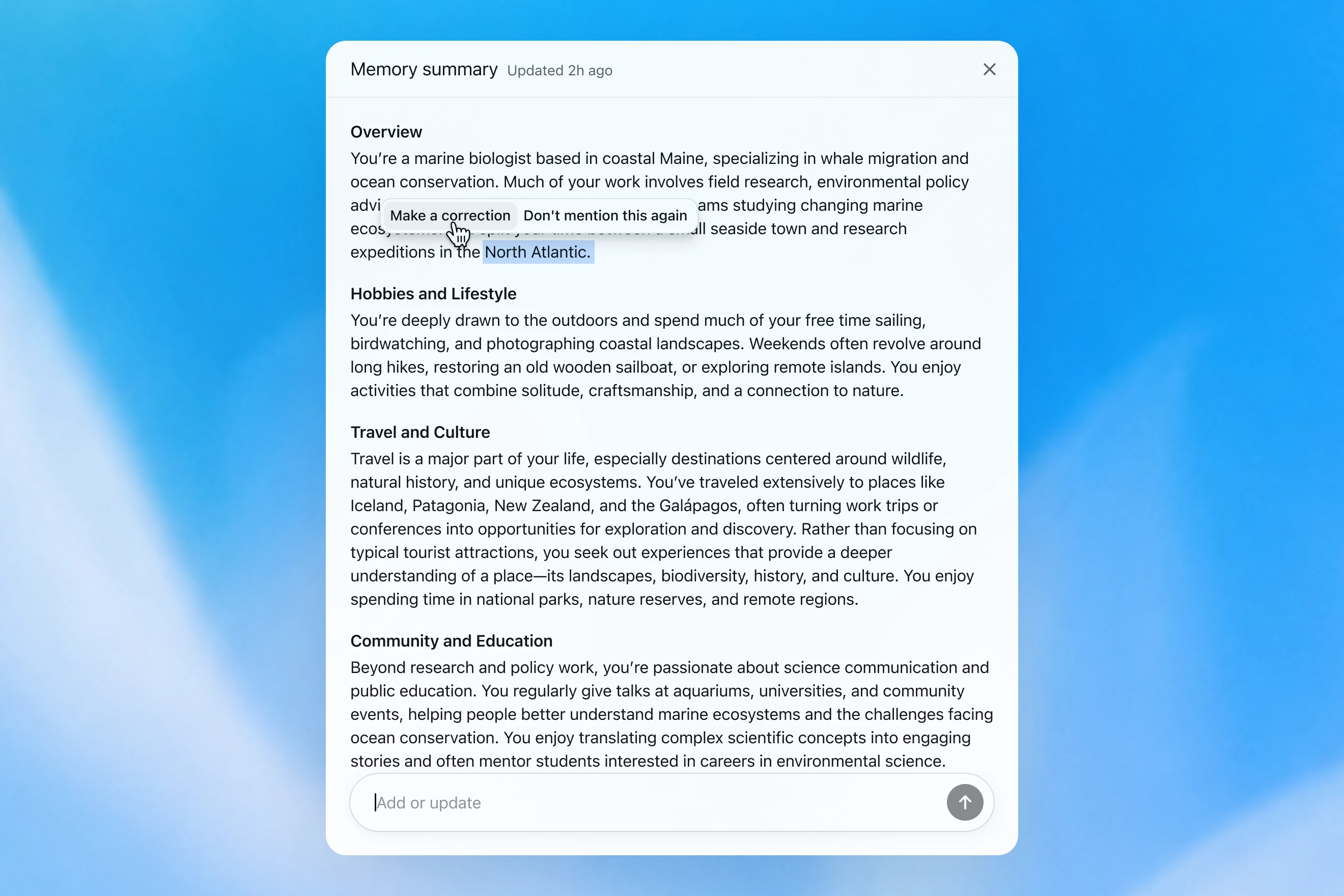
Memory summary modal showing a personalized overview of a user’s work, hobbies, travel interests, and community involvement, with options to correct or dismiss specific details.

Cum evaluăm memoria

Când ne gândim cum arată o „memorie bună” în ChatGPT, ne vin în minte câteva lucruri:

  1. Păstrează contextul util: îi spui ceva o singură dată lui ChatGPT, iar acesta își amintește informația în conversațiile tale ulterioare.
  2. Respectă preferințele și constrângerile: dacă descrii o preferință (de exemplu, ești vegetarian), atunci ChatGPT ar trebui să acționeze în continuare într-un mod consecvent cu acea preferință.
  3. Rămâne actuală în timp: memoria ar trebui să țină cont de trecerea timpului. Imaginează-ți „Utilizatorul își planifică petrecerea de ziua lui pentru sâmbăta viitoare”; în cele din urmă, vine duminica.

Putem evalua cum s-a îmbunătățit în timp memoria ChatGPT Plus și Pro în raport cu fiecare dintre cele trei obiective de memorie de mai sus. Facem acest lucru pentru fiecare dintre:

  1. 2024: Memorii salvate
  2. 2025: Memorii salvate + Dreaming V0
  3. 2026: Dreaming V3

Păstrarea contextului

Când începi o conversație nouă cu ChatGPT, nu trebuie să te prezinți de la zero. ChatGPT îți poate economisi timp și poate construi pe baza contextului anterior, mai ales pentru proiecte complexe, de lungă durată.

De exemplu, imaginează-ți că folosești ChatGPT pentru a cumpăra echipament foto nou, compatibil cu aparatul tău actual. Dacă ai discutat în trecut cu ChatGPT despre configurația camerei tale, poți cere produse compatibile cu „configurația mea foto” și poți primi recomandări personalizate care îți îndeplinesc nevoile.

GPT-5.2 Instant

What would I need to buy to use TTL for my underwater photography setup?

To use TTL flash underwater, you need a compatible chain from camera → housing/trigger → cable → strobe. What you buy depends mostly on whether your setup uses fiber-optic TTL or electrical TTL.

Basic shopping checklist

  • TTL-capable underwater strobe
    Look for strobes that support your TTL type, such as Inon S-TTL, Sea & Sea DS-TTL, Ikelite DS TTL, or compatible Backscatter/Nauticam systems. TTL has to be supported by the strobe, not just the camera.
  • TTL trigger or TTL converter
    This is the key piece. It translates your camera’s flash metering into something the underwater strobe can understand. Examples include Nauticam optical TTL converters, Sea & Sea TTL converters, Backscatter Smart Control optical TTL triggers, or Ikelite DS Link TTL converters, depending on housing and camera brand. Backscatter notes that Nauticam optical TTL converters can work with fiber-optic-connected Inon and Sea & Sea TTL strobes, while Ikelite’s DS Link converters are made around Ikelite DS strobes and electrical sync setups. (Backscatter.com(se deschide într-o fereastră nouă))
  • Connection cable
    For fiber optic TTL, buy one fiber optic cable per strobe. Ikelite’s fiber-optic guide says each strobe needs its own light path, converter/adapter, and cord. (Ikelite(se deschide într-o fereastră nouă))
    For
    electrical TTL, buy the correct sync cord, such as Ikelite-style, Nikonos 5-pin, or housing-specific bulkhead cable.
  • Housing compatibility parts
    You may need a hot-shoe adapter, bulkhead, fiber optic window/adapter, or housing-specific TTL board. Many TTL triggers mount inside the housing on the camera hot shoe.
  • Strobe arms, clamps, tray, and mounting hardware
    TTL controls exposure, but you still need to physically mount and aim the strobes.
  • Batteries and spares
    Bring strobe batteries, trigger batteries if required, spare fiber optic cables or sync cord O-rings, and silicone grease for serviceable O-rings.

Which route should you choose?

Fiber optic TTL is usually easiest if your housing has optical ports or can use the camera’s pop-up flash/LED trigger. It is common with compact, mirrorless, Nauticam, Sea & Sea, AOI, and Olympus/OM TG-style setups.

Electrical TTL is often best if you use Ikelite DS strobes or an Ikelite-style housing/bulkhead. Ikelite says its DS Link TTL converters are faster and more reliable than fiber-optic TTL triggers, and they do not require batteries. (Backscatter.com(se deschide într-o fereastră nouă))

The compatibility rule

You need all three to match:

camera brand/protocol + housing/trigger type + strobe TTL system

For example:

  • Sony camera + Nauticam housing + optical TTL trigger + Inon/Sea & Sea-compatible fiber optic strobe
  • Nikon/Canon/Sony camera + Ikelite housing/bulkhead + Ikelite DS Link TTL converter + Ikelite DS strobe
  • Compact camera with built-in flash + fiber optic cable + S-TTL/DS-TTL-capable strobe

So the practical answer is: buy a TTL-compatible strobe, the correct TTL trigger/converter for your camera and housing, and the right fiber optic or electrical sync cable. The exact part numbers depend on your camera, housing, and strobe model.

Modelul produce un răspuns generic, care îl lasă pe utilizator să facă singur verificări complicate de compatibilitate.

GPT-5.3 Instant

What would I need to buy to use TTL for my underwater photography setup?

I’ll verify this against your actual setup: Sony A1 II in Nauticam NA-A1II, with Backscatter Mini Flash 3 and Inon Z-330 strobes. The key question is whether you want TTL with the Mini Flash 3, the Z-330s, or both.

For your setupSony A1 II + Nauticam NA-A1II + Backscatter Mini Flash 3 + Inon Z-330 — there are two different TTL paths:

Best buy for Mini Flash 3 TTL

Buy:

Backscatter Smart Control TTL LED Nauticam Flash Trigger for Sony
SKU: BS-TR-SN2

Backscatter lists it as custom-designed for Nauticam full-frame Sony housings, TTL-compatible with Mini Flash 3, and the NA-A1II housing page offers it as the “Backscatter Smart Control TTL Flash Trigger” option. (Backscatter.com(se deschide într-o fereastră nouă))

You’d use normal optical fiber cables from the housing to the Mini Flash 3. On the MF-3, you’d use SC or SC Macro mode; Backscatter says SC / SC Macro are the TTL modes for Mini Flash 3, with SC Macro specifically tuned for close macro work. (Backscatter.com(se deschide într-o fereastră nouă))

For Inon Z-330 TTL

For the Inon Z-330, the relevant unit is:

UW Technics 11075-HSS TTL Converter for Sony / Nauticam

UW Technics explicitly lists Inon Z-330 as a compatible TTL strobe and supports optical TTL output. (UWTechnics(se deschide într-o fereastră nouă))

But I would not buy this for Mini Flash 3 TTL. Backscatter’s own UW Technics listing says Backscatter strobes are manual / HSS only on that converter, while the Backscatter Smart Control trigger is the one listed for Sony TTL with the Mini Flash 3. (Backscatter.com(se deschide într-o fereastră nouă))

Practical recommendation

Since you shoot macro and have the Mini Flash 3, I’d buy the Backscatter Smart Control TTL LED Nauticam Flash Trigger for Sony — BS-TR-SN2.

The catch: there probably is no single trigger that gives true TTL for both the Mini Flash 3 and Inon Z-330 at the same time. The Backscatter trigger is the right TTL solution for the MF-3; the UW Technics converter is the right TTL solution for the Z-330. So choose based on which strobe you actually want TTL for.

For your use case, I’d prioritize Mini Flash 3 TTL / SC Macro and treat the Z-330s as manual when needed.

Modelul își amintește configurația camerei utilizatorului și recomandă un produs compatibil.

GPT‑5.2 Instant răspunde în cele din urmă la întrebare, dar în încercarea de a explica limitele sale de siguranță, începe cu un preambul lung despre aspectele cu care nu poate ajuta. GPT‑5.3 Instant, pe de altă parte, intră direct în subiect.

Putem construi o evaluare din exemple asemănătoare, în care modelului i se cere să răspundă la o solicitare ce necesită reamintirea unor informații factuale despre utilizator. Modelul este apoi recompensat dacă răspunde într-un mod care folosește corect contextul relevant. În această evaluare, noul sistem bazat pe dreaming îmbunătățește capacitatea modelului de a-și aminti fapte relevante.

Respectarea preferințelor

Memoria ajută, de asemenea, ChatGPT să răspundă în moduri care se potrivesc mai bine preferințelor și constrângerilor tale.

Imaginează-ți că planifici o călătorie la Singapore. Cu două luni înainte de călătorie, îi ceri ChatGPT să te ajute cu un itinerar. ChatGPT știe deja din planificările de călătorie anterioare că îți place fotografia de natură sălbatică, preferi hotelurile cu aer condiționat puternic și preferi o cină liniștită unui bar aglomerat.

GPT-5.2 Instant
Help me plan a trip to Singapore. I'm going to be there for a work trip in July and will have a few days free at the end.

Great add-on city for a work trip: Singapore is compact, safe, excellent for solo exploring, and easy to do in 2–4 free days. July is hot and humid; expect daytime highs around 31–33°C / 88–91°F, warm nights, and sudden rain, so plan outdoor time early morning or after 5 p.m. and keep midday for museums, malls, cafés, or hotel downtime. Singapore’s official weather service notes typical daily highs of 31–33°C and lows of 23–25°C. (Singapore Weather Service(se deschide într-o fereastră nouă))

memory-preferences-without

A strong 3-day plan

Day 1: Marina Bay, Gardens, and skyline

Start late afternoon at Marina Bay and walk the waterfront: Merlion Park, Helix Bridge, ArtScience Museum exterior, then into Gardens by the Bay. Book Cloud Forest, Flower Dome, and either the OCBC Skyway or Supertree Observatory if views matter to you. Gardens by the Bay lists Cloud Forest and Flower Dome as open daily 9 a.m.–9 p.m.; Supertree Observatory is also listed as 9 a.m.–9 p.m. with last admission at 8:30 p.m., but check maintenance closures before booking. (Gardens by the Bay(se deschide într-o fereastră nouă))

Evening: stay for the Supertree light show area, then dinner at Lau Pa Sat for an easy first-night hawker experience near the CBD. It has 80+ stalls and local staples like satay, laksa, nasi lemak, bak kut teh, kaya toast, and char kway teow. (Laupasat(se deschide într-o fereastră nouă))

Day 2: Culture neighborhoods and food

Morning: Chinatown. Visit Buddha Tooth Relic Temple, walk the shophouse streets, and eat at Maxwell Food Centre or Chinatown Complex Food Centre. Visit Singapore lists Maxwell, Chinatown Complex, Old Airport Road, Tiong Bahru Market, Newton, and others among popular hawker centres. (Visit Singapore(se deschide într-o fereastră nouă))

Afternoon: Kampong Glam and Haji Lane for Sultan Mosque, murals, boutiques, and cafés. Then head to Little India around golden hour for temples, flower garlands, Tekka Centre, and dinner.

Evening: either cocktails around Ann Siang / Club Street, or keep it low-key with a night walk along the Singapore River: Boat Quay to Clarke Quay to Robertson Quay.

Day 3: Nature or beach day

Pick one based on your energy.

For nature: do Singapore Botanic Gardens early, then the National Orchid Garden, followed by lunch in Dempsey Hill or Tiong Bahru. This is the best “green Singapore” day without leaving the city.

For beach/resort mode: go to Sentosa. Choose the southern beaches, Fort Siloso Skywalk, or a beach club. I would skip trying to do every Sentosa attraction unless you love theme parks.

For local food focus: do Tiong Bahru Market for breakfast, National Gallery Singapore midday, then Old Airport Road Food Centre for dinner. The official events page also shows exhibitions and cultural events, so it is worth checking once your exact July dates are fixed. (Visit Singapore(se deschide într-o fereastră nouă))

Best places to stay after the work part

Marina Bay / CBD is easiest if you want polished, walkable, skyline-heavy Singapore and minimal transit.

Chinatown / Telok Ayer / Tanjong Pagar is my top pick for a few free days: great food, MRT access, heritage streets, cocktail bars, and close to work districts.

Bugis / Kampong Glam is better if you want boutique hotels, cafés, street art, and a slightly more relaxed neighborhood feel.

Orchard is convenient for shopping and rainy-day malls, but less atmospheric.

What to book ahead

Book Gardens by the Bay conservatories/Skyway, any special restaurants, and possibly a cocktail bar. For hawker centres, do not over-plan; just go hungry, carry tissues or wet wipes, and be ready to share tables.

July packing notes

Bring breathable work clothes, comfortable walking shoes, a small umbrella, and a light layer for aggressive air-conditioning. I would also plan one “rain-flexible” indoor block each day, because showers can arrive suddenly even when the forecast looks fine.

My suggested balance: Day 1 Marina Bay/Gardens, Day 2 Chinatown–Kampong Glam–Little India, Day 3 Botanic Gardens or Sentosa. That gives you the Singapore highlights without turning your post-work break into another work project.

Modelul produce un răspuns generic, mai turistic, care nu ajută la rezervarea hotelului și ignoră în mare parte interesele utilizatorului.

GPT-5.3 Instant
Help me plan a trip to Singapore. I'm going to be there for a work trip in July and will have a few days free at the end.

I’ll build this around your known constraints: a few free days after work, hot/humid July weather, wildlife/photography/nature bias, strong AC needs for sleep, and good but not overly social dining. I’ll verify current July logistics and then give a practical short itinerary rather than a generic Singapore list.

memory-preferences-with

Here’s how I’d structure it: 2–3 free days, mostly nature / wildlife / photography, with heat-managed mornings and AC breaks. July is hot and humid: Singapore’s July long-term stats are about 31.4°C / 88.5°F average daily max, 25.4°C / 77.7°F min, 146.6 mm rain, and 14 rain days, so outdoor plans should be early morning or evening, not midday. (National Environment Agency(se deschide într-o fereastră nouă))

Best plan for 3 free days

Day 1 — Gardens by the Bay + Marina Bay, low-friction

Morning: Cloud Forest + Flower Dome. This is the obvious “touristy” pick, but it fits you well because it’s visually interesting, good for photography, and climate-controlled. Gardens by the Bay lists Cloud Forest and Flower Dome-type attractions running 9:00am–9:00pm, and Cloud Forest currently has the Jurassic World experience listed as ongoing. (Gardens by the Bay(se deschide într-o fereastră nouă))

Late afternoon / evening: Supertree Grove + Borealis / light show. Gardens currently lists Borealis every Sat, Sun & Mon, 8:00–8:30pm at Supertree Grove, so try to align this with one of those nights. (Gardens by the Bay(se deschide într-o fereastră nouă))

Dinner: do something easy nearby: Marina Bay / Tanjong Pagar / Telok Ayer. For you, I’d prioritize reservation-based restaurants with real tables over hawker centers on the first night, because you dislike cramped solo seating.

Day 2 — Mandai wildlife day

Morning to afternoon: Bird Paradise + River Wonders. Bird Paradise is probably the best fit photographically; River Wonders is less “wildlife photography” and more controlled exhibits, but it pairs well logistically. River Wonders is listed as daily 9:00am–6:00pm, last entry 5:00pm. (Mandai Wildlife Reserve(se deschide într-o fereastră nouă))

Evening: Night Safari. This is the rare Singapore attraction that is genuinely better at night and avoids the worst heat. Night Safari is listed as daily 6:00pm–12:00am, last entry 11:15pm, with tram plus walking trails and over 900 nocturnal animals. (Mandai Wildlife Reserve(se deschide într-o fereastră nouă))

This is a full day. I would not add Singapore Zoo unless you have 4 free days; Mandai can become exhausting fast.

Day 3 — Nature reserve / macro-ish walking + food

Early morning: Singapore Botanic Gardens or MacRitchie / Windsor Nature Park. For a few free days, Botanic Gardens is the safer pick: easier transport, less sweaty, better bailout options, and more consistent casual photography. MacRitchie / Windsor is better if you want more actual forest, but it is hotter, sweatier, and less predictable.

Midday: AC break.

Late afternoon: Joo Chiat / Katong or Chinatown / Telok Ayer for walking, architecture, coffee, and dinner. This gives you a different texture from Marina Bay without turning the day into a logistics project.

My ranking for you

  1. Cloud Forest / Gardens by the Bay — best combination of photogenic, iconic, heat-managed.
  2. Bird Paradise + Night Safari — best wildlife-focused day.
  3. Botanic Gardens early morning — best low-stress outdoor nature.
  4. Joo Chiat / Katong — best neighborhood walk.
  5. Hawker centers — worth doing, but not ideal for your seating preferences unless timed off-peak.

What I’d avoid or deprioritize

I would skip Sentosa unless you specifically want beach/resort stuff. I would also skip a packed “greatest hits” day of Merlion / Orchard / Little India / Chinatown / Clarke Quay; it’s inefficient and hot. For you, the trip will be better if each day has one strong anchor plus one easy evening plan.

Hotel / sleep note

Since this is a work trip, your hotel may be fixed. If you can choose or extend at the same hotel, the hard gate is still AC. Singapore hotels are generally AC-heavy, but your requirement is unusually strict.

One thing I need to make this concrete

Send the exact free dates and whether your work hotel is fixed. Then I’d turn this into a day-by-day plan with restaurant targets and a hotel/AC callout.

Modelul produce un răspuns personalizat în funcție de interesele utilizatorului pentru fotografia de natură sălbatică, cine liniștite și prioritățile sale la rezervarea unui hotel.

GPT‑5.2 Instant răspunde în cele din urmă la întrebare, dar în încercarea de a explica limitele sale de siguranță, începe cu un preambul lung despre aspectele cu care nu poate ajuta. GPT‑5.3 Instant, pe de altă parte, intră direct în subiect.

Preferințele pot lua mai multe forme:

  1. Instrucțiuni despre cum ar trebui să răspundă ChatGPT („nu-l mai aduce în discuție pe Stan”).
  2. Preferințele sau constrângerile tale personale („Sunt vegetarian”)
  3. Preferințe implicite care modelează ceea ce este relevant pentru tine („Locuiesc lângă San Francisco” → opțiunile locale ar trebui adaptate acestei zone)

În dezvoltarea noului sistem de memorie, am îmbunătățit capacitatea ChatGPT de a aplica preferințe relevante din conversațiile anterioare. Pornind de la exemplul „Sunt vegetarian” de mai sus, putem evalua dacă modelul folosește corect memoria pentru a produce opțiuni de masă potrivite pentru vegetarieni atunci când un utilizator vegetarian cere sugestii pentru pregătirea meselor.

Menținerea actualității în timp

Timpul nu se oprește când conversația ta se încheie.

Sistemele tradiționale de memorie se pot învechi. De exemplu, îi spui ChatGPT „Sunt în Singapore și am nevoie de o recomandare pentru cină în seara asta”. Apoi trece timpul, călătoria ta se termină și te întrebi de ce ChatGPT crede că încă ești în Singapore.

Cu dreaming, memoriile sunt actualizate automat pe măsură ce timpul trece, permițându-i ChatGPT să își revizuiască memoria de la „Vei merge la Singapore în iulie” la „Ai fost la Singapore în iulie 2026” atunci când călătoria se încheie. Apoi, când te întorci acasă, ChatGPT poate oferi din nou recomandări adaptate locației tale de acasă și fusului tău orar.

GPT-5.2 Instant

Help me find something for take-out tonight that's still open.

It’s about 5:19 AM Sunday in Singapore, so your safest take-out/delivery bets are 24-hour places.

Best bets right now:

  1. McDelivery / McDonald’s Singapore — easiest islandwide option; McDonald’s says McDelivery is available 24 hours, 7 days a week. Breakfast menu should be on now. (McDonald's Singapore(se deschide într-o fereastră nouă))
  2. Srisun Express — good for prata, Indian Muslim food, local comfort food; their site says they’re halal-certified and open 24/7. (Sri Sun Express(se deschide într-o fereastră nouă))
  3. 89.7 Supper Club — good if you’re near Changi Village or Geylang East; their outlets page says both locations are open 24 hours, 7 days a week. (89.7 Supper Club(se deschide într-o fereastră nouă))
  4. 126 Dim Sum Wen Dao Shi — worth checking on GrabFood/foodpanda if you’re in the East; a 2025 guide says it runs till 5:30 AM on weekdays and round-the-clock on weekends. Since it’s Sunday morning, it may still be available. (Eatbook(se deschide într-o fereastră nouă))
  5. Prata around Geylang / Serangoon / Bedok / Jalan Kayu — look in GrabFood or Google Maps for “prata open now”; guides list multiple 24-hour prata/supper spots, including Mufiz Prata Corner and RK Eating House. (Eatbook(se deschide într-o fereastră nouă))

For the fastest path: open GrabFood / foodpanda / Deliveroo, set filter to Open now, then search “prata,” “McDonald’s,” “Srisun,” “89.7,” “dim sum,” or “nasi lemak.” If you tell me your neighborhood or nearest MRT, I’ll narrow it to specific nearby places.

Modelul crede că utilizatorul este încă în Singapore.

GPT-5.3 Instant

Help me find something for take-out tonight that's still open.

I’ll use Portola Valley / Ladera as the starting point and prioritize places that are plausibly open for takeout tonight, then narrow to low-friction options rather than a huge list.

For tonight, Saturday May 30, near Ladera / Portola Valley, I’d start here:

  1. Alpine Inn — safest casual pickup option. Open Saturday until 9:30 pm and has Order Takeout on its site. Good for burgers / tavern food. (Rossotti's Alpine Inn(se deschide într-o fereastră nouă))
  2. Taverna Portola Valley — nearby at Ladera Country Shopper; open daily, Saturday dinner until 9:00 pm. Better if you want Greek / Mediterranean. (TAVERNA Portola Valley(se deschide într-o fereastră nouă))
  3. Portola Bistro — also nearby; Saturday dinner until 9:30 pm. Good option for Italian / Mediterranean / pizza-ish dinner. (Portola Bistro -(se deschide într-o fereastră nouă))
  4. Amigos Grill — Mexican, very close in Ladera Country Shopper. Official site says call to order at 650-851-3997; DoorDash / order.online lists pickup/delivery ordering until 8:40 pm. (Amigos Grill(se deschide într-o fereastră nouă))
  5. State of Mind Slice House, Palo Alto — best fallback if you want pizza and can drive farther; Friday–Saturday hours are 11 am–10 pm. (State of Mind Slice House(se deschide într-o fereastră nouă))

My pick: Alpine Inn for easiest local takeout, Taverna if you want something less heavy, State of Mind if it’s later and you want the most reliable post-9 pm option.

Modelul oferă răspunsuri relevante pentru locația de acasă a utilizatorului.

GPT‑5.2 Instant răspunde în cele din urmă la întrebare, dar în încercarea de a explica limitele sale de siguranță, începe cu un preambul lung despre aspectele cu care nu poate ajuta. GPT‑5.3 Instant, pe de altă parte, intră direct în subiect.

În evaluările noastre privind memoria, măsurăm dacă ChatGPT poate răspunde corect la solicitări în care trecerea timpului afectează semnificativ răspunsul sau recomandarea corectă. Dreaming aduce o îmbunătățire substanțială în această zonă:

O bază mai scalabilă pentru viitor

La OpenAI, misiunea noastră este să ne asigurăm că inteligența generală artificială aduce beneficii întregii omeniri.

Deși memoria bazată pe dreaming a fost disponibilă utilizatorilor Plus și Pro de ceva timp, abia acum putem oferi utilizatorilor Free o versiune care îndeplinește standardul nostru de calitate și este practică de furnizat la scară largă. Îmbunătățirile recente au redus de aproximativ 5 ori calculul necesar pentru a furniza dreaming utilizatorilor Free, făcând posibilă începerea lansării dreaming pentru utilizatorii Free în următoarele săptămâni și creșterea capacității memoriei pentru utilizatorii Plus și Pro.

Privind înainte, dreaming ne oferă acum o bază comună de memorie pentru toți utilizatorii. Această actualizare reprezintă cel mai capabil sistem de memorie al nostru de până acum și vom continua să îl îmbunătățim.

Pentru a afla mai multe despre această versiune și despre comenzile utilizatorului pentru memorie, vizitează Întrebările frecvente despre Memorie(se deschide într-o fereastră nouă).


Autor

OpenAI