Preskočite na glavni sadržaj
OpenAI

27. april 2026.

Inženjering

Specifikacija otvorenog koda za Codex orkestraciju: Symphony

Autori: Alex Kotliarskyi, Victor Zhu i Zach Brock

Učitavanje…

Prije šest mjeseci, dok smo radili na internom alatu za produktivnost, naš tim je donio (u to vrijeme) kontroverznu odluku: izgradit ćemo naš repozitorij bez ijedne linije koda koju je napisao čovjek. Svaka linija u repozitoriju našeg projekta morala je biti generisana pomoću Codexa.

Da bismo to omogućili, redizajnirali smo naš inženjerski radni tok iz temelja. Izgradili smo repozitorij prilagođen agentima, mnogo ulagali u automatizirane testove i zaštitne mehanizme te tretirali Codex kao punopravnog saigrača. To putovanje dokumentovali smo u našoj prethodnoj objavi na blogu o harness engineeringu (razvoju infrastrukturnog okvira za agente).

I uspjelo je, ali tada smo naišli na sljedeće usko grlo: stalno mijenjanje konteksta.

Da bismo riješili ovaj novi problem, izgradili smo sistem pod nazivom Symphony. Symphony(otvara se u novom prozoru) je orkestrator agenata koji tablu za upravljanje projektima poput Lineara pretvara u kontrolnu ravan za agente za kodiranje. Svaki otvoreni zadatak dobija agenta, agenti rade neprekidno, a ljudi pregledaju rezultate.

Ova objava objašnjava kako smo kreirali Symphony—što je u nekim timovima rezultiralo povećanim brojem spojenih pull requestova od 500%—i kako ga iskoristiti da vlastiti alat za praćenje problema pretvorite u uvijek aktivan orkestrator agenata.

Granice interaktivnih agenata za kodiranje

Mada postaju lakši za korištenje, agenti za kodiranje—bilo da im se pristupa kroz web aplikacije ili CLI—su i dalje interaktivni alati.

Kako se obim agentskog rada povećavao u OpenAI-ju, otkrili smo novu vrstu opterećenja. Svaki inženjer bi otvorio nekoliko Codex sesija, dodijelio zadatke, pregledao rezultate, usmjeravao agenta i to ponavljao. U praksi, većina osoba je mogla udobno upravljati s tri do pet sesija istovremeno prije nego što bi im promjena konteksta postala problem. Nakon toga je produktivnost opadala. Zaboravljali bismo koja sesija šta radi, skakali između terminala da agente vratimo na pravi put i otklanjali probleme u dugotrajnim zadacima koji bi zastali na pola.

Agenti su bili brzi, ali imali smo usko grlo u sistemu: ljudsku pažnju. U suštini smo izgradili tim izuzetno sposobnih mlađih inženjera, a zatim smo naše ljude, inženjere, zudužili da ih mikromenadžuju. Takav sistem nije mogao da raste.

Promjena perspektive

Shvatili smo da optimizujemo pogrešnu stvar. Naš sistem smo orijentisali oko sesija kodiranja i spojenih PR-ova, iako su PR-ovi i sesije zapravo samo sredstvo do cilja. Radni tokovi u razvoju softvera u velikoj mjeri su organizovani oko isporuka: problema, zadataka, tiketa, prekretnica.

Zato smo se zapitali šta bi se dogodilo kada bismo prestali direktno nadzirati agente i umjesto toga im dopustili da sami preuzimaju posao iz našeg alata za praćenje zadataka.

Ta ideja postala je Symphony, pisana specifikacija koja funkcioniše kao supervizor za orkestraciju agentskog rada.

Pretvaranje našeg alata za praćenje prpoblema u orkestratora agenata

Symphony je počeo s jednostavnim konceptom: svaki otvoreni zadatak treba da preuzme i završi agent. Umjesto upravljanja Codex sesijama u više kartica, naš alat za praćenje problema pretvorili smo u upravljački panel.


U ovoj postavci, svaki otvoreni problem u Linearu se mapira na namjenski radni prostor agenta. Symphony neprekidno prati tablu zadataka i osigurava da svaki aktivni zadatak ima agenta koji radi u petlji dok zadatak ne bude završen. Ako se agent sruši ili zastane, Symphony ga ponovo pokreće. Ako se pojavi novi posao, Symphony ga preuzima i počinje organizovati rad.

Naš radni tok smo izgradili na osnovu statusa tiketa, koristeći alat za upravljanje zadacima, Linear, kao mašinu stanja.

Agenti za kodiranje koriste statuse Lineara kao mašinu stanja da bi radili zajedno s nama.

U praksi, Symphony razdvaja posao od sesija i od pull requesta. Neki problemi proizvode više PR-ova kroz različite repozitorije; drugi su čisto istraživanje ili analiza koji nikada ne dodirnu bazu koda.

Kada se posao apstrahuje na taj način, tiketi mogu predstavljati mnogo veće cjeline rada.

Symphony redovno koristimo za orkestraciju složenih funkcionalnosti i migracije infrastrukture. Naprimjer, možemo kreirati zadatak u kojem tražimo od agenta da analizira bazu koda, Slack ili Notion, te izradi plan implementacije. Kada budemo zadovoljni planom, agent generiše stablo zadataka, razlažući posao na faze i definišući zavisnosti između zadataka.

Agenti počinju raditi samo na zadacima koji nisu blokirani, tako da se izvršavanje za ovaj DAG (niz koraka izvršavanja) odvija prirodno i optimalno paralelno. U primjeru ispod označili smo da je React nadogradnja blokirana migracijom na Vite. Očekivano, agenti su počeli nadograđivati React tek nakon što je migracija na Vite bila završena.

Agenti mogu i sami kreirati posao. Tokom implementacije ili pregleda, oni često uoče poboljšanja koja izlaze izvan opsega trenutnog zadatka: problem s performansama, priliku za refaktorisanje ili bolju arhitekturu. Kada se to desi, oni jednostavno kreiraju novi problem koji kasnije možemo procijeniti i rasporediti—mnoge od tih naknadnih zadataka također preuzimaju agenti. Dok mi nadgledamo ovaj proces, agenti ostaju organizovani i održavaju posao u pokretu.

Ovakav način rada drastično smanjuje kognitivni trošak pokretanja nejasno definisanog posla. Ako agent nešto pogriješi, to je i dalje korisna informacija, a naš trošak je skoro nula. Možemo vrlo jeftino kreirati tikete da agent ode praviti prototipe i istraživati, i odbaciti sva istraživanja koja nam se ne dopadnu.

Budući da orkestrator radi na razvojnim mašinama i nikada ne spava, zadatke možemo dodavati odakle god želimo, znajući da će ih agent preuzeti. Naprimjer, jedan inženjer u našem timu napravio je tri značajne promjene iz Linear aplikacije na svom telefonu, iz udobne kolibe na lošem wifi-ju.

Rast istraživanja zahvaljujući ovakvom načinu rada

Kada smo posmatrali efekte rada sa Symphonyjem, najočitija promjena je uočena u izlazu. U nekim timovima u OpenAI-ju vidjeli smo da se broj spojenih PR-ova povećao 6 puta u prve tri sedmice. Izvan OpenAI-ja, osnivač Lineara, Karri Saarinen, istakao je porast broja kreiranih radnih prostora(otvara se u novom prozoru) nakon što smo objavili Symphony. Međutim, dublja promjena nastala je u načinu na koji timovi razmišljaju o poslu.

Kada naši inženjeri više ne provode vrijeme nadzirući Codex sesije, ekonomika promjene koda potpuno se mijenja. Percipirani trošak svake promjene opada jer više ne ulažemo ljudski trud u samo sprovođenje implementacije.

To je promijenilo naše ponašanje. Postalo je trivijalno pokretati spekulativne zadatke u Symphonyju. Dovoljno je isprobati ideju, istražiti refaktorisanje, testirati hipotezu i zadržati samo rezultate koji djeluju obećavajuće.

To također proširuje krug onih koji mogu inicirati posao. Naš produkt menadžer i dizajner sada mogu direktno slati zahtjeve za funkcionalnosti u Symphony. Ne moraju preuzimati repozitorij niti upravljati Codex sesijom. Dovoljno je da opišu funkcionalnost i dobit će paket za pregled koji sadrži video obilazak funkcionalnosti koja radi unutar stvarnog proizvoda.

Symphony se također ističe u velikim monorepozitorijima (poput onog koji imamo u OpenAI-ju), gdje je posljednji korak spajanja PR-a spor i osjetljiv. Sistem prati CI, po potrebi radi rebase, rješava konflikte, ponavlja nepouzdane provjere i općenito provodi promjene kroz cijeli tok. Do trenutka kada tiket dođe do statusa Spajanje, velika je vjerovatnoća da će promjena ući u glavnu granu bez ljudske intervencije.
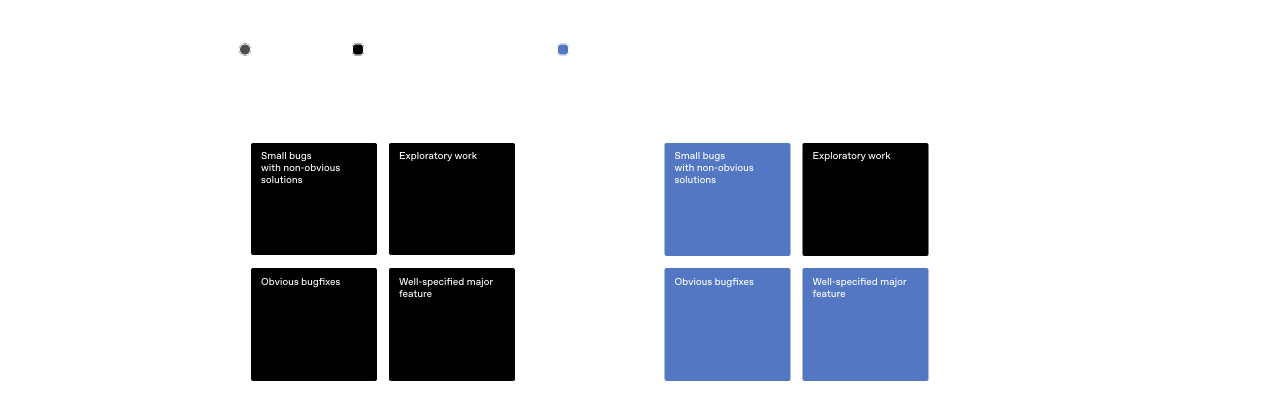
Mreža prikaza Symphonyja prije i poslije

Nakon implementacije Symphonyja, više posla delegiramo agentima i fokusiramo se na teže zadatke koji su više istraživačkog tipa.

Napredak donosi nove, drugačije probleme

Rad na ovom nivou nosi kompromise. Kada smo prešli sa interaktivnog usmjeravanja agenata na dodjeljivanje posla na nivou tiketa, izgubili smo mogućnost da ih stalno usmjeravamo usred rada i korigujemo kurs kada je potrebno. Ponekad bi agent proizveo nešto potpuno pogrešno. To je bilo korisno—ti neuspjesi su otkrili praznine u sistemu i pomogli nam da ga učinimo robusnijim.

Umjesto da rezultat ručno ispravljamo, dodali smo zaštitne mehanizme i sposobnosti kako bi agenti sljedeći put uspjeli. Vremenom nas je to navelo da našem harnessu dodamo nove mogućnosti, kao što su pokretanje end-to-end testova, upravljanje aplikacijom kroz Chrome DevTools i vođenje QA smoke testova. Značajno smo unaprijedili dokumentaciju i pojasnili kako izgleda dobar rezultat.

Nije svaki zadatak pogodan za Symphony. Neki problemi i dalje zahtijevaju da inženjeri rade direktno s interaktivnim Codex sesijama, posebno kada su u pitanju nejasni problemi ili posao koji traži snažno prosuđivanje i stručnost. U praksi su to obično najzanimljiviji i najugodniji zadaci na koje naši inženjeri troše vrijeme.

Razlika je u tome što Symphony može preuzeti većinu rutinskog implementacijskog rada. To omogućava inženjerima da se fokusiraju na jedan težak problem odjednom, umjesto da stalno mijenjaju kontekst prelazeći između manjih zadataka.

Također smo naučili da tretiranje agenata kao rigidnih čvorova u mašini stanja ne funkcioniše dobro. Modeli postaju pametniji i mogu rješavati veće probleme od okvira u koji ih pokušavamo smjestiti. Naprimjer, rane verzije su imale sve GitHub integracije kao dio vanjskog harnessa—naprimjer, rane verzije su očekivale da Codex pravi samo izmjene koda, a ostatak procesa (slanje promjena, pokretanje testova) bio je definisan u kodu. Naše rane verzije rada sa agentima su od Codexa tražile samo da implementira zadatak. Taj pristup se pokazao previše ograničavajućim. Codex je sasvim sposoban da kreira više PR-ova, kao i da čita povratne informacije iz pregleda i reagira na njih. Zato smo mu dali alate—gh CLI, sposobnosti čitanja CI logova itd.—i sada možemo tražiti od Codexa da radi više, poput zatvaranja starih PR-ova ili izvlačenja izvještaja o završenom naspram napuštenom poslu. Ove vrste zadataka bile su daleko izvan početnog okvira implementacije funkcionalnosti.

Zato smo se na kraju usmjerili ka tome da agentima dajemo ciljeve umjesto strogih tranzicija, slično kao što bi dobar menadžer dodijelio cilj direktnom saradniku u svom timu. Snaga modela dolazi iz njihove sposobnosti da rezonuju, zato im dajte alate i kontekst i pustite ih da rade.

Korištenje Symphonyja za izgradnju Symphonyja

Kada otvorite Symphony repozitorij, prvo što ćete primijetiti jeste da je Symphony tehnički samo datoteka SPEC.md—definicija problema i namjeravanog rješenja. Umjesto izgradnje složenog sistema nadzora, definisali smo problem i namjeravana rješenja, dajući agentima usmjeravanje na visokom nivou.

Markdown

1
# Symphony Service Specification
2

3
Status: Draft v1 (language-agnostic)
4

5
Purpose: Define a service that orchestrates coding agents to get project work done.
6

7
## 1. Problem Statement
8

9
Symphony is a long-running automation service that continuously reads work from an issue tracker
10
(Linear in this specification version), creates an isolated workspace for each issue, and runs a
11
coding agent session for that issue inside the workspace.
12

13
The service solves four operational problems:
14

15
- It turns issue execution into a repeatable daemon workflow instead of manual scripts.
16
- It isolates agent execution in per-issue workspaces so agent commands run only inside per-issue
17
workspace directories.
18
- It keeps the workflow policy in-repo (`WORKFLOW.md`) so teams version the agent prompt and runtime
19
settings with their code.
20
- It provides enough observability to operate and debug multiple concurrent agent runs.
21

22
Implementations are expected to document their trust and safety posture explicitly. This
23
specification does not require a single approval, sandbox, or operator-confirmation policy; some
24
implementations may target trusted environments with a high-trust configuration, while others may
25
require stricter approvals or sandboxing.
26

27
Important boundary:
28

29
- Symphony is a scheduler/runner and tracker reader.
30
- Ticket writes (state transitions, comments, PR links) are typically performed by the coding agent
31
using tools available in the workflow/runtime environment.
32
- A successful run may end at a workflow-defined handoff state (for example `Human Review`), not
33
necessarily `Done`.
34

35
## 2. Goals and Non-Goals
36

37
### 2.1 Goals
38

39
- Poll the issue tracker on a fixed cadence and dispatch work with bounded concurrency.
40
- Maintain a single authoritative orchestrator state for dispatch, retries, and reconciliation.
41
- Create deterministic per-issue workspaces and preserve them across runs.
42
- Stop active runs when issue state changes make them ineligible.
43
- Recover from transient failures with exponential backoff.
44
- Load runtime behavior from a repository-owned `WORKFLOW.md` contract.
45
- Expose operator-visible observability (at minimum structured logs).
46
- Support restart recovery without requiring a persistent database.
47

48
### 2.2 Non-Goals
49

50
- Rich web UI or multi-tenant control plane.
51
- Prescribing a specific dashboard or terminal UI implementation.
52
- General-purpose workflow engine or distributed job scheduler.
53
- Built-in business logic for how to edit tickets, PRs, or comments. (That logic lives in the
54
workflow prompt and agent tooling.)
55
- Mandating strong sandbox controls beyond what the coding agent and host OS provide.
56
- Mandating a single default approval, sandbox, or operator-confirmation posture for all
57
implementations.
58

59
## 3. System Overview
60

61
### 3.1 Main Components
62

63
1. `Workflow Loader`
64
- Reads `WORKFLOW.md`.
65
- Parses YAML front matter and prompt body.
66
- Returns `{config, prompt_template}`.
67

68
2. `Config Layer`
69
- Exposes typed getters for workflow config values.
70
- Applies defaults and environment variable indirection.
71
- Performs validation used by the orchestrator before dispatch.
72

73
3. `Issue Tracker Client`
74
- Fetches candidate issues in active states.
75
- Fetches current states for specific issue IDs (reconciliation).
76
- Fetches terminal-state issues during startup cleanup.
77
- Normalizes tracker payloads into a stable issue model.
78

79
4. `Orchestrator`
80
- Owns the poll tick.
81
- Owns the in-memory runtime state.
82
- Decides which issues to dispatch, retry, stop, or release.
83
- Tracks session metrics and retry queue state.
84

85
5. `Workspace Manager`
86
- Maps issue identifiers to workspace paths.
87
- Ensures per-issue workspace directories exist.
88
- Runs workspace lifecycle hooks.
89
- Cleans workspaces for terminal issues.
90

91
6. `Agent Runner`
92
- Creates workspace.
93
- Builds prompt from issue + workflow template.
94
- Launches the coding agent app-server client.
95
- Streams agent updates back to the orchestrator.
96

97
7. `Status Surface` (optional)
98
- Presents human-readable runtime status (for example terminal output, dashboard, or other
99
operator-facing view).
100
101
8. `Logging`
102
- Emits structured runtime logs to one or more configured sinks.
103

104
### 3.2 Abstraction Levels
105

106
Symphony is easiest to port when kept in these layers:
107

108
1. `Policy Layer` (repo-defined)
109
- `WORKFLOW.md` prompt body.
110
- Team-specific rules for ticket handling, validation, and handoff.
111

112
2. `Configuration Layer` (typed getters)
113
- Parses front matter into typed runtime settings.
114
- Handles defaults, environment tokens, and path normalization.
115

116
3. `Coordination Layer` (orchestrator)
117
- Polling loop, issue eligibility, concurrency, retries, reconciliation.
118

119
4. `Execution Layer` (workspace + agent subprocess)
120
- Filesystem lifecycle, workspace preparation, coding-agent protocol.
121

122
5. `Integration Layer` (Linear adapter)
123
- API calls and normalization for tracker data.
124

125
6. `Observability Layer` (logs + optional status surface)
126
- Operator visibility into orchestrator and agent behavior.
127

128
### 3.3 External Dependencies
129

130
- Issue tracker API (Linear for `tracker.kind: linear` in this specification version).
131
- Local filesystem for workspaces and logs.
132
- Optional workspace population tooling (for example Git CLI, if used).
133
- Coding-agent executable that supports JSON-RPC-like app-server mode over stdio.
134
- Host environment authentication for the issue tracker and coding agent.
135

136
## 4. Core Domain Model
137

138
### 4.1 Entities
139

140
#### 4.1.1 Issue
141

142
Normalized issue record used by orchestration, prompt rendering, and observability output.
143

144
Fields:
145

146
- `id` (string)
147
- Stable tracker-internal ID.
148
- `identifier` (string)
149
- Human-readable ticket key (example: `ABC-123`).
150
- `title` (string)
151
- `description` (string or null)
152
- `priority` (integer or null)
153
- Lower numbers are higher priority in dispatch sorting.
154
- `state` (string)
155
- Current tracker state name.
156
- `branch_name` (string or null)
157
- Tracker-provided branch metadata if available.
158
- `url` (string or null)
159
- `labels` (list of strings)
160
- Normalized to lowercase.
161
- `blocked_by` (list of blocker refs)
162
- Each blocker ref contains:
163
- `id` (string or null)
164
- `identifier` (string or null)
165
- `state` (string or null)
166
- `created_at` (timestamp or null)
167
- `updated_at` (timestamp or null)
168

169
#### 4.1.2 Workflow Definition
170

171
Parsed `WORKFLOW.md` payload:
172

173
- `config` (map)
174
- YAML front matter root object.
175
- `prompt_template` (string)
176
- Markdown body after front matter, trimmed.
177

178
#### 4.1.3 Service Config (Typed View)
179

180
Typed runtime values derived from `WorkflowDefinition.config` plus environment resolution.
181

182
Examples:
183

184
- poll interval
185
- workspace root
186
- active and terminal issue states
187
- concurrency limits
188
- coding-agent executable/args/timeouts
189
- workspace hooks
190

191
#### 4.1.4 Workspace
192

193
Filesystem workspace assigned to one issue identifier.
194

195
Fields (logical):
196

197
- `path` (workspace path; current runtime typically uses absolute paths, but relative roots are
198
possible if configured without path separators)
199
- `workspace_key` (sanitized issue identifier)
200
- `created_now` (boolean, used to gate `after_create` hook)
201

202
#### 4.1.5 Run Attempt
203

204
One execution attempt for one issue.
205

206
Fields (logical):
207

208
- `issue_id`
209
- `issue_identifier`
210
- `attempt` (integer or null, `null` for first run, `>=1` for retries/continuation)
211
- `workspace_path`
212
- `started_at`
213
- `status`
214
- `error` (optional)
215

216
#### 4.1.6 Live Session (Agent Session Metadata)
217

218
State tracked while a coding-agent subprocess is running.
219

220
Fields:
221

222
- `session_id` (string, `<thread_id>-<turn_id>`)
223
- `thread_id` (string)
224
- `turn_id` (string)
225
- `codex_app_server_pid` (string or null)
226
- `last_codex_event` (string/enum or null)
227
- `last_codex_timestamp` (timestamp or null)
228
- `last_codex_message` (summarized payload)
229
- `codex_input_tokens` (integer)
230
- `codex_output_tokens` (integer)
231
- `codex_total_tokens` (integer)
232
- `last_reported_input_tokens` (integer)
233
- `last_reported_output_tokens` (integer)
234
- `last_reported_total_tokens` (integer)
235
- `turn_count` (integer)
236
- Number of coding-agent turns started within the current worker lifetime.
237

238
#### 4.1.7 Retry Entry
239

240
Scheduled retry state for an issue.
241

242
Fields:
243

244
- `issue_id`
245
- `identifier` (best-effort human ID for status surfaces/logs)
246
- `attempt` (integer, 1-based for retry queue)
247
- `due_at_ms` (monotonic clock timestamp)
248
- `timer_handle` (runtime-specific timer reference)
249
- `error` (string or null)
250

251
#### 4.1.8 Orchestrator Runtime State
252

253
Single authoritative in-memory state owned by the orchestrator.
254

255
Fields:
256

257
- `poll_interval_ms` (current effective poll interval)
258
- `max_concurrent_agents` (current effective global concurrency limit)
259
- `running` (map `issue_id -> running entry`)
260
- `claimed` (set of issue IDs reserved/running/retrying)
261
- `retry_attempts` (map `issue_id -> RetryEntry`)
262
- `completed` (set of issue IDs; bookkeeping only, not dispatch gating)
263
- `codex_totals` (aggregate tokens + runtime seconds)
264
- `codex_rate_limits` (latest rate-limit snapshot from agent events)
265

266
### 4.2 Stable Identifiers and Normalization Rules
267

268
- `Issue ID`
269
- Use for tracker lookups and internal map keys.
270
- `Issue Identifier`
271
- Use for human-readable logs and workspace naming.
272
- `Workspace Key`
273
- Derive from `issue.identifier` by replacing any character not in `[A-Za-z0-9._-]` with `_`.
274
- Use the sanitized value for the workspace directory name.
275
- `Normalized Issue State`
276
- Compare states after `lowercase`.
277
- `Session ID`
278
- Compose from coding-agent `thread_id` and `turn_id` as `<thread_id>-<turn_id>`.
279

280
## 5. Workflow Specification (Repository Contract)
281

282
### 5.1 File Discovery and Path Resolution
283

284
Workflow file path precedence:
285

286
1. Explicit application/runtime setting (set by CLI startup path).
287
2. Default: `WORKFLOW.md` in the current process working directory.
288

289
Loader behavior:
290

291
- If the file cannot be read, return `missing_workflow_file` error.
292
- The workflow file is expected to be repository-owned and version-controlled.
293

294
### 5.2 File Format
295

296
`WORKFLOW.md` is a Markdown file with optional YAML front matter.
297

298
Design note:
299

300
- `WORKFLOW.md` should be self-contained enough to describe and run different workflows (prompt,
301
runtime settings, hooks, and tracker selection/config) without requiring out-of-band
302
service-specific configuration.
303

304
Parsing rules:
305

306
- If file starts with `---`, parse lines until the next `---` as YAML front matter.
307
- Remaining lines become the prompt body.
308
- If front matter is absent, treat the entire file as prompt body and use an empty config map.
309
- YAML front matter must decode to a map/object; non-map YAML is an error.
310
- Prompt body is trimmed before use.
311

312
Returned workflow object:
313

314
- `config`: front matter root object (not nested under a `config` key).
315
- `prompt_template`: trimmed Markdown body.
316

317
### 5.3 Front Matter Schema
318

319
Top-level keys:
320

321
- `tracker`
322
- `polling`
323
- `workspace`
324
- `hooks`
325
- `agent`
326
- `codex`
327

328
Unknown keys should be ignored for forward compatibility.
329

330
Note:
331

332
- The workflow front matter is extensible. Optional extensions may define additional top-level keys
333
(for example `server`) without changing the core schema above.
334
- Extensions should document their field schema, defaults, validation rules, and whether changes
335
apply dynamically or require restart.
336
- Common extension: `server.port` (integer) enables the optional HTTP server described in Section
337
13.7.
338

339
#### 5.3.1 `tracker` (object)
340

341
Fields:
342

343
- `kind` (string)
344
- Required for dispatch.
345
- Current supported value: `linear`
346
- `endpoint` (string)
347
- Default for `tracker.kind == "linear"`: `https://api.linear.app/graphql`
348
- `api_key` (string)
349
- May be a literal token or `$VAR_NAME`.
350
- Canonical environment variable for `tracker.kind == "linear"`: `LINEAR_API_KEY`.
351
- If `$VAR_NAME` resolves to an empty string, treat the key as missing.
352
- `project_slug` (string)
353
- Required for dispatch when `tracker.kind == "linear"`.
354
- `active_states` (list of strings)
355
- Default: `Todo`, `In Progress`
356
- `terminal_states` (list of strings)
357
- Default: `Closed`, `Cancelled`, `Canceled`, `Duplicate`, `Done`
358

359
#### 5.3.2 `polling` (object)
360

361
Fields:
362

363
- `interval_ms` (integer or string integer)
364
- Default: `30000`
365
- Changes should be re-applied at runtime and affect future tick scheduling without restart.
366

367
#### 5.3.3 `workspace` (object)
368

369
Fields:
370

371
- `root` (path string or `$VAR`)
372
- Default: `<system-temp>/symphony_workspaces`
373
- `~` and strings containing path separators are expanded.
374
- Bare strings without path separators are preserved as-is (relative roots are allowed but
375
discouraged).
376
377
#### 5.3.4 `hooks` (object)
378

379
Fields:
380

381
- `after_create` (multiline shell script string, optional)
382
- Runs only when a workspace directory is newly created.
383
- Failure aborts workspace creation.
384
- `before_run` (multiline shell script string, optional)
385
- Runs before each agent attempt after workspace preparation and before launching the coding
386
agent.
387
- Failure aborts the current attempt.
388
- `after_run` (multiline shell script string, optional)
389
- Runs after each agent attempt (success, failure, timeout, or cancellation) once the workspace
390
exists.
391
- Failure is logged but ignored.
392
- `before_remove` (multiline shell script string, optional)
393
- Runs before workspace deletion if the directory exists.
394
- Failure is logged but ignored; cleanup still proceeds.
395
- `timeout_ms` (integer, optional)
396
- Default: `60000`
397
- Applies to all workspace hooks.
398
- Non-positive values should be treated as invalid and fall back to the default.
399
- Changes should be re-applied at runtime for future hook executions.
400
401
#### 5.3.5 `agent` (object)
402

403
Fields:
404

405
- `max_concurrent_agents` (integer or string integer)
406
- Default: `10`
407
- Changes should be re-applied at runtime and affect subsequent dispatch decisions.
408
- `max_retry_backoff_ms` (integer or string integer)
409
- Default: `300000` (5 minutes)
410
- Changes should be re-applied at runtime and affect future retry scheduling.
411
- `max_concurrent_agents_by_state` (map `state_name -> positive integer`)
412
- Default: empty map.
413
- State keys are normalized (`lowercase`) for lookup.
414
- Invalid entries (non-positive or non-numeric) are ignored.
415

416
#### 5.3.6 `codex` (object)
417

418
Fields:
419

420
For Codex-owned config values such as `approval_policy`, `thread_sandbox`, and
421
`turn_sandbox_policy`, supported values are defined by the targeted Codex app-server version.
422
Implementors should treat them as pass-through Codex config values rather than relying on a
423
hand-maintained enum in this spec. To inspect the installed Codex schema, run
424
`codex app-server generate-json-schema --out <dir>` and inspect the relevant definitions referenced
425
by `v2/ThreadStartParams.json` and `v2/TurnStartParams.json`. Implementations may validate these
426
fields locally if they want stricter startup checks.
427

428
- `command` (string shell command)
429
- Default: `codex app-server`
430
- The runtime launches this command via `bash -lc` in the workspace directory.
431
- The launched process must speak a compatible app-server protocol over stdio.
432
- `approval_policy` (Codex `AskForApproval` value)
433
- Default: implementation-defined.
434
- `thread_sandbox` (Codex `SandboxMode` value)
435
- Default: implementation-defined.
436
- `turn_sandbox_policy` (Codex `SandboxPolicy` value)
437
- Default: implementation-defined.
438
- `turn_timeout_ms` (integer)
439
- Default: `3600000` (1 hour)
440
- `read_timeout_ms` (integer)
441
- Default: `5000`
442
- `stall_timeout_ms` (integer)
443
- Default: `300000` (5 minutes)
444
- If `<= 0`, stall detection is disabled.
445

446
### 5.4 Prompt Template Contract
447

448
The Markdown body of `WORKFLOW.md` is the per-issue prompt template.
449

450
Rendering requirements:
451

452
- Use a strict template engine (Liquid-compatible semantics are sufficient).
453
- Unknown variables must fail rendering.
454
- Unknown filters must fail rendering.
455

456
Template input variables:
457

458
- `issue` (object)
459
- Includes all normalized issue fields, including labels and blockers.
460
- `attempt` (integer or null)
461
- `null`/absent on first attempt.
462
- Integer on retry or continuation run.
463

464
Fallback prompt behavior:
465

466
- If the workflow prompt body is empty, the runtime may use a minimal default prompt
467
(`You are working on an issue from Linear.`).
468
- Workflow file read/parse failures are configuration/validation errors and should not silently fall
469
back to a prompt.
470

471
### 5.5 Workflow Validation and Error Surface
472

473
Error classes:
474

475
- `missing_workflow_file`
476
- `workflow_parse_error`
477
- `workflow_front_matter_not_a_map`
478
- `template_parse_error` (during prompt rendering)
479
- `template_render_error` (unknown variable/filter, invalid interpolation)
480

481
Dispatch gating behavior:
482

483
- Workflow file read/YAML errors block new dispatches until fixed.
484
- Template errors fail only the affected run attempt.
485

486
## 6. Configuration Specification
487

488
### 6.1 Source Precedence and Resolution Semantics
489

490
Configuration precedence:
491

492
1. Workflow file path selection (runtime setting -> cwd default).
493
2. YAML front matter values.
494
3. Environment indirection via `$VAR_NAME` inside selected YAML values.
495
4. Built-in defaults.
496

497
Value coercion semantics:
498

499
- Path/command fields support:
500
- `~` home expansion
501
- `$VAR` expansion for env-backed path values
502
- Apply expansion only to values intended to be local filesystem paths; do not rewrite URIs or
503
arbitrary shell command strings.
504
505
### 6.2 Dynamic Reload Semantics
506

507
Dynamic reload is required:
508

509
- The software should watch `WORKFLOW.md` for changes.
510
- On change, it should re-read and re-apply workflow config and prompt template without restart.
511
- The software should attempt to adjust live behavior to the new config (for example polling
512
cadence, concurrency limits, active/terminal states, codex settings, workspace paths/hooks, and
513
prompt content for future runs).
514
- Reloaded config applies to future dispatch, retry scheduling, reconciliation decisions, hook
515
execution, and agent launches.
516
- Implementations are not required to restart in-flight agent sessions automatically when config
517
changes.
518
- Extensions that manage their own listeners/resources (for example an HTTP server port change) may
519
require restart unless the implementation explicitly supports live rebind.
520
- Implementations should also re-validate/reload defensively during runtime operations (for example
521
before dispatch) in case filesystem watch events are missed.
522
- Invalid reloads should not crash the service; keep operating with the last known good effective
523
configuration and emit an operator-visible error.
524

525
### 6.3 Dispatch Preflight Validation
526

527
This validation is a scheduler preflight run before attempting to dispatch new work. It validates
528
the workflow/config needed to poll and launch workers, not a full audit of all possible workflow
529
behavior.
530

531
Startup validation:
532

533
- Validate configuration before starting the scheduling loop.
534
- If startup validation fails, fail startup and emit an operator-visible error.
535

536
Per-tick dispatch validation:
537

538
- Re-validate before each dispatch cycle.
539
- If validation fails, skip dispatch for that tick, keep reconciliation active, and emit an
540
operator-visible error.
541

542
Validation checks:
543

544
- Workflow file can be loaded and parsed.
545
- `tracker.kind` is present and supported.
546
- `tracker.api_key` is present after `$` resolution.
547
- `tracker.project_slug` is present when required by the selected tracker kind.
548
- `codex.command` is present and non-empty.
549

550
### 6.4 Config Fields Summary (Cheat Sheet)
551

552
This section is intentionally redundant so a coding agent can implement the config layer quickly.
553

554
- `tracker.kind`: string, required, currently `linear`
555
- `tracker.endpoint`: string, default `https://api.linear.app/graphql` when `tracker.kind=linear`
556
- `tracker.api_key`: string or `$VAR`, canonical env `LINEAR_API_KEY` when `tracker.kind=linear`
557
- `tracker.project_slug`: string, required when `tracker.kind=linear`
558
- `tracker.active_states`: list of strings, default `["Todo", "In Progress"]`
559
- `tracker.terminal_states`: list of strings, default `["Closed", "Cancelled", "Canceled", "Duplicate", "Done"]`
560
- `polling.interval_ms`: integer, default `30000`
561
- `workspace.root`: path, default `<system-temp>/symphony_workspaces`
562
- `worker.ssh_hosts` (extension): list of SSH host strings, optional; when omitted, work runs
563
locally
564
- `worker.max_concurrent_agents_per_host` (extension): positive integer, optional; shared per-host
565
cap applied across configured SSH hosts
566
- `hooks.after_create`: shell script or null
567
- `hooks.before_run`: shell script or null
568
- `hooks.after_run`: shell script or null
569
- `hooks.before_remove`: shell script or null
570
- `hooks.timeout_ms`: integer, default `60000`
571
- `agent.max_concurrent_agents`: integer, default `10`
572
- `agent.max_turns`: integer, default `20`
573
- `agent.max_retry_backoff_ms`: integer, default `300000` (5m)
574
- `agent.max_concurrent_agents_by_state`: map of positive integers, default `{}`
575
- `codex.command`: shell command string, default `codex app-server`
576
- `codex.approval_policy`: Codex `AskForApproval` value, default implementation-defined
577
- `codex.thread_sandbox`: Codex `SandboxMode` value, default implementation-defined
578
- `codex.turn_sandbox_policy`: Codex `SandboxPolicy` value, default implementation-defined
579
- `codex.turn_timeout_ms`: integer, default `3600000`
580
- `codex.read_timeout_ms`: integer, default `5000`
581
- `codex.stall_timeout_ms`: integer, default `300000`
582
- `server.port` (extension): integer, optional; enables the optional HTTP server, `0` may be used
583
for ephemeral local bind, and CLI `--port` overrides it
584

585
## 7. Orchestration State Machine
586

587
The orchestrator is the only component that mutates scheduling state. All worker outcomes are
588
reported back to it and converted into explicit state transitions.
589

590
### 7.1 Issue Orchestration States
591

592
This is not the same as tracker states (`Todo`, `In Progress`, etc.). This is the service's internal
593
claim state.
594

595
1. `Unclaimed`
596
- Issue is not running and has no retry scheduled.
597

598
2. `Claimed`
599
- Orchestrator has reserved the issue to prevent duplicate dispatch.
600
- In practice, claimed issues are either `Running` or `RetryQueued`.
601

602
3. `Running`
603
- Worker task exists and the issue is tracked in `running` map.
604

605
4. `RetryQueued`
606
- Worker is not running, but a retry timer exists in `retry_attempts`.
607

608
5. `Released`
609
- Claim removed because issue is terminal, non-active, missing, or retry path completed without
610
re-dispatch.
611
612
Important nuance:
613

614
- A successful worker exit does not mean the issue is done forever.
615
- The worker may continue through multiple back-to-back coding-agent turns before it exits.
616
- After each normal turn completion, the worker re-checks the tracker issue state.
617
- If the issue is still in an active state, the worker should start another turn on the same live
618
coding-agent thread in the same workspace, up to `agent.max_turns`.
619
- The first turn should use the full rendered task prompt.
620
- Continuation turns should send only continuation guidance to the existing thread, not resend the
621
original task prompt that is already present in thread history.
622
- Once the worker exits normally, the orchestrator still schedules a short continuation retry
623
(about 1 second) so it can re-check whether the issue remains active and needs another worker
624
session.
625

626
### 7.2 Run Attempt Lifecycle
627

628
A run attempt transitions through these phases:
629

630
1. `PreparingWorkspace`
631
2. `BuildingPrompt`
632
3. `LaunchingAgentProcess`
633
4. `InitializingSession`
634
5. `StreamingTurn`
635
6. `Finishing`
636
7. `Succeeded`
637
8. `Failed`
638
9. `TimedOut`
639
10. `Stalled`
640
11. `CanceledByReconciliation`
641

642
Distinct terminal reasons are important because retry logic and logs differ.
643

644
### 7.3 Transition Triggers
645

646
- `Poll Tick`
647
- Reconcile active runs.
648
- Validate config.
649
- Fetch candidate issues.
650
- Dispatch until slots are exhausted.
651

652
- `Worker Exit (normal)`
653
- Remove running entry.
654
- Update aggregate runtime totals.
655
- Schedule continuation retry (attempt `1`) after the worker exhausts or finishes its in-process
656
turn loop.
657
658
- `Worker Exit (abnormal)`
659
- Remove running entry.
660
- Update aggregate runtime totals.
661
- Schedule exponential-backoff retry.
662

663
- `Codex Update Event`
664
- Update live session fields, token counters, and rate limits.
665

666
- `Retry Timer Fired`
667
- Re-fetch active candidates and attempt re-dispatch, or release claim if no longer eligible.
668

669
- `Reconciliation State Refresh`
670
- Stop runs whose issue states are terminal or no longer active.
671

672
- `Stall Timeout`
673
- Kill worker and schedule retry.
674

675
### 7.4 Idempotency and Recovery Rules
676

677
- The orchestrator serializes state mutations through one authority to avoid duplicate dispatch.
678
- `claimed` and `running` checks are required before launching any worker.
679
- Reconciliation runs before dispatch on every tick.
680
- Restart recovery is tracker-driven and filesystem-driven (no durable orchestrator DB required).
681
- Startup terminal cleanup removes stale workspaces for issues already in terminal states.
682

683
## 8. Polling, Scheduling, and Reconciliation
684

685
### 8.1 Poll Loop
686

687
At startup, the service validates config, performs startup cleanup, schedules an immediate tick, and
688
then repeats every `polling.interval_ms`.
689

690
The effective poll interval should be updated when workflow config changes are re-applied.
691

692
Tick sequence:
693

694
1. Reconcile running issues.
695
2. Run dispatch preflight validation.
696
3. Fetch candidate issues from tracker using active states.
697
4. Sort issues by dispatch priority.
698
5. Dispatch eligible issues while slots remain.
699
6. Notify observability/status consumers of state changes.
700

701
If per-tick validation fails, dispatch is skipped for that tick, but reconciliation still happens
702
first.
703

704
### 8.2 Candidate Selection Rules
705

706
An issue is dispatch-eligible only if all are true:
707

708
- It has `id`, `identifier`, `title`, and `state`.
709
- Its state is in `active_states` and not in `terminal_states`.
710
- It is not already in `running`.
711
- It is not already in `claimed`.
712
- Global concurrency slots are available.
713
- Per-state concurrency slots are available.
714
- Blocker rule for `Todo` state passes:
715
- If the issue state is `Todo`, do not dispatch when any blocker is non-terminal.
716

717
Sorting order (stable intent):
718

719
1. `priority` ascending (1..4 are preferred; null/unknown sorts last)
720
2. `created_at` oldest first
721
3. `identifier` lexicographic tie-breaker
722

723
### 8.3 Concurrency Control
724

725
Global limit:
726

727
- `available_slots = max(max_concurrent_agents - running_count, 0)`
728

729
Per-state limit:
730

731
- `max_concurrent_agents_by_state[state]` if present (state key normalized)
732
- otherwise fallback to global limit
733

734
The runtime counts issues by their current tracked state in the `running` map.
735

736
Optional SSH host limit:
737

738
- When `worker.max_concurrent_agents_per_host` is set, each configured SSH host may run at most
739
that many concurrent agents at once.
740
- Hosts at that cap are skipped for new dispatch until capacity frees up.
741

742
### 8.4 Retry and Backoff
743

744
Retry entry creation:
745

746
- Cancel any existing retry timer for the same issue.
747
- Store `attempt`, `identifier`, `error`, `due_at_ms`, and new timer handle.
748

749
Backoff formula:
750

751
- Normal continuation retries after a clean worker exit use a short fixed delay of `1000` ms.
752
- Failure-driven retries use `delay = min(10000 * 2^(attempt - 1), agent.max_retry_backoff_ms)`.
753
- Power is capped by the configured max retry backoff (default `300000` / 5m).
754

755
Retry handling behavior:
756

757
1. Fetch active candidate issues (not all issues).
758
2. Find the specific issue by `issue_id`.
759
3. If not found, release claim.
760
4. If found and still candidate-eligible:
761
- Dispatch if slots are available.
762
- Otherwise requeue with error `no available orchestrator slots`.
763
5. If found but no longer active, release claim.
764

765
Note:
766

767
- Terminal-state workspace cleanup is handled by startup cleanup and active-run reconciliation
768
(including terminal transitions for currently running issues).
769
- Retry handling mainly operates on active candidates and releases claims when the issue is absent,
770
rather than performing terminal cleanup itself.
771

772
### 8.5 Active Run Reconciliation
773

774
Reconciliation runs every tick and has two parts.
775

776
Part A: Stall detection
777

778
- For each running issue, compute `elapsed_ms` since:
779
- `last_codex_timestamp` if any event has been seen, else
780
- `started_at`
781
- If `elapsed_ms > codex.stall_timeout_ms`, terminate the worker and queue a retry.
782
- If `stall_timeout_ms <= 0`, skip stall detection entirely.
783

784
Part B: Tracker state refresh
785

786
- Fetch current issue states for all running issue IDs.
787
- For each running issue:
788
- If tracker state is terminal: terminate worker and clean workspace.
789
- If tracker state is still active: update the in-memory issue snapshot.
790
- If tracker state is neither active nor terminal: terminate worker without workspace cleanup.
791
- If state refresh fails, keep workers running and try again on the next tick.
792

793
### 8.6 Startup Terminal Workspace Cleanup
794

795
When the service starts:
796

797
1. Query tracker for issues in terminal states.
798
2. For each returned issue identifier, remove the corresponding workspace directory.
799
3. If the terminal-issues fetch fails, log a warning and continue startup.
800

801
This prevents stale terminal workspaces from accumulating after restarts.
802

803
## 9. Workspace Management and Safety
804

805
### 9.1 Workspace Layout
806

807
Workspace root:
808

809
- `workspace.root` (normalized path; the current config layer expands path-like values and preserves
810
bare relative names)
811

812
Per-issue workspace path:
813

814
- `<workspace.root>/<sanitized_issue_identifier>`
815

816
Workspace persistence:
817

818
- Workspaces are reused across runs for the same issue.
819
- Successful runs do not auto-delete workspaces.
820

821
### 9.2 Workspace Creation and Reuse
822

823
Input: `issue.identifier`
824

825
Algorithm summary:
826

827
1. Sanitize identifier to `workspace_key`.
828
2. Compute workspace path under workspace root.
829
3. Ensure the workspace path exists as a directory.
830
4. Mark `created_now=true` only if the directory was created during this call; otherwise
831
`created_now=false`.
832
5. If `created_now=true`, run `after_create` hook if configured.
833

834
Notes:
835

836
- This section does not assume any specific repository/VCS workflow.
837
- Workspace preparation beyond directory creation (for example dependency bootstrap, checkout/sync,
838
code generation) is implementation-defined and is typically handled via hooks.
839

840
### 9.3 Optional Workspace Population (Implementation-Defined)
841

842
The spec does not require any built-in VCS or repository bootstrap behavior.
843

844
Implementations may populate or synchronize the workspace using implementation-defined logic and/or
845
hooks (for example `after_create` and/or `before_run`).
846

847
Failure handling:
848

849
- Workspace population/synchronization failures return an error for the current attempt.
850
- If failure happens while creating a brand-new workspace, implementations may remove the partially
851
prepared directory.
852
- Reused workspaces should not be destructively reset on population failure unless that policy is
853
explicitly chosen and documented.
854

855
### 9.4 Workspace Hooks
856

857
Supported hooks:
858

859
- `hooks.after_create`
860
- `hooks.before_run`
861
- `hooks.after_run`
862
- `hooks.before_remove`
863

864
Execution contract:
865

866
- Execute in a local shell context appropriate to the host OS, with the workspace directory as
867
`cwd`.
868
- On POSIX systems, `sh -lc <script>` (or a stricter equivalent such as `bash -lc <script>`) is a
869
conforming default.
870
- Hook timeout uses `hooks.timeout_ms`; default: `60000 ms`.
871
- Log hook start, failures, and timeouts.
872

873
Failure semantics:
874

875
- `after_create` failure or timeout is fatal to workspace creation.
876
- `before_run` failure or timeout is fatal to the current run attempt.
877
- `after_run` failure or timeout is logged and ignored.
878
- `before_remove` failure or timeout is logged and ignored.
879

880
### 9.5 Safety Invariants
881

882
This is the most important portability constraint.
883

884
Invariant 1: Run the coding agent only in the per-issue workspace path.
885

886
- Before launching the coding-agent subprocess, validate:
887
- `cwd == workspace_path`
888

889
Invariant 2: Workspace path must stay inside workspace root.
890

891
- Normalize both paths to absolute.
892
- Require `workspace_path` to have `workspace_root` as a prefix directory.
893
- Reject any path outside the workspace root.
894

895
Invariant 3: Workspace key is sanitized.
896

897
- Only `[A-Za-z0-9._-]` allowed in workspace directory names.
898
- Replace all other characters with `_`.
899

900
## 10. Agent Runner Protocol (Coding Agent Integration)
901

902
This section defines the language-neutral contract for integrating a coding agent app-server.
903

904
Compatibility profile:
905

906
- The normative contract is message ordering, required behaviors, and the logical fields that must
907
be extracted (for example session IDs, completion state, approval handling, and usage/rate-limit
908
telemetry).
909
- Exact JSON field names may vary slightly across compatible app-server versions.
910
- Implementations should tolerate equivalent payload shapes when they carry the same logical
911
meaning, especially for nested IDs, approval requests, user-input-required signals, and
912
token/rate-limit metadata.
913

914
### 10.1 Launch Contract
915

916
Subprocess launch parameters:
917

918
- Command: `codex.command`
919
- Invocation: `bash -lc <codex.command>`
920
- Working directory: workspace path
921
- Stdout/stderr: separate streams
922
- Framing: line-delimited protocol messages on stdout (JSON-RPC-like JSON per line)
923

924
Notes:
925

926
- The default command is `codex app-server`.
927
- Approval policy, cwd, and prompt are expressed in the protocol messages in Section 10.2.
928

929
Recommended additional process settings:
930

931
- Max line size: 10 MB (for safe buffering)
932

933
### 10.2 Session Startup Handshake
934

935
Reference: https://developers.openai.com/codex/app-server/
936

937
The client must send these protocol messages in order:
938

939
Illustrative startup transcript (equivalent payload shapes are acceptable if they preserve the same
940
semantics):
941

942
```json
943
{"id":1,"method":"initialize","params":{"clientInfo":{"name":"symphony","version":"1.0"},"capabilities":{}}}
944
{"method":"initialized","params":{}}
945
{"id":2,"method":"thread/start","params":{"approvalPolicy":"<implementation-defined>","sandbox":"<implementation-defined>","cwd":"/abs/workspace"}}
946
{"id":3,"method":"turn/start","params":{"threadId":"<thread-id>","input":[{"type":"text","text":"<rendered prompt-or-continuation-guidance>"}],"cwd":"/abs/workspace","title":"ABC-123: Example","approvalPolicy":"<implementation-defined>","sandboxPolicy":{"type":"<implementation-defined>"}}}
947
```
948

949
1. `initialize` request
950
- Params include:
951
- `clientInfo` object (for example `{name, version}`)
952
- `capabilities` object (may be empty)
953
- If the targeted Codex app-server requires capability negotiation for dynamic tools, include the
954
necessary capability flag(s) here.
955
- Wait for response (`read_timeout_ms`)
956
2. `initialized` notification
957
3. `thread/start` request
958
- Params include:
959
- `approvalPolicy` = implementation-defined session approval policy value
960
- `sandbox` = implementation-defined session sandbox value
961
- `cwd` = absolute workspace path
962
- If optional client-side tools are implemented, include their advertised tool specs using the
963
protocol mechanism supported by the targeted Codex app-server version.
964
4. `turn/start` request
965
- Params include:
966
- `threadId`
967
- `input` = single text item containing rendered prompt for the first turn, or continuation
968
guidance for later turns on the same thread
969
- `cwd`
970
- `title` = `<issue.identifier>: <issue.title>`
971
- `approvalPolicy` = implementation-defined turn approval policy value
972
- `sandboxPolicy` = implementation-defined object-form sandbox policy payload when required by
973
the targeted app-server version
974
975
Session identifiers:
976

977
- Read `thread_id` from `thread/start` result `result.thread.id`
978
- Read `turn_id` from each `turn/start` result `result.turn.id`
979
- Emit `session_id = "<thread_id>-<turn_id>"`
980
- Reuse the same `thread_id` for all continuation turns inside one worker run
981

982
### 10.3 Streaming Turn Processing
983

984
The client reads line-delimited messages until the turn terminates.
985

986
Completion conditions:
987

988
- `turn/completed` -> success
989
- `turn/failed` -> failure
990
- `turn/cancelled` -> failure
991
- turn timeout (`turn_timeout_ms`) -> failure
992
- subprocess exit -> failure
993

994
Continuation processing:
995

996
- If the worker decides to continue after a successful turn, it should issue another `turn/start`
997
on the same live `threadId`.
998
- The app-server subprocess should remain alive across those continuation turns and be stopped only
999
when the worker run is ending.
1000

1001
Line handling requirements:
1002

1003
- Read protocol messages from stdout only.
1004
- Buffer partial stdout lines until newline arrives.
1005
- Attempt JSON parse on complete stdout lines.
1006
- Stderr is not part of the protocol stream:
1007
- ignore it or log it as diagnostics
1008
- do not attempt protocol JSON parsing on stderr
1009

1010
### 10.4 Emitted Runtime Events (Upstream to Orchestrator)
1011

1012
The app-server client emits structured events to the orchestrator callback. Each event should
1013
include:
1014

1015
- `event` (enum/string)
1016
- `timestamp` (UTC timestamp)
1017
- `codex_app_server_pid` (if available)
1018
- optional `usage` map (token counts)
1019
- payload fields as needed
1020

1021
Important emitted events may include:
1022

1023
- `session_started`
1024
- `startup_failed`
1025
- `turn_completed`
1026
- `turn_failed`
1027
- `turn_cancelled`
1028
- `turn_ended_with_error`
1029
- `turn_input_required`
1030
- `approval_auto_approved`
1031
- `unsupported_tool_call`
1032
- `notification`
1033
- `other_message`
1034
- `malformed`
1035

1036
### 10.5 Approval, Tool Calls, and User Input Policy
1037

1038
Approval, sandbox, and user-input behavior is implementation-defined.
1039

1040
Policy requirements:
1041

1042
- Each implementation should document its chosen approval, sandbox, and operator-confirmation
1043
posture.
1044
- Approval requests and user-input-required events must not leave a run stalled indefinitely. An
1045
implementation should either satisfy them, surface them to an operator, auto-resolve them, or
1046
fail the run according to its documented policy.
1047

1048
Example high-trust behavior:
1049

1050
- Auto-approve command execution approvals for the session.
1051
- Auto-approve file-change approvals for the session.
1052
- Treat user-input-required turns as hard failure.
1053

1054
Unsupported dynamic tool calls:
1055

1056
- Supported dynamic tool calls that are explicitly implemented and advertised by the runtime should
1057
be handled according to their extension contract.
1058
- If the agent requests a dynamic tool call (`item/tool/call`) that is not supported, return a tool
1059
failure response and continue the session.
1060
- This prevents the session from stalling on unsupported tool execution paths.
1061

1062
Optional client-side tool extension:
1063

1064
- An implementation may expose a limited set of client-side tools to the app-server session.
1065
- Current optional standardized tool: `linear_graphql`.
1066
- If implemented, supported tools should be advertised to the app-server session during startup
1067
using the protocol mechanism supported by the targeted Codex app-server version.
1068
- Unsupported tool names should still return a failure result and continue the session.
1069

1070
`linear_graphql` extension contract:
1071

1072
- Purpose: execute a raw GraphQL query or mutation against Linear using Symphony's configured
1073
tracker auth for the current session.
1074
- Availability: only meaningful when `tracker.kind == "linear"` and valid Linear auth is configured.
1075
- Preferred input shape:
1076

1077
```json
1078
{
1079
"query": "single GraphQL query or mutation document",
1080
"variables": {
1081
"optional": "graphql variables object"
1082
}
1083
}
1084
```
1085

1086
- `query` must be a non-empty string.
1087
- `query` must contain exactly one GraphQL operation.
1088
- `variables` is optional and, when present, must be a JSON object.
1089
- Implementations may additionally accept a raw GraphQL query string as shorthand input.
1090
- Execute one GraphQL operation per tool call.
1091
- If the provided document contains multiple operations, reject the tool call as invalid input.
1092
- `operationName` selection is intentionally out of scope for this extension.
1093
- Reuse the configured Linear endpoint and auth from the active Symphony workflow/runtime config; do
1094
not require the coding agent to read raw tokens from disk.
1095
- Tool result semantics:
1096
- transport success + no top-level GraphQL `errors` -> `success=true`
1097
- top-level GraphQL `errors` present -> `success=false`, but preserve the GraphQL response body
1098
for debugging
1099
- invalid input, missing auth, or transport failure -> `success=false` with an error payload
1100
- Return the GraphQL response or error payload as structured tool output that the model can inspect
1101
in-session.
1102
1103
Illustrative responses (equivalent payload shapes are acceptable if they preserve the same outcome):
1104

1105
```json
1106
{"id":"<approval-id>","result":{"approved":true}}
1107
{"id":"<tool-call-id>","result":{"success":false,"error":"unsupported_tool_call"}}
1108
```
1109

1110
Hard failure on user input requirement:
1111

1112
- If the agent requests user input, fail the run attempt immediately.
1113
- The client detects this via:
1114
- explicit method (`item/tool/requestUserInput`), or
1115
- turn methods/flags indicating input is required.
1116

1117
### 10.6 Timeouts and Error Mapping
1118

1119
Timeouts:
1120

1121
- `codex.read_timeout_ms`: request/response timeout during startup and sync requests
1122
- `codex.turn_timeout_ms`: total turn stream timeout
1123
- `codex.stall_timeout_ms`: enforced by orchestrator based on event inactivity
1124

1125
Error mapping (recommended normalized categories):
1126

1127
- `codex_not_found`
1128
- `invalid_workspace_cwd`
1129
- `response_timeout`
1130
- `turn_timeout`
1131
- `port_exit`
1132
- `response_error`
1133
- `turn_failed`
1134
- `turn_cancelled`
1135
- `turn_input_required`
1136

1137
### 10.7 Agent Runner Contract
1138

1139
The `Agent Runner` wraps workspace + prompt + app-server client.
1140

1141
Behavior:
1142

1143
1. Create/reuse workspace for issue.
1144
2. Build prompt from workflow template.
1145
3. Start app-server session.
1146
4. Forward app-server events to orchestrator.
1147
5. On any error, fail the worker attempt (the orchestrator will retry).
1148

1149
Note:
1150

1151
- Workspaces are intentionally preserved after successful runs.
1152

1153
## 11. Issue Tracker Integration Contract (Linear-Compatible)
1154

1155
### 11.1 Required Operations
1156

1157
An implementation must support these tracker adapter operations:
1158

1159
1. `fetch_candidate_issues()`
1160
- Return issues in configured active states for a configured project.
1161

1162
2. `fetch_issues_by_states(state_names)`
1163
- Used for startup terminal cleanup.
1164

1165
3. `fetch_issue_states_by_ids(issue_ids)`
1166
- Used for active-run reconciliation.
1167

1168
### 11.2 Query Semantics (Linear)
1169

1170
Linear-specific requirements for `tracker.kind == "linear"`:
1171

1172
- `tracker.kind == "linear"`
1173
- GraphQL endpoint (default `https://api.linear.app/graphql`)
1174
- Auth token sent in `Authorization` header
1175
- `tracker.project_slug` maps to Linear project `slugId`
1176
- Candidate issue query filters project using `project: { slugId: { eq: $projectSlug } }`
1177
- Issue-state refresh query uses GraphQL issue IDs with variable type `[ID!]`
1178
- Pagination required for candidate issues
1179
- Page size default: `50`
1180
- Network timeout: `30000 ms`
1181

1182
Important:
1183

1184
- Linear GraphQL schema details can drift. Keep query construction isolated and test the exact query
1185
fields/types required by this specification.
1186

1187
A non-Linear implementation may change transport details, but the normalized outputs must match the
1188
domain model in Section 4.
1189

1190
### 11.3 Normalization Rules
1191

1192
Candidate issue normalization should produce fields listed in Section 4.1.1.
1193

1194
Additional normalization details:
1195

1196
- `labels` -> lowercase strings
1197
- `blocked_by` -> derived from inverse relations where relation type is `blocks`
1198
- `priority` -> integer only (non-integers become null)
1199
- `created_at` and `updated_at` -> parse ISO-8601 timestamps
1200

1201
### 11.4 Error Handling Contract
1202

1203
Recommended error categories:
1204

1205
- `unsupported_tracker_kind`
1206
- `missing_tracker_api_key`
1207
- `missing_tracker_project_slug`
1208
- `linear_api_request` (transport failures)
1209
- `linear_api_status` (non-200 HTTP)
1210
- `linear_graphql_errors`
1211
- `linear_unknown_payload`
1212
- `linear_missing_end_cursor` (pagination integrity error)
1213

1214
Orchestrator behavior on tracker errors:
1215

1216
- Candidate fetch failure: log and skip dispatch for this tick.
1217
- Running-state refresh failure: log and keep active workers running.
1218
- Startup terminal cleanup failure: log warning and continue startup.
1219

1220
### 11.5 Tracker Writes (Important Boundary)
1221

1222
Symphony does not require first-class tracker write APIs in the orchestrator.
1223

1224
- Ticket mutations (state transitions, comments, PR metadata) are typically handled by the coding
1225
agent using tools defined by the workflow prompt.
1226
- The service remains a scheduler/runner and tracker reader.
1227
- Workflow-specific success often means "reached the next handoff state" (for example
1228
`Human Review`) rather than tracker terminal state `Done`.
1229
- If the optional `linear_graphql` client-side tool extension is implemented, it is still part of
1230
the agent toolchain rather than orchestrator business logic.
1231

1232
## 12. Prompt Construction and Context Assembly
1233

1234
### 12.1 Inputs
1235

1236
Inputs to prompt rendering:
1237

1238
- `workflow.prompt_template`
1239
- normalized `issue` object
1240
- optional `attempt` integer (retry/continuation metadata)
1241

1242
### 12.2 Rendering Rules
1243

1244
- Render with strict variable checking.
1245
- Render with strict filter checking.
1246
- Convert issue object keys to strings for template compatibility.
1247
- Preserve nested arrays/maps (labels, blockers) so templates can iterate.
1248

1249
### 12.3 Retry/Continuation Semantics
1250

1251
`attempt` should be passed to the template because the workflow prompt may provide different
1252
instructions for:
1253

1254
- first run (`attempt` null or absent)
1255
- continuation run after a successful prior session
1256
- retry after error/timeout/stall
1257

1258
### 12.4 Failure Semantics
1259

1260
If prompt rendering fails:
1261

1262
- Fail the run attempt immediately.
1263
- Let the orchestrator treat it like any other worker failure and decide retry behavior.
1264

1265
## 13. Logging, Status, and Observability
1266

1267
### 13.1 Logging Conventions
1268

1269
Required context fields for issue-related logs:
1270

1271
- `issue_id`
1272
- `issue_identifier`
1273

1274
Required context for coding-agent session lifecycle logs:
1275

1276
- `session_id`
1277

1278
Message formatting requirements:
1279

1280
- Use stable `key=value` phrasing.
1281
- Include action outcome (`completed`, `failed`, `retrying`, etc.).
1282
- Include concise failure reason when present.
1283
- Avoid logging large raw payloads unless necessary.
1284

1285
### 13.2 Logging Outputs and Sinks
1286

1287
The spec does not prescribe where logs must go (stderr, file, remote sink, etc.).
1288

1289
Requirements:
1290

1291
- Operators must be able to see startup/validation/dispatch failures without attaching a debugger.
1292
- Implementations may write to one or more sinks.
1293
- If a configured log sink fails, the service should continue running when possible and emit an
1294
operator-visible warning through any remaining sink.
1295

1296
### 13.3 Runtime Snapshot / Monitoring Interface (Optional but Recommended)
1297

1298
If the implementation exposes a synchronous runtime snapshot (for dashboards or monitoring), it
1299
should return:
1300

1301
- `running` (list of running session rows)
1302
- each running row should include `turn_count`
1303
- `retrying` (list of retry queue rows)
1304
- `codex_totals`
1305
- `input_tokens`
1306
- `output_tokens`
1307
- `total_tokens`
1308
- `seconds_running` (aggregate runtime seconds as of snapshot time, including active sessions)
1309
- `rate_limits` (latest coding-agent rate limit payload, if available)
1310

1311
Recommended snapshot error modes:
1312

1313
- `timeout`
1314
- `unavailable`
1315

1316
### 13.4 Optional Human-Readable Status Surface
1317

1318
A human-readable status surface (terminal output, dashboard, etc.) is optional and
1319
implementation-defined.
1320

1321
If present, it should draw from orchestrator state/metrics only and must not be required for
1322
correctness.
1323

1324
### 13.5 Session Metrics and Token Accounting
1325

1326
Token accounting rules:
1327

1328
- Agent events may include token counts in multiple payload shapes.
1329
- Prefer absolute thread totals when available, such as:
1330
- `thread/tokenUsage/updated` payloads
1331
- `total_token_usage` within token-count wrapper events
1332
- Ignore delta-style payloads such as `last_token_usage` for dashboard/API totals.
1333
- Extract input/output/total token counts leniently from common field names within the selected
1334
payload.
1335
- For absolute totals, track deltas relative to last reported totals to avoid double-counting.
1336
- Do not treat generic `usage` maps as cumulative totals unless the event type defines them that
1337
way.
1338
- Accumulate aggregate totals in orchestrator state.
1339

1340
Runtime accounting:
1341

1342
- Runtime should be reported as a live aggregate at snapshot/render time.
1343
- Implementations may maintain a cumulative counter for ended sessions and add active-session
1344
elapsed time derived from `running` entries (for example `started_at`) when producing a
1345
snapshot/status view.
1346
- Add run duration seconds to the cumulative ended-session runtime when a session ends (normal exit
1347
or cancellation/termination).
1348
- Continuous background ticking of runtime totals is not required.
1349

1350
Rate-limit tracking:
1351

1352
- Track the latest rate-limit payload seen in any agent update.
1353
- Any human-readable presentation of rate-limit data is implementation-defined.
1354

1355
### 13.6 Humanized Agent Event Summaries (Optional)
1356

1357
Humanized summaries of raw agent protocol events are optional.
1358

1359
If implemented:
1360

1361
- Treat them as observability-only output.
1362
- Do not make orchestrator logic depend on humanized strings.
1363

Referentna implementacija je napisana u Elixiru—jer kada je kôd praktično besplatan, konačno možete birati jezike prema njihovim prednostima, poput one koje ima Elixir—ali osnovna ideja se može izraziti u jednostavnom Markdown dokumentu. Podstičemo vas da svog omiljenog agenta za kodiranje usmjerite na specifikaciju i navedete ga da na osnovu nje implementira vlastitu verziju.

Prvu verziju Symphonyja činila je samo Codex sesija pokrenuta u tmuxu, koja je periodično provjeravala Linear i pokretala podagente za nove zadatke. Radila je, ali nije bila naročito pouzdana. Druga verzija je bila smještena unutar našeg glavnog repozitorija projekta, koji je bio napravljen baš za agente. Već smo imali postavljen okvir za agente koji im daje potrebne funkcionalnosti i kontekst da kvalitetno rade u ovom repozitoriju, tako da ih je Symphony jednostavno sve povezao.

Kada je osnovna funkcionalnost uspostavljena, iskoristili smo Symphony da napravimo Symphony.

Kada smo interno demonstrirali sistem koji upravlja zadacima i prilaže videozapis kao dokaz svog rada, reakcija je bila izuzetno pozitivna: naš projektni kanal za Symphony je rastao, a timovi širom organizacije počeli su ga spontano koristiti. Osnovni preduslov za eksterno lansiranje u OpenAI-ju jeste da proizvod zadovolji interno tržište. Na osnovu upotrebe koju smo vidjeli u OpenAI-ju, postalo je jasno da Symphony trebamo podijeliti i van kompanije.

Zato smo izdvojili ideju u samostalni SPEC.md i zatražili od Codexa da ga implementira. Za referentnu implementaciju odabrali smo Elixir, relativno rijedak jezik s odličnim primitivama za orkestraciju i nadzor konkurentnih procesa. Codex je Elixir implementaciju izgradio iz jednog pokušaja, a mi smo odatle nastavili iterirati i na specifikaciji i na implementaciji. Da bismo dotjerali specifikaciju, čak smo tražili od Codexa da je implementira i u nekoliko drugih jezika—TypeScript, Go, Rust, Java, Python—te da rezultate iskoristi za prepoznavanje nejasnoća i pojednostavljivanje sistema. Uspio je u svakom jeziku.

Kroz proces izgradnje Codexa uklonili smo mnogo usputne složenosti, poput zavisnosti od specifičnih repozitorija ili Linear MCP-a. Symphony više ne zavisi od naših internih repozitorija ni radnih tokova. Osnovni pristup postao je jednostavan:

Za svaki otvoreni zadatak osiguraj da agent radi u vlastitom radnom prostoru.

Osim što olakšava aktivni rad, radni tok razvoja je sada nešto što agenti poznaju i prate. Radni tok razvoja—rad na problemu, preuzimanje repozitorija, stavljanje u status "u toku" kako bi PM znao da se na tome radi, dodavanje PR-a, prebacivanje u status "Pregled", prilaganje videozapisa itd.—sada je zabilježen u jednostavnoj datoteci WORKFLOW.md. Sve je to proces koji su i ljudi slijedili, ali nikada nije bio dokumentovan. Umjesto oslanjanja na ovaj implicitni skup koraka, sada ga dokumentujemo, a Symphony vodi računa da ga se agenti pridržavaju. To nam omogućava da gradimo agente koji rade uz nas. Ako odlučimo da agenti trebaju da prilože samorefleksiju uz završeni rad, dodat ćemo to u WORKFLOW.md, a Symphony će agente usmjeriti na taj korak.

Također smo dobili priliku da koristimo Codex u režimu app servera(otvara se u novom prozoru), ugrađenom headless režimu za Codex. Ovaj režim nam je omogućio da pokrećemo Codex i programski komuniciramo s njim putem dobro dokumentovanog JSON-RPC API-ja za stvari poput pokretanja niti ili reagiranja na poteze. To je mnogo praktičniji i skalabilniji način od pokušaja interakcije s Codexom putem CLI-ja ili živih tmux sesija.

Codex App Server savršeno je odgovarao našem slučaju upotrebe: koristimo harness koji Codex pruža, a pritom imamo kontrole i priključke za integraciju. Naprimjer, da bismo izbjegli davanje pristupnog tokena za Linear podagentima, koristimo dinamička pozivanja alata(otvara se u novom prozoru) da izložimo sirovu funkciju linear_graphql, koja izvršava proizvoljne zahtjeve u Linearu, bez oslanjanja na MCP ili izlaganja pristupnog tokena kontejnerima.

Šta je sljedeće

Symphony je namjerno urađen kao minimalistički sloj za orkestraciju. Otvoreno objavljujemo njegov kôd kako bismo demonstrirali moć Codex App Servera kada se upari s različitim alatima za radni tok, poput Lineara. Kao takav, ne planiramo održavati Symphony kao samostalan proizvod. Posmatrajte ga kao referentnu implementaciju. Slično kao što su mnogi programeri usmjeravali svoje agente za kodiranje na objavu o harness inženjeringu da bi izgradili svoje repozitorije, nadamo se da ćete usmjeriti svog omiljenog agenta za kodiranje na Symphony specifikaciju(otvara se u novom prozoru) i repozitorij(otvara se u novom prozoru) kako biste izgradili vlastite verzije prilagođene svojim okruženjima.

Snaga dolazi od Codexa i njegovog app servera. Symphony je bio način da povežemo Codex i Linear, dva alata koja smo već koristili, kako bismo riješili problem upravljanja radom. Kako agenti za kodiranje postaju bolji u rezonovanju i praćenju instrukcija, pretpostavljamo da će se usko grlo i u drugim kompanijama pomjeriti sa pisanja koda prema upravljanju radom agenata. Posebno je uzbudljivo to što je barijera za eksperimentisanje s ovim sistemima agenata za kodiranje sada iznenađujuće niska; dovoljno je graditi koristeći Codex.

Pohvale zajednici

Oduševljeni smo što vidimo da inženjerska zajednica koristi Symphony u sedmicama nakon objave, uz više od 15 hiljada GitHub zvjezdica(otvara se u novom prozoru) zaključno s 23. aprilom.